

• Home
  • Contact
  • Site Map
George Weigel - Central PA Gardening
  • Landscape 1
  • Landscape 2
  • Landscape 3
  • Landscape 4
  • Garden Drawings
  • Talks & Trips
  • Patriot-News/Pennlive Posts
  • Buy Helpful Info

Navigation

  • Storage Shed (Useful Past Columns)
  • About George
  • Sign Up for George's Free E-Column
  • Plant Profiles
    • Annuals
    • Edibles
    • Roses
    • Bulbs/Corms/Tubers
    • Evergreens/Conifers
    • Flowering shrubs
    • Ornamental Grasses
    • Perennials
      • Amsonia (blue star)
      • Foamybells 'Alabama Sunrise'
      • Dianthus Firewitch
      • Campanula Blue Clips
      • Japanese painted fern
      • Creeping sedum 'Angelina'
      • Aster 'Lady in Black'
      • Crested iris
      • Salvia 'Marcus'
      • Euphorbia 'Bonfire'
      • Ligularia 'Britt-Marie Crawford'
      • Hosta 'Sagae'
      • Phlox 'Jeana'
      • Baptisia 'Purple Smoke'
      • Coralbells 'Electra'
      • Hosta 'June'
      • Creeping sedum 'Tricolor'
      • Variegated Solomon's seal
      • Foamybells 'Sweet Tea'
      • Lenten rose 'HGC Pink Frost'
      • Foamybells 'Tapestry'
      • Dwarf catmint
      • Astilbe 'Visions'
      • Coneflower PowWow 'Wild Berry'
      • Maidenhair fern
      • Goldenrod Little Lemon
      • Dwarf Shasta daisy
      • Indian pinks
      • Coralbells 'Bronze Wave'
      • Mountain mint
      • Christmas fern
      • Creeping sedum 'John Creech'
      • Liriope Purple Explosion
      • Dwarf Russian sages
      • Hardy begonia
      • Betony 'Hummelo'
      • Ornamental onion 'Summer Beauty'
      • Brunnera 'Silver Heart'
      • Lily 'Forever Susan'
      • Butterfly weed
      • Blazing star
      • Phlox 'Shortwood'
      • Allegheny spurge
      • Toad lily
      • Aromatic aster
      • Salvia 'Caradonna'
      • Candytuft
      • Sweet woodruff
      • Lavender 'Phenomenal'
      • Anemone Wild Swan and Dreaming Swan
      • Hardy hibiscus 'Midnight Marvel'
      • Black-eyed susan 'American Gold Rush'
      • Ornamental onion 'Millenium'
      • Aster Kickin' series
      • Sedum SunSparkler series
      • Autumn fern 'Brilliance'
      • Salvia Sensation Compact Deep Blue
      • Goat's beard 'Misty Lace'
      • Phlox 'Minnie Pearl'
      • Coneflower Sombrero series
      • Yarrow Little Moonshine
      • Hens and chicks Chick Charms
      • Giant hyssop 'Blue Fortune'
      • Coralbells Primo 'Black Pearl'
      • Montauk daisy
      • Peony 'Bartzella'
      • Lily-of-the-Nile (Agapanthus)
      • Lamium 'Purple Dragon'
      • Hardy hibiscus Summerific Series
      • Creeping sedum 'Atlantis'
      • Goldenrod 'Little Miss Sunshine'
      • Hardy geranium 'Azure Rush'
      • Hardy ginger
      • Turtlehead
      • Rodgersia (Rodger's flower)
      • Culver’s root (Veronicastrum)
      • English Lavender ‘Imperial Gem’
      • Aralia ‘Sun King’
      • Ironweed ‘Summer’s Swan Song’
      • False Sunflower ‘Bleeding Hearts’ (Heliopsis)
      • Japanese Anemone ‘Andrea Atkinson’
      • Eastern Beebalm
      • Creeping sedum 'Little Miss Sunshine'
      • Bear's breeches
      • Bee balm 'Purple Rooster'
      • Calamint
      • Aster 'Bluebird'
      • Woodland phlox 'Blue Moon'
      • Bowman's root 'Pink Profusion'
      • Goat's beard
      • Beardtongue (Penstemon)
      • Coneflower Artisan Yellow Ombre
      • White wood aster
      • Aster 'Grape Crush'
      • Foamflower 'Brandywine'
      • Fringe-leaf bleeding heart
      • Salvia 'Blue By You'
      • Montbretia/Crocosmia
      • Heath aster 'Snow Flurry'
      • Goldenrod 'Fireworks'
      • Astilbe 'Pumila'
      • Barrenwort
      • Brunnera 'Jack Frost'
      • Catmint 'Walker's Low'
      • Centaurea 'Amethyst in Snow'
      • Coneflower Big Sky series
      • Coneflower 'Coconut Lime'
      • Coneflower 'Pink Double Delight'
      • Coralbells 'Citronelle'
      • Coralbells 'Caramel'
      • Coralbells 'Gypsy Dancer'
      • Coreopsis 'Zagreb'
      • Goldenrod 'Golden Fleece'
      • Euphorbia Helena's Blush'
      • Foamybells 'Stoplight'
      • Foamflower 'Sugar and Spice'
      • Gaillardia 'Goblin'
      • Gaillardia 'Oranges and Lemons'
      • Hardy geranium 'Biokovo'
      • Hardy geranium Rozanne
      • Hosta 'Krossa Regal'
      • Lamium 'Pink Chablis'
      • Lamium 'White Nancy'
      • Leadwort
      • Lenten rose
      • Liriope 'Big Blue'
      • Old-fashioned bleeding heart
      • Russian sage 'Little Spire'
      • Salvia 'May Night'
      • Sedum 'Autumn Joy'
      • Sedum 'Neon' and 'Brilliant'
      • Variegated liriope
      • Veronica 'Waterperry Blue'
    • Trees
    • Vines
  • Timely Tips
  • George’s Handy Lists
  • George's Friends
  • Photo Galleries
  • Links and Resources
  • Support George’s Efforts


George’s new “50 American Public Gardens You Really Ought to See” e-book steers you to the top gardens to add to your bucket list.

Read More | Order Now


George’s “Survivor Plant List” is a 19-page booklet detailing hundreds of the toughest and highest-performing plants.

Click Here


Has the info here been useful? Support George’s efforts by clicking below.


Looking for other ways to support George?

Click Here

Goldenrod ‘Fireworks’

* Common name: Goldenrod ‘Fireworks’
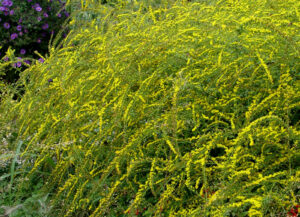
Goldenrod ‘Fireworks’ in bloom in early fall.

* Botanical name: Solidago rugosa ‘Fireworks’

* What it is: Goldenrods are Pennsylvania-native perennials that bloom gold to golden-yellow in early fall.

   ‘Fireworks’ is a classic selection of goldenrod that’s distinctive for its long, arching flower wands that the plant’s namer thought resembled fireworks exploding.

   It’s also a heavy bloomer that stays in color for about three weeks from late September into October.

   Goldenrods are excellent late-season pollinator attractors, but they aren’t a leading hay-fever, sneeze-inducer as many people think (that culprit is ragweed, which is a less noticeable bloomer that flowers at the same time).

   Deer usually don’t bother goldenrods.

   ‘Fireworks’ grows in spreading clumps (not fast-spreading runners) and sometimes self-seeds.

   The variety is an all-around strong-enough performer that it won a 2025 Gold Medal Award from the Pennsylvania Horticultural Society as a plant deserving more use in mid-Atlantic landscapes. ‘Fireworks’ also was the top scorer in the Chicago Botanic Garden’s 2001 trial of 22 different goldenrods.

* Size: Plants grow three to three-and-a-half feet tall with a spread of two-and-a-half to three feet.

* Where to use: Goldenrods do well in full sun to light shade and will grow in dry to sometimes-wet soil.

   Good locations for ‘Fireworks’ include meadows and meadow gardens, perennial borders, rock gardens, cut-flower gardens, rain gardens, pollinator gardens, and really any sunny bed or bank where you like the plant’s loose look and have adequate space.

* Care: Keep plants damp the first season to establish the roots, then water is usually not needed except in extended dry spells.

   Fertilizer also isn’t usually needed. A scattering of an organic granular fertilizer formulated for flowers is optional in early spring.

   Snip off flower stems after bloom if you don’t want any seeding. Otherwise, let the seed heads and foliage stand through winter and cut it to the ground before new growth begins in spring.

   Clumps can be dug and divided every two to three years in early spring if you want to expand the planting or give divisions to friends.

* Great partner: Red switchgrass, big bluestem ‘Blackhawk,’ and prairie dropseed are three native grasses that give good textural and color contrast to goldenrods in fall.

   Red mums are a good perennial partner that overlap goldenrod’s bloom time.

   Most any green or golden evergreen is a good shrubby partner.


  • Home
  • Garden House-Calls
  • George's Talks & Trips
  • Disclosure

© 2026 George Weigel | Site designed and programmed by Pittsburgh Web Developer Andy Weigel using WordPress