
• Home
  • Contact
  • Site Map
George Weigel - Central PA Gardening
  • Landscape 1
  • Landscape 2
  • Landscape 3
  • Landscape 4
  • Garden Drawings
  • Talks & Trips
  • Patriot-News/Pennlive Posts
  • Buy Helpful Info

Navigation

  • Storage Shed (Useful Past Columns)
  • About George
  • Sign Up for George's Free E-Column
  • Plant Profiles
    • Annuals
    • Edibles
    • Roses
    • Bulbs/Corms/Tubers
    • Evergreens/Conifers
      • Boxwood 'Green Velvet'
      • Cherry laurel
      • Boxwood 'Dee Runk'
      • Juniper 'Gold Cone'
      • Concolor fir
      • Nandina 'Firepower'
      • Oriental spruce
      • Arborvitae 'Green Giant'
      • Boxwood 'Elegantissima'
      • Dwarf cryptomeria 'Black Dragon'
      • Serbian spruce
      • Juniper 'Silver Mist'
      • Boxwood 'Green Mountain'
      • Dwarf arborvitae 'Holmstrup'
      • Bosnian pine
      • Japanese plum yew 'Fastigiata'
      • Spreading English yew 'Repandens'
      • Nordmann fir
      • Box honeysuckle 'Baggesen's Gold'
      • PJM rhododendron
      • Hinoki cypress 'Gracilis'
      • Cryptomeria 'Globosa Nana'
      • Eastern red cedar
      • Bald cypress
      • Dwarf blue spruce 'Fat Albert'
      • Hinoki cypress 'Verdoni'
      • Leucothoe
      • Japanese garden juniper
      • Green-thread falsecypress
      • Weeping bald cypress 'Cascade Falls'
      • Bald cypress 'Peve Minaret'
      • Arborvitae 'Whipcord'
      • Oriental spruce 'Skylands'
      • American holly
      • Juniper ‘Grey Owl’
      • Falsecypress Soft Serve
      • Boxwood NewGen series
      • Columnar junipers
      • Boxwood 'Little Missy'
      • Swiss stone pine
      • Arborvitae 'Junior Giant'
      • Leucothoe 'ReJoyce'
      • Cryptomeria
      • Dawn redwood
      • Dwarf Birds Nest spruce
      • Dwarf goldthread falsecypress 'Golden Mop'
      • Dwarf Hinoki cypress 'Nana Gracilis'
      • Hinoki cypress 'Crippsii'
      • Holly 'Blue Princess'
      • Holly Dragon Lady
      • Holly Red Beauty
      • Japanese umbrella pine
      • Korean fir
      • Russian cypress
      • Rhododendron 'Ken Janeck'
      • Sweetbox
      • Weeping Alaska cedar
    • Flowering shrubs
    • Ornamental Grasses
    • Perennials
    • Trees
    • Vines
  • Timely Tips
  • George’s Handy Lists
  • George's Friends
  • Photo Galleries
  • Links and Resources
  • Support George’s Efforts


George’s new “50 American Public Gardens You Really Ought to See” e-book steers you to the top gardens to add to your bucket list.

Read More | Order Now


George’s “Survivor Plant List” is a 19-page booklet detailing hundreds of the toughest and highest-performing plants.

Click Here


Has the info here been useful? Support George’s efforts by clicking below.


Looking for other ways to support George?

Click Here

Arborvitae ‘Junior Giant’

* Common name: Arborvitae ‘Junior Giant’
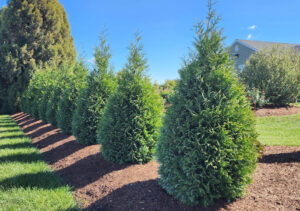
A line of arborvitae Junior Giant in a screening setting.
Credit: Plants Nouveau

* Botanical name: Thuja standishii x Thuja plicata ‘Junior Giant’

* What it is: Arborvitae are the top-selling evergreens for tall privacy hedges, but one drawback is that they sometimes grow too fast and end up getting too big for the space without regular and heavy pruning.

   Junior Giant is a recent introduction that grows at a more moderate pace and tops out more in the 15- to 20-foot-tall range instead of the 30- to 40-foot heights of standard arborvitae varieties – making it a better size for most yards.

   This one is actually a “sport” or selection of the popular Green Giant arborvitae – a western arborvitae hybrid that’s now the leading arborvitae variety because of its deer-resistance and strong single leader (as opposed to two or three leaders that cause plants to splay apart in ice storms).

   Junior Giant retains both of those traits – plus the dark-green color and soft needles – but in a more compact package. Junior’s shape is tear-dropped, and its habit is even fuller and denser than Green Giant.

   Angela Treadwell-Palmer, co-owner of the Plants Nouveau plant-introduction company, likes to call Junior Giant “Green Giant’s baby brother.”

   Other than an outside chance of bagworms, Junior Giant seldom runs into any bug or disease problems.

* Size: Grows about one foot a year to 15 to 20 feet tall and about eight feet wide. Plant five to six feet apart in a hedge setting.

* Where to use: Arborvitae are most often used as hedge plants around property borders or clustered anywhere that privacy screening is needed. Because of the smaller size, Junior Giant is a specimen candidate in mixed gardens, flanking doorways and gates, and at house corners. Growth is best in full sun, but arborvitae also do reasonably well in part shade.

* Care: Work an inch or two of compost into the top foot of the planting bed if you have poorly drained clay soil.

   Keep the soil consistently damp the first two to three seasons until the roots establish, then arborvitae usually don’t need any supplemental water except in extended droughts.

   Fertilizer is usually not needed.

   Pruning also not needed so long as space is OK. Once plants reach the size you prefer, trim them in late spring to early summer to maintain that size. Never cut back so far that you’re into the needleless inner part of the branches.

* Great partner: Bright red or golden flowers look good in front of or around Junior Giants. Perennial ones include black-eyed susans, coreopsis, dwarf goldenrod, red or gold daylilies, and red or gold mums.

   Good annual-flower partners include red begonias, red or gold celosia, red or gold lantana, red vinca, red or gold marigolds, and dwarf yellow or red zinnias.

   Red shrub roses (e.g. Red Drift, Oso Easy Urban Legend, Petite Knock Out) or St. Johnswort ‘Albury Purple’ are good shrubby partners.


  • Home
  • Garden House-Calls
  • George's Talks & Trips
  • Disclosure

© 2026 George Weigel | Site designed and programmed by Pittsburgh Web Developer Andy Weigel using WordPress