

• Home
  • Contact
  • Site Map
George Weigel - Central PA Gardening
  • Landscape 1
  • Landscape 2
  • Landscape 3
  • Landscape 4
  • Garden House-Calls
  • George's Talks & Trips
  • Patriot-News/Pennlive Posts
  • Buy Helpful Info
  • Rent a Florida Villa

Navigation

  • Ramblings and Readlings Home
  • Storage Shed (Useful Past Columns)
  • About George
  • Sign Up for George's FREE E-Column
  • Plant Profiles
    • Annuals
    • Edibles
    • Roses
    • Bulbs/Corms/Tubers
    • Evergreens/Conifers
      • Boxwood 'Green Velvet'
      • Cherry laurel
      • Boxwood 'Dee Runk'
      • Juniper 'Gold Cone'
      • Concolor fir
      • Nandina 'Firepower'
      • Oriental spruce
      • Arborvitae 'Green Giant'
      • Boxwood 'Elegantissima'
      • Boxwood 'Justin Brouwers'
      • Dwarf cryptomeria 'Black Dragon'
      • Serbian spruce
      • Juniper 'Silver Mist'
      • Boxwood 'Green Mountain'
      • Dwarf arborvitae 'Holmstrup'
      • Bosnian pine
      • Japanese plum yew 'Fastigiata'
      • Spreading English yew 'Repandens'
      • Nordmann fir
      • Box honeysuckle 'Baggesen's Gold'
      • PJM rhododendron
      • Hinoki cypress 'Gracilis'
      • Cryptomeria 'Globosa Nana'
      • Eastern red cedar
      • Bald cypress
      • Cryptomeria
      • Dawn redwood
      • Dwarf Birds Nest Spruce
      • Dwarf goldthread falsecypress 'Golden Mop'
      • Dwarf Hinoki cypress 'Nana Gracilis'
      • Hinoki cypress 'Crippsii'
      • Holly 'Blue Princess'
      • Holly Dragon Lady
      • Holly Red Beauty
      • Japanese umbrella pine
      • Korean Fir
      • Osmanthus 'Goshiki'
      • Russian cypress
      • Rhododendron 'Ken Janeck'
      • Sweetbox
      • Weeping Alaska cedar
    • Flowering shrubs
    • Ornamental Grasses
    • Perennials
    • Trees
    • Vines
  • Timely Tips
  • George’s Handy Lists
  • George's Friends
  • Photo Galleries
  • Public Gardens Worth Seeing
  • Links and Resources
  • Support George’s Efforts


George’s “Pennsylvania Month-by-Month Gardening” helps you know when to do what in the landscape.

Read More | Order Now


Want George to help improve
your landscape?

Click Here


Need help in the yard?

Click Here


Has the info here been useful? Support George’s efforts by clicking below.


Looking for other ways to support George?

Click Here

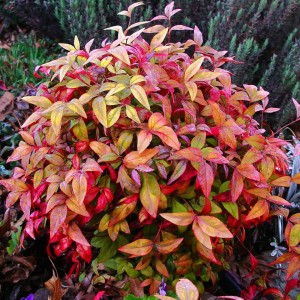
Nandina ‘Firepower’

Dwarf nandina 'Firepower' in winter.

* Common name: Dwarf heavenly bamboo ‘Firepower’

* Botanical name: Nandina domestica ‘Firepower’

* What it is: A compact, broad-leafed evergreen that gets red-tinged new leaves in spring, then stays light green all summer. Foliage turns bright red in fall and holds that color most of winter. No fruits.

* Size: 3 feet tall and wide.

* Where to use: Versatile in full sun to mostly full shade and so can be used most anywhere a compact evergreen is needed – foundations, lining a walkway, underneath trees and interplanted with flowers in mixed gardens. Reasonably tolerant of tree-root competition.

* Care: Keep damp the first season, then water usually not needed. Work compost into soil at planting, then fertilizer usually not needed. Trim off any browned-out foliage or dead branch tips at end of winter but don’t cut whole way to ground.

* Great partner: Golden variegated Japanese forest grass or Bowles golden sedge.



Comments


4 comments

  • Marilyn says:
    April 8, 2017 at 10:43 pm

    Does this plant grow well in zone 4B?

  • George says:
    April 10, 2017 at 5:53 am

    Marilyn,
    No, nandina is winter-hardy generally down to Zone 6. Zone 5 might be doable some years (especially with protection), but the odds aren’t good for long at all in Zone 4.

  • Bob says:
    July 9, 2017 at 11:16 am

    For “protection” would a wind barrier and an anti-dessicant spray be sufficient for this plant’s thriving in cold weatherin zone 5B?

  • George says:
    July 10, 2017 at 5:50 am

    Bob,
    You can probably get away with growing nandina in 5B with some good siting, such as planting along a south- or west-facing wall, in a wind-protected courtyard or similar warm microclimate in your yard. Protecting the plant over winter with a burlap barrier also will help. The anti-desiccant won’t be of much help… those are more helpful as a pre-transplant spray when moving a plant.
    Also, plant in spring instead of fall to give the plant a chance to root before winter. And keep it well watered the first couple of seasons, especially heading into winter. You might see the plant get brown leaves over winter (maybe almost completely some years), but there’s a good chance the roots will survive and it’ll push out new foliage in spring each year.

Leave a Reply

Click here to cancel reply.


George's Certifications
  • Home
  • Garden House-Calls
  • George's Talks & Trips
  • Disclosure

© 2017 George Weigel | Site designed and programmed by Pittsburgh Web Developer Andy Weigel using WordPress