



Dwarf goldthread falsecypress ‘Golden Mop’
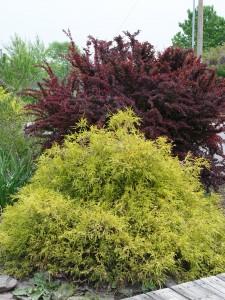
Goldthread falsecypress 'Golden Mop'
* Common name: Dwarf goldthread falsecypress ‘Golden Mop’
* Botanical name: Chamaecyparis pisifera ‘Filifera Golden Mop’
* What it is: Almost unkillable and fairly compact evergreen with a shaggy habit and soft, thready, bright-gold needles.
* Size: Gets bigger than the listed 3 to 4 feet. Five feet tall and wide is a good realistic maintenance size.
* Where to use: Sunny banks, along driveways and other brutal sites. Overcomes poor soil and drought. Just avoid soggy soil. This is the shaggy golden evergreen often seen in shopping-center parking lots.
* Care: Water enough to get through the first year, then nothing. Annual spring feeding with Holly-tone is optional. With adequate space, no pruning needed. If it outgrows the space, cut back long stems to a joint with hand-pruners. No shearing! Don’t destroy the natural shape.
* Great partner: Red daylilies, such as ‘Pardon Me,’ ‘Red Hot Returns’ or ‘Ruby Stella.’

I am looking at buying a Golden mop cypress
I want one that can be trimmed or something great like it.
It needs to be 2 ft high and 2 ft wide.
Someone said an Nandini dwarf is excellent
Need help!
Joel
Joel,
Even a dwarf falsecypress is going to get much bigger than 2-by-2. I’d go with the dwarf nandina. Good plant and it can be kept that size. I like ‘Moonbay’ and ‘Firepower.’
Here’s a link to more on ‘Firepower:’ https://georgeweigel.net/plant-of-the-week-profiles/evergreens/nandina-firepower
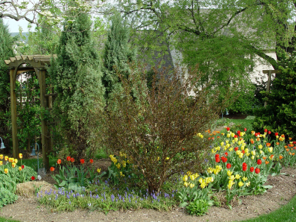
Hi, In the picture, what is the blood red shrub behind the dwarf goldthread falsecypress? Can they be partnered as shown?
That’s a red barberry, and yes, it’s also a full-sun shrub that’ll tolerate the same conditions as goldthread falsecypress. The only caution I’d add is that many varieties of barberry, including the popular dwarf ‘Crimson Pygmy,’ are rampant seeders that can spread into the wild. Some of the newer red varieties and the golden one called ‘Bonanza Gold’ are sterile or nearly so. Look on the label before you buy to see if the variety says something like “sterile” or “doesn’t seed.”
Good Morning I have a goldthread falsecypress in my landscape next to my house that is getting too overgrown for its space. When is the best time to prune or possible move for my area Zone 6-7?
Kim,
The best time to prune would be end of winter, just before new growth occurs. Second best time is late spring, just after new growth finishes. Either way, don’t go back into the bare wood.
The two best times to move the plant are end of winter and end of summer to early fall.
Hey George!! My golden mops which I have over 10 are all turning brown in the middle and dropping there cypress leaves. We have been very wet here in the south. Not sure what to do. zone 8
Deborah,
If all of the browning is toward the inside of the plant, that’s needle drop of old growth. Sometimes you see more drop than usual in a stressful year… i.e. drought or excessive rain or excessive heat. So long as the foliage is still greenish/gold (and not brown) toward the branch tips, it’ll be fine (probably) and will resume growth next spring.
The only worry would be if soggy soil caused enough root death that the plant will shut down next spring when the plant hits peak growth. If enough roots aren’t alive to supply the growth needs, the plant would die and drop all needles. Then the branches would eventually turn brown and brittle. If you’re headed down that road, there’s really nothing you can do do at this point. Good drainage is the way to prevent root death from soggy soil.
I have my 2 plants in pots & they seem to be wintering so far- Zone 5- should I wait for Spring to plant them or keep them in their pots?
Judy,
If the ground is unfrozen, you’re better off planting them than leaving the pots exposed above-ground or even trying to overwinter them in a garage or shed. Just watch over the rest of winter that freezing and thawing doesn’t push up the root ball and expose it to drying winds. If that happens, tamp the ball back down. I’d also suggest getting two to three inches of mulch in place right after planting.
A second option is sinking the plants — pots and all — into the ground to insulate the roots until you can plant permanently in spring. If the ground is frozen, sit the plants in a protected area and surround them with fallen leaves or mulch to simulate being in the ground.
Happy New Year. I’m in the 28348 area code which I believe is Zone 8. I’m looking for the best shrubs to plant as a border in the north, east and west sun. A little history—on the north border I’m concerned about my neighbor’s fence (i.e. the amount of sun the north shrubs will get) as it pertains to what I plant there. I’m not looking to provide PRIVACY from/to my neighbors—just want to beautify the borders. I want to add more dwarf-golden-mops and ground cover loropetalums on the west end; along with a few pencil trees. The objective of the east end is to capture blowing leaves—I want to place dwarf burning bushes there. This is an empty lot that I just want to beautify and I don’t want anything that needs a lot of attention and can handle pine trees and oak trees. Do you think I’ll need to cut down any of those trees or can my border plant ideas handle the soil with the above trees. Thank you so much for your time.
Ms. Janet,
I’m not very familiar with Zone 8 plants. You’d get your best advice by consulting with a local garden center, your local Extension office, or a landscape designer close to home. The only suggestion I’d make is to rethink the burning bushes, which seed around a lot and are on many states’ invasive plant lists.
It’s great you’re beautifying the area. Best wishes making it happen.
I was considering a gold mop “cypress” to replace a rose bush which replaced a PJM rhodo that is in a fairly damp spot these days near a rain spout. With all the rain we’ve been having, it has been consistently damp. I have read other articles that said they require moisture, but my experience in zone 6-7 has been more like what you say.
I’m glad I saw your post so I won’t put one (actually would have been transplanting one) in that spot. I am nearly set now on a red twig dogwood. Is there any other shrub that you would suggest?
Brigette,
A redtwig dogwood would be a better bet in a damp spot than a rose or falsecypress. If it’s somewhat shaded, summersweet (Clethra) and Virginia sweetspire (Itea) would be two good options. And if you have 6 to 8 feet of space, winterberry hollies are damp-soil-tolerant.
I planted a Golden Mops cypress a few years ago and have been puzzled at its poor progress.I think the deer are eating it. Is it a plant that deer love?
Donna,
That’s a plant deer don’t normally eat, but they could if they get hungry enough and there’s nothing better around. Browsing damage should be fairly obvious as opposed to just stunted growth that shows no signs of chewing damage. Poorly drained clay soil can stunt the plant’s growth if you see no evidence of chewing.
We planted about 10 golden mop cypress around the house. Is there a way to find out if we have the dwarf golden mop cypress? If these are not dwarf, we will need to remove them because they are too close to the house’s foundation.
Helen,
The easiest/fastest way to determine whether you have dwarf plants is to look on the tags that came with the plants. They’ll have estimated plant sizes (usually 10 years out) but at least the cultivar name, which you could then look up online to determine size. ‘Golden Mop,’ for example, is a dwarf cultivar, growing in the five- to six-foot range.
If you don’t have any tags, sometimes the receipt from the garden center will list the cultivar name.
If you have no record whatsoever, you’ll find out in a few years. Dwarf plants will grow slower and stay about as tall as wide while standard-size types or the straight species will grow faster and keep going up and up to maybe 18 feet or so in 20 years.
Looking at golden mop cypress as a foundation plant for the sunnier part of the front garden. Seeking an “equivalent” plant for the partly shady side. Facing east, good early morning sun, but then shaded by tall ash tree whose lowest limbs/leaves are 20-25 foot off the ground. Zone 5b in WI. Currently planted with yews and I’m seeking plants that require no pruning, seek interesting natural form.
Julia,
Goldthread falsecypress will take some shade, although the color might not be as vibrant. You must not have the emerald ash borer out your way? They’ve been killing almost all ash trees out our way the past two years, so I’d be concerned about losing them here and ending up with a full-sun bed anyway.
If the ash trees are healthy, golden Hinoki cypress would be a plant I’d look at with golden foliage and ability to do reasonably well with morning sun and afternoon shade. For something taller, there are a few gold-tinted arborvitae.
Just wondering if you could help me determine what the root system is like. We are on a septic system and I was wondering how far away it needs to be from it.
Kelly,
Like most plants, falsecypress roots go out more than down. The bulk of the roots will be in the top foot of the ground, and the spread is about twice the canopy of the top growth (if even that). You might see some small feeder roots extending a foot or two beyond the canopy. These are shrubs and don’t have nearly the root mass of a tree.
Hi George,
I desperately need help with my Golden Mop. I’m not a plant expert and just started taking care of my garden recently without knowing how sensitive some of these bushes can be. I cut back my Golden Mop and removed all the thread-leafs with the goal of making it smaller. I cut it in fall 2019. I reside in NY. NoW it’s just all branches and no threadleafs. I’m wondering if threadleaf will grow back or if I have completed destroyed the bush? 😞 Anything I can do to help it recover?
Cindy,
Some evergreens can tolerate ruthless whackbacks, but falsecyress like ‘Golden Mop’ is not one of them. Fall (heading into winter) also was the worst time to do a heavy cut like that. Falsecypress is best pruned lightly and regularly to keep them to the size you like as opposed to one fell swoop in which cuts go back into bare wood. The best timing is end of winter through spring… no later than mid-summer.
Plants do their best to survive, so I wouldn’t give up quite yet. It’s possible some dormant buds are left that will push new shoots, once we get some extended heat and sunlight. Things have been slow to get going in the cloudy cold the last few weeks.
Just keep the plant damp if it gets dry in the next few weeks and scatter a balanced organic fertilizer over the bed underneath to give a little nutritional boost to help with any attempt to regrow. Even under the best scenario, it’ll be two seasons before it would fill back in. Even then, you could see just a partial recovery with a few branches showing life and the rest dead.
If you don’t see any life by around the end of June, it’s a goner.
I have three dwarf ‘Golden Mop’ falsecypress whose tops are looking floppy. Can I cut the tops off in the fall? I’ve had them for 3 years and they are thriving, but pushing 5′ tall and would like to keep them from growing taller.
Lilibet,
You can do a light trim once a year to control the size and “tightness” of goldthread falsecypresses like these, but the best timing is end of winter or very early spring instead of fall.
The second best time would be later in spring or early summer after the season’s new growth has almost finished.
Never take off so much that you’re back into bare wood on the branches. That could kill branches. Light trims every year are far better for maintaining size and shape once these get where you want.
I have a gold thread mop falsecyrpess that is now 12 ft tall and 5 ft wide
the plant was tagged stating 3-4 tall with the same width.
How do I control this over growth? It is over growing its space.
Connie,
That sounds a bit big even for a dwarf goldthread falsecypress, which are often labeled 3 to 4 feet but can easily grow upwards of 6 feet in time.
You can try cutting the plant down to size, but a far better option would have been to start doing regular annual cutbacks once the plant hit the maintenance size you wanted. I don’t think you’ll kill the plant by doing a major whackback, but you may harm the denseness and look for years.
End of winter would be the best time for a severe cutback — right before next year’s new growth begins. Now, in the middle of a hot dry summer, is not a good time. Neither is fall.
Try to make your cuts so that the remaining branches still have needles. If you cut back into where the branches are bare, there’s a good chance it won’t push new growth. This is why it’s best to do lighter, annual cuts… you’re never going back into bare wood.
Your other option is to remove the overgrown plant and either buy something else that’s naturally more compact or try again for a dwarf goldthread and then start trimming when it reaches the size you want. Here’s a link to a column I wrote a few weeks ago on some of the best compact plants for Pennsylvania landscapes: https://www.pennlive.com/gardening/2020/06/shrink-your-garden-down-to-size-with-these-compact-plants.html
A good compromise is to try the severe cutback at the end of this coming winter, give it a year to recover, then decide whether it’s worth keeping the existing plant or replacing it then.
I have what I think are goldthread cypress. When I purchased them, it was because they were to be fast-growing and we are using them for privacy. They have done great. Now I want to get more to extend the privacy screen, but every type I see are listed as slow-growing. Is there a fast growing variety?
Karen,
I wouldn’t say goldthread falsecypress (even the dwarf forms) are slow-growing. They’re more like average. Dwarf types should hit about four feet tall and five feet wide in about five years, i.e. about a foot of growth per year in average soil.
The standard forms of goldthread falsecypress grow a little faster, but they also can go to 10 or 12 feet tall and six to eight feet wide in about 10 years. Dwarf ones would be four to five feet tall and about five to six feet wide in that time.
If you want something very fast-growing, go with arborvitae. I like ‘Green Giant’ and ‘Virginian’ western arborvitae (deer-resistant). These will go much taller, though… upwards of 30 feet in time if you never prune them. I also like ‘Soft Serve’ falsecypress, which is a medium-speed grower about halfway between the size of arborvitae and dwarf goldthread falsecypress.
See my Plant Profiles page under “Evergreens/Conifers” for more on evergreens I like of various sizes: https://georgeweigel.net/plant-of-the-week-profiles/evergreens