



Japanese umbrella pine
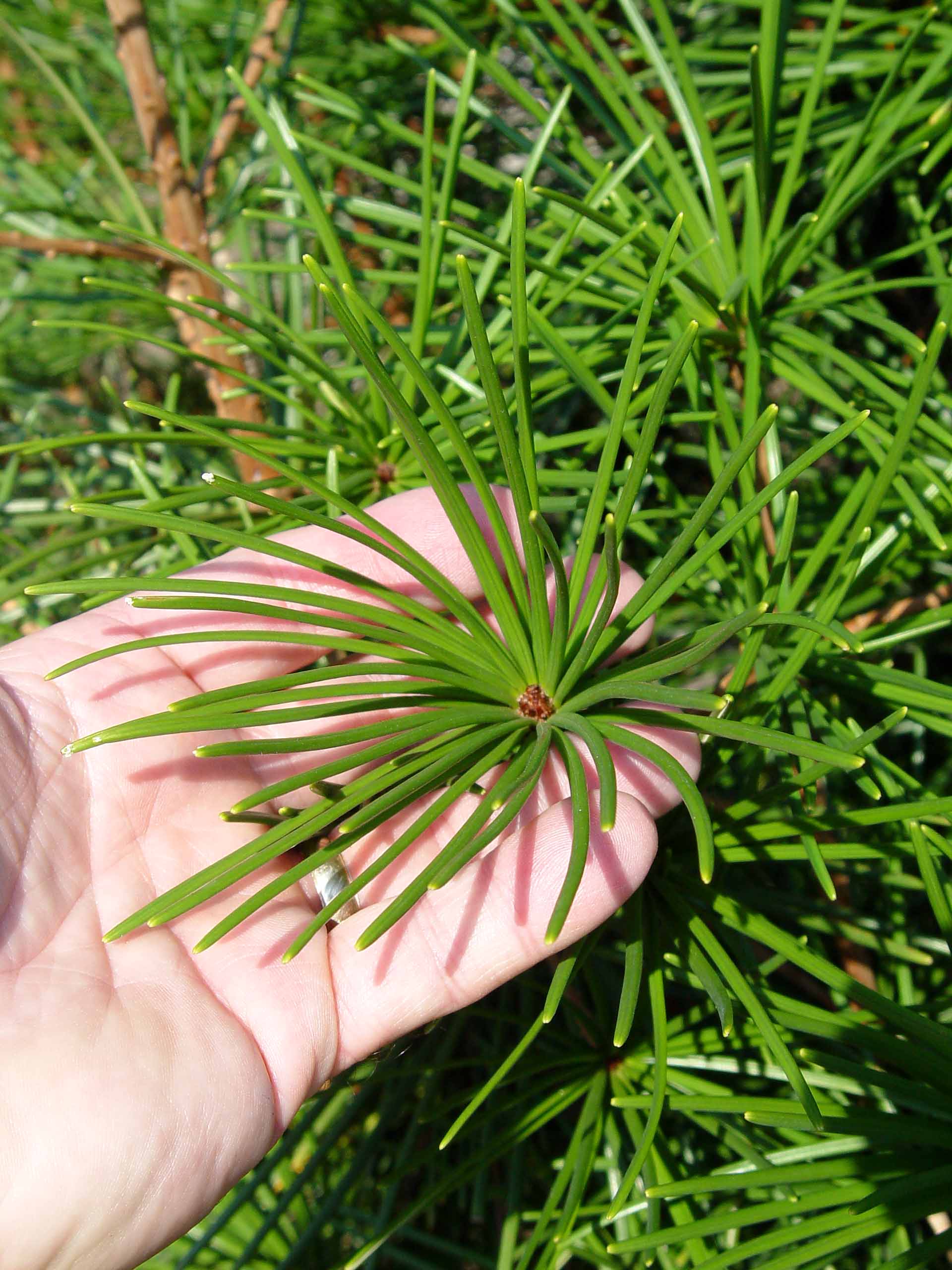
Closeup of George’s Japanese umbrella pine needles.
* Common name: Japanese umbrella pine
* Botanical name: Sciadopitys verticillata
* What it is: An eye-grabbing evergreen specimen with large, rounded, shiny green needles and a broad pyramidal habit. Not a true pine.
* Size: Very slow-growing to about 10 feet tall and 6 feet wide in 15 years. Can double that in another 20 years.
* Where to use: Look for a prime spot with northwestern wind protection and out of the hottest afternoon sun. A southeast house corner is one good spot. A water garden or patio corner are other possibilities.
* Care: Does best in rich, moist, acidic soil. Water weekly in a drought, especially in early years. Annual spring scattering of Holly-tone or similar acidifying, granular organic fertilizer is helpful. Heavy pruning not needed… just a little thinning to eliminate crossing branches and guide young growth in first few years.
* Great partner: Edge with golden variegated Japanese forestgrass, dwarf golden hosta or barrenwort ‘Frohnleiten’ or ‘Neosulphureum.’
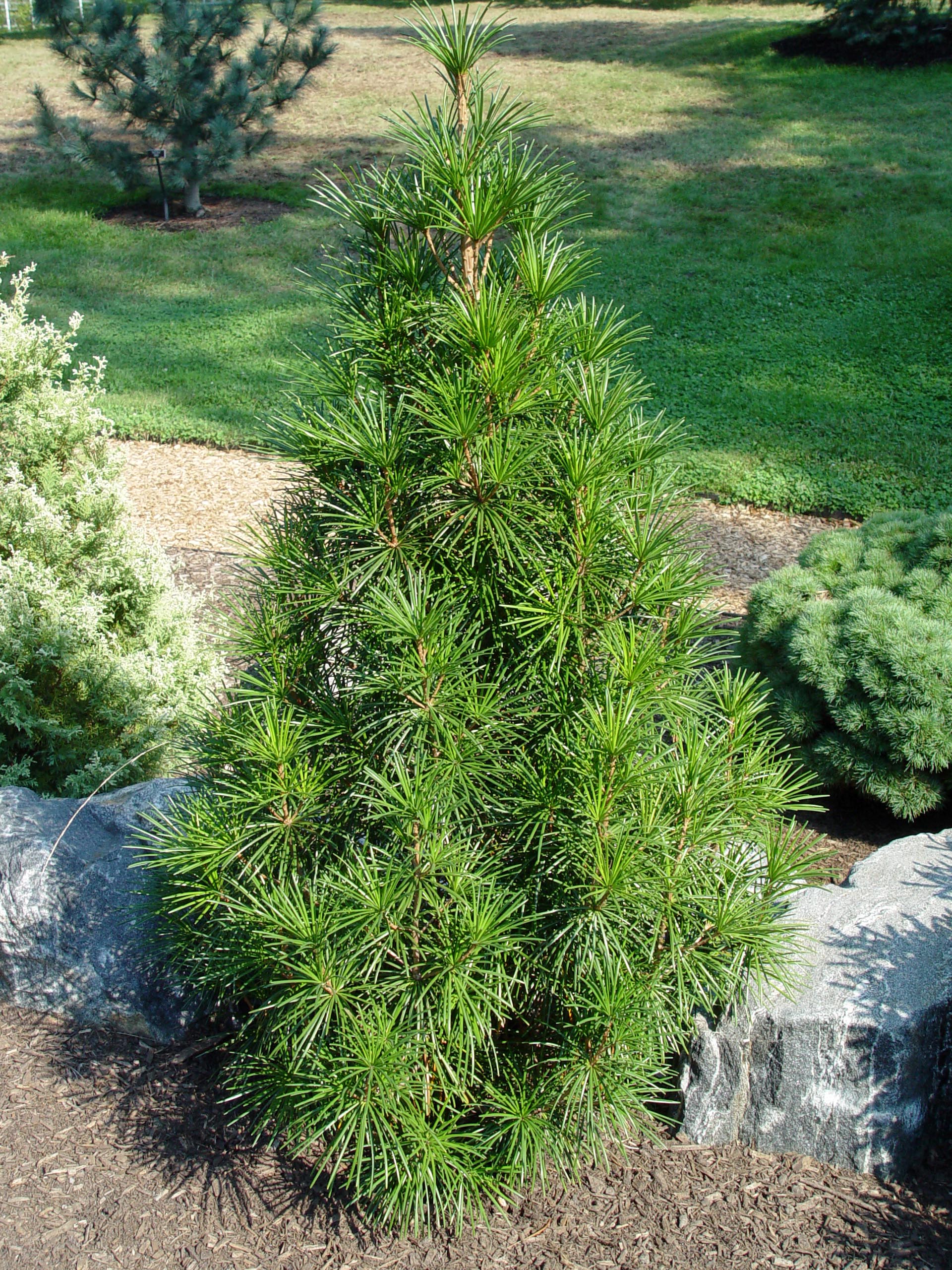
A baby Japanese umbrella pine.
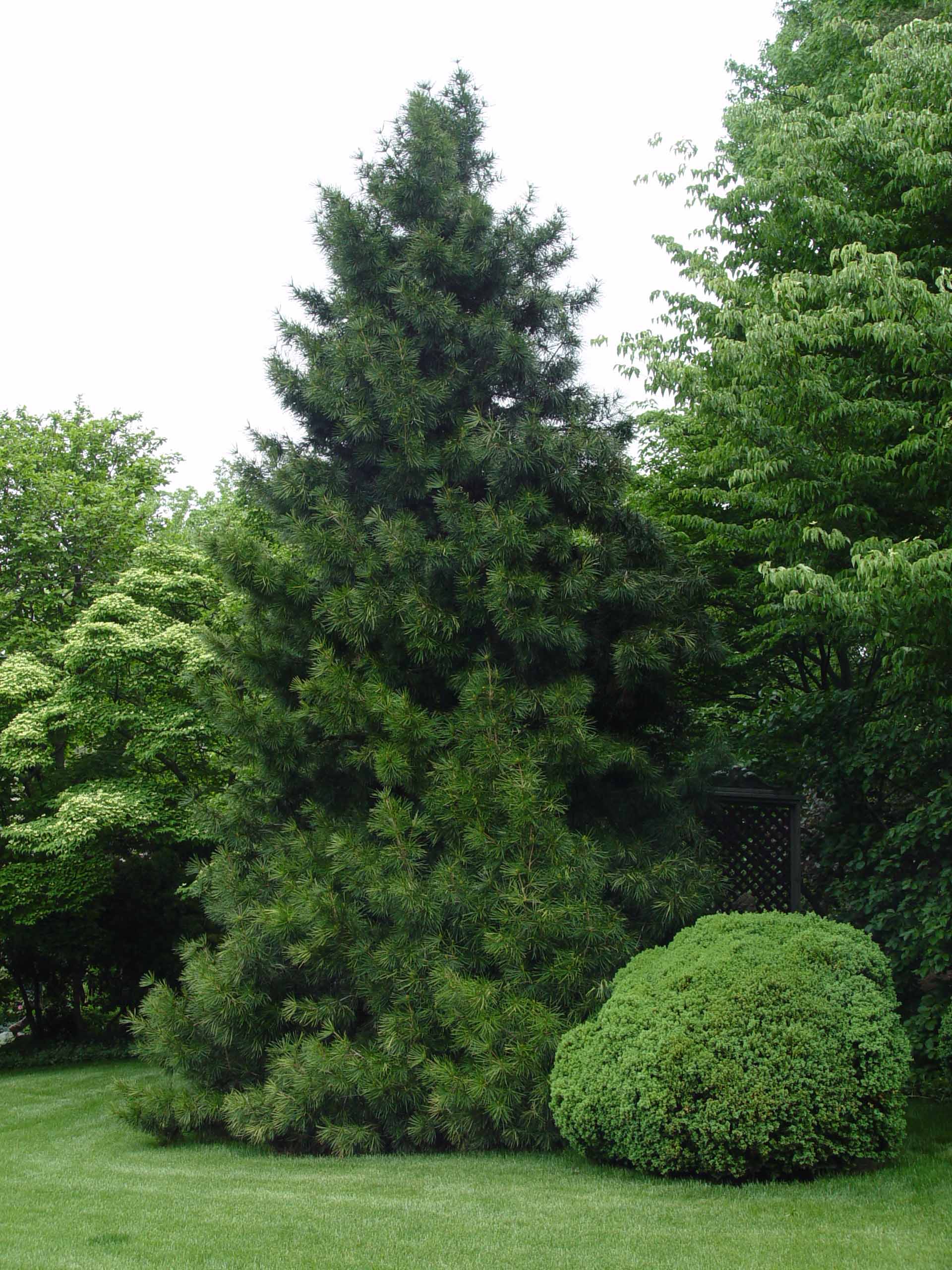
A mature Japanese umbrella pine — at leastd 25-30 years old.

Kathy,
It sounds like you’ve grown yourself two free new umbrella pines! They are most likely “suckers” attached to the mother plant. If they’re now four feet tall, they should have adequate roots, which means that you can sever them from the mother and transplant or give them as a gift.
Try to dig away a little soil first to identify the main shoot that’s connecting the mother to the “baby.” That’s where you cut what equates in human terms to the umbilical cord. Once that’s seperated, dig up the baby and all of its root. Now (early spring) is a good time to transplant. Keep it watered this whole first season when things go dry.
Hello,
I have a 12 foot umbrella pine that has been growing in a giant pot.
We recently transplanted it in the ground and noticed it had 2 trunks. The one main trunk looks good and there is a second one growing about 5 inches above the base from the side of the tree straight up next to the main one.
Should I remove that large branch or trunk? My thought is that without that second “trunk” the main trunk would grow stronger and be healthier.
The secondary branch or trunk is nearly as large as the main one. So it would definitely affect the look of the tree if that second one was removed.
Please let me know. I have had this tree for many years and would like to keep it healthy and happy.
Thank you.
Rhonda Bjornstad
Rhonda,
If you get to a double-leader situation early enough, it’s best to remove the weaker or less-upright one ASAP. When you do corrective pruning early, you’ll help guide the tree and make it better looking without doing much short-term harm.
The issue here is if the competing leader is almost as big as the main trunk, pruning it will create a rather large wound that isn’t a great idea to create. The second matter is if you remove that branch, you’re probably taking side shoots from it as well, which could leave a bare area on that side of the tree.
The main risk of leaving double leaders is the possibility of it splitting down the joint in a snowstorm or windstorm. At 12 years of age and by the sound of the branch size, I’d probably be inclined to let it alone, especially if it’s as big as a thumb or bigger.
Hi George,
I’ve had my umbrella pine for around ten years in a pot. It’s starting to look worse for wear with not much foliage and the leaves are a yellowy pale green colour. It has been in the same place for at least five years. It is in a south east position with lots of sun. As I’m near the sea, the garden is very windy. I have pruned and fed the plant but it still looks sick. What can I try?
Tina,
My hunch is your plant is lacking either nitrogen or iron. You could do a soil test to see if anything turns up there or just treat with a product that ideally has nitrogen, iron, and sulfur to lower pH and make iron more available. I use liquid Ironite if you can find it at the garden center (I’ve had to order online). Or look for liquid iron and see if the product also has nitrogen and sulfur.
If you can’t find anything with all three, it’s also fine to treat with two or three different products, although that’s more expensive and more work.
My second suspicion would be poor drainage. We’ve had a pair of rainy seasons the past two years, and conifers in poorly drained sites or heavy clay have particularly suffered. Not much you can do about that except hope for less soggy conditions or dig up the plant and either move it or created raised beds before replanting.
Hello!
We have a very small umbrella pine that was planted at our new house 3 years ago. My husband just moved it under our deck which is about 20 ft high. He says he can just keep pruning the tree so it doesn’t grow too tall. I feel that seems a bit odd to do with a tree that could naturally become tall and beautiful. We live in WA. Thoughts?
Paola,
It’ll be years until the umbrella pine tries to get close to 20 feet tall. If you don’t mind the pruning, it can be kept to even 12 to 15 feet tall with a spread at the base of six or eight feet. I think it’ll look good at that size. Umbrella pines are also slow-growers, so you probably won’t have to do anything for years.
Hi George,
We have 2 Japanese Unbrella Pines on each side of our porch. We planted them in 1998 about 25 years ago, they were about 2′ tall then. They are now about 25′ tall now. They must love our yard. It is too bad that we didn’t realize that they would get so big. On the bright side, when we sit on our porch no one can see us. We just love the privacy they give us.
Stay well.
Beth
Hi George, I’ve had an umbrella pine that I planted in a very shaded area and it’s grown very well. I moved it this Spring to a sunnier spot and it’s turning all brown. Is this from over watering it? Not sure what’s going on but I would really like to save it if I can. If I can’t I just might buy another one. I really love it!!! Thanks Shelby
Shelby,
That sounds like a classic case of a plant reacting to a sudden and significant shift in light. My guess is that the new bright light was too much for the shade-adapted needles to handle. Umbrella pines appreciate some afternoon shade even when acclimated to a site.
If the plant is otherwise healthy, it’s possible your umbrella pine will grow a new set of needles. I wouldn’t give up on it for dead yet. Watch for new growth emerging from the browned branches. Keep the plant watered and lay an inch or two of compost around the base along with an inch or two of mulch to aid the recovery.
The worse scenario is that the shock of transplant damaged too many of the roots. Transplanting in the middle of a sunny day or right before a hot, dry spell are other stressors. Those, combined with the drastic change in light, could be enough to kill the umbrella pine. If no new growth happens by late summer, then it’s probably dead. Even then, I’d personally give the plant until next spring for one last chance since it’s such a slow-growing and valuable species.
Overwatering is also possible but not as likely. You’d really have to be putting on a lot of water and having it sit in poorly drained soil. Stick your finger into the soil beside the rootball to gauge whether it’s too wet down there.
Can I prune the lowest branches of my umbrella pine to clean under it and remove the awful fabric sheeting that only exacerbates weed growth?
Thank you!
Barbara,
Yes, that’s not a problem. Just don’t remove more than one-third of the low branches.
If I prune back my umbrella pine branches will new growth appear from the branches I pruned? My umbrella pine has some spindly branches that are tipping over to the side and are too long.
Sharon,
So long as you don’t prune so far back into the branches that you’re into needle-less wood, your umbrella pine should produce new growth.
A good place to cut is back to a joint where a cluster of side shoots is already growing. Then you’re shortening the branch length while knowing you already have live growth coming out where you’re cutting.
Hello, have you ever encountered a Sciadopitys that has inconsistent branch die-back? This is the case for mine, and has been happening for the past five or so years. It is otherwise healthy in color and growth. I planted it 28 years ago and it is roughly 20+ feet tall. The dead branches are not broken; they are firmly attached to the trunk. No sign of boring insect activity as far as I have observed.
Hi Linda,
I haven’t seen or heard about that being a common issue with Japanese umbrella pine.
Borers would be a good guess, but if you see no sign of that — especially after pruning off a dead branch — then that can’t be it.
My second guess would be verticillium wilt or a similar disease that affects the tree’s vascular system. It’s possible the tree is fighting off most of it but is losing a few battles here and there.
Next time a branch dies, after cutting it off, look at the big end and see if there are any dark spots. Verticillium plugs up the xylem and phloem transport channels, similar to how cholesterol can clog our arteries. Spots in that inner wood would be a verticillium clue. If that isn’t the case, I’m not sure what could be causing the dieback.
Either way, there’s no good treatment for verticillium, other than trying to keep the tree as healthy as possible by doing good things like watering in a drought, keeping the soil nutrition level adequate, and avoiding assaults like over-mulching, weed-whacker injury, and heavy-handed pruning.
Thank you so much for your suggestions, George. So very, very helpful. These magnificent trees are known to be trouble-free; hence, very difficult to get info.
I will inspect for verticillium wilt. By the way, great website; I stumbled upon it by pure accident.
Linda
Thank you for your suggestion about water being the cause of needles turning brown. I was concerned I had overwatered during our hot weather so decided to change pots while checking to see if that was the case. In fact the root ball was quite dry while the dirt around the edges was damp. I did move to a larger pot and deep watered. It is in shock from the move, I fear, with the needles drooping but no new brown ones. Would fertilizer help? If so, what would you recommend? I have cedar fertilizer 30-10-10 and bone meal. Anything you would recommend to help it through this recovery period?
Many thanks,
Sharon
Sharon,
I would not recommend fertilizer. Just keep the soil consistently damp and move the pot to a partly shaded spot, i.e. out of direct afternoon shade.
Hi George,
I so enjoy your articles, I refer to them frequently for our York PA garden! Thank you
I’m looking for a smaller conifer for a dappled shade area in front of a garden shed that receives very late afternoon sun for 2-3 hours. Preferably 8’ or a little less in height. Do you have any suggestions? Thank you so much!
Jennifer,
That sounds like a mostly shaded spot, which is a little more than most conifers prefer.
A dwarf Hinoki cypress might work, although the habit is probably going to be more open than dense. I like the dwarf Hinoki varieties ‘Nana Gracilis, ‘Gracilis Compacta,’ and ‘Kosteri’ for green-needled choices. ‘Torulosa’ is green with a sort of twisted habit. If you like a gold-tinted variety better, look for ‘Verdoni’ or ‘Tetragona Aurea.’ All of those grow slowly, more upright than wide, and can be lightly sheared once a year to keep them the size you like once they reach it.
Upright Japanese plum yew is among the most shade-tolerant conifers. One called ‘Fastigiata’ is a columnar upright that grows to about eight feet tall and three feet across in eight or 10 years.
Ordinary yews are also shade-tolerant and shear well to encourage denseness. The old-fashioned Hicks yew is more upright and can be kept eight by four with an annual trim.
If you’re OK with an evergreen and not necessarily a conifer, my top choice of all would the variegated upright boxwood ‘Elegantissima.’ These are shade-tolerant, colorful all year with their white and green little leaves, and they’re deer-resistant (if that’s a concern). The growth rate is fairly slow. It might take 10 or 12 years to reach six to eight feet tall and about four feet across, but then you can keep it that way with an annual trim. I’ve seen other upright variegated boxwoods that are just labeled “variegated boxwood,” and those are decent performers, too, although I’ve grown ‘Elegantissima’ myself and can vouch for that one first-hand.
The green upright boxwoods ‘Green Mountain’ and ‘Dee Runk’ (more columnar) are other good options if you don’t like variegation.
Is Sciadopitys verticillata poisonous?
Ryan,
It doesn’t show up on poisonous plants list, and none of the descriptions I’ve ever read about it mention toxicity one way or the other. I’m aware of at least one nursery that lists it as being non-toxic.
Hi,
I was just given a Sciadopitys verticillata “Green Star”. It has been in a pot for 2 years and maybe pushed up against other plants or the house. It has developed some white spots that eventually become bigger. The previous owner is concerned that it is root bound but that doesn’t seem to be the case. Will the spikes gradually be replaced? Also the shape is odd. It is full but not a pyramid form. More like an oval shape. Will the bottom part fill out as the tree ages or is this the way it will stay? It has not been pruned.
I have read various mixed information about how big these trees get. I do not want to misplant it.
Thanks!
Thanks for your reply.
I want to move one of these at my new home.How difficult is it to transplant? It it a well established tree 10 feet tall. What kind of root system do they have? Thanks
Tyler,
‘Green Star’ is supposed to be a very compact and slow-growing form of Japanese umbrella pine, but it is supposed to grow in a pyramidal form, not oval. Is it possible that the leader broke off, causing the more rounded habit? If not, then light and gradual pruning at the end of each winter can start to reshape the tree.
I’d plant it in the ground as soon as the weather cools a little and we get some better soil moisture. Sometime in September would be ideal. I’d figure on a 10-year size of around six feet tall and three feet wide, from the average of what I’ve read. The tree will keep growing from there, albeit slowly, so it could be around 10 feet tall and five or six feet wide in 20-25 years. (I’ve never grown this cultivar myself… just the species and the slightly smaller ‘Joe Kozey’ variety.) I suspect after two years in the same pot, the roots are getting crowded.
I’m not sure what the white spots could be. If the needles are dead and dropping from any of the branches, then it’s likely that branch is going to remain bare. I wouldn’t cut anything now, though. Wait until later next spring to be sure any wood is dead and still needleless before removing it. If this plant was packed up against other plants or against a house, it’s possible that prolonged shade has killed those parts of the tree. Getting it in the ground with light all around will help and maybe encourage new growth if it’s not too late. The green parts should be fine.
Kathy,
I successfully moved an umbrella pine that was about five feet tall and in the ground four or five years. The bigger the tree and longer it’s been established, the lower the odds of success.
The trick is getting as much of the root ball as possible, transplanting in ideal conditions (cool and damp), and keeping the plant well watered after the move, as if it’s a new plant.Here’s a link to a post I wrote with detailed instructions on transplanting: http://georgeweigel.net/favorite-past-garden-columns/transplantaphobia
The root system of umbrella pines is average — not shallow like some species but also not as huge as a fast-growing shade tree. The bigger the tree, the bigger the rootball, and therefore the harder it will be to dig and move by hand without doing root damage.
Hello, I’m new to this plant and have one about 6 feet tall in a planter, as well as two much smaller ones in planters. They are all in the same location on our south-facing deck (half sun during the day and half shade from another tree). For some reason, the past few weeks the larger one is starting to sag a lot with its needles and branches. The smaller plants look fine. They also get watered twice a week unless it rains since it is very hot this time of year. Any ideas on what could be causing it and how to fix it?
Kelsey,
That sounds like a reaction to heat and dry soil. Trees in planters are much more vulnerable to this kind of weather than trees in the ground, where the roots are insulated by more soil and cooler soil temperatures.
The best solution would be to plant the umbrella pines, ideally in a site that’s out of afternoon sun and reasonably moist.
If that’s not an option, then you may need to water more often — probably even daily in hot, dry weather. The bigger the pot size, the better.
I have just brought an umbrella pine but only want it to grow to about 4 feet tall and 4 feet wide. Is this possible to achieve?
Peter,
It’s possible for awhile but not ideal. Umbrella pines are very slow-growing, so at least you have that on your side.
It’s best to do light trims once or twice a year (end of winter through early summer) to maintain the size as opposed to letting it get bigger than you want and then chop it back.
Umbrella pines don’t shear as well as many conifers that have shorter internodes (the space between the shoots coming out of the branches). It’s best to make each of your cuts just above one of the whorls of needles so you don’t have a lot of dead stubs showing (and possibly getting infected).
Eventually, the trunk is going to get thicker and thicker and the branches larger and larger to the point where pruning becomes harder. Given the slow rate of growth, you likely won’t reach that point for maybe 15-20 years down the road.
My cousin has an established Japanese Umbrella Pine in his front bed that was doing quite well. It is about 10′ x 5-6′. This summer he was away for a month or so and when he returned home the tree started to turn brown all over. Top to bottom, about 50/50 green/brown needles, seemingly all at once. I’ve tried to look up online and in my books, but I can’t come up with anything. My only guess is that the dry summer took it toll on the tree. Any idea what is wrong with it? Thanks for any help!
Anne,
The effects of heat and dry soil would be my first guess, especially if the tree is planted in full sun and poor soil. Umbrella pines do best in loose, acidic, and slightly damp soil with some protection from full-on afternoon sun. They really don’t like heat conditions above Zone 7, and they don’t do well in drought conditions.
A lot of conifers also have suffered the last few years from the heavy rains we’ve had. In poorly drained clay or low-lying areas, standing water can rot their roots. Sometimes, soggy years can rot enough of the roots that the tree survives and even looks normal, but then when a drought comes along, adequate roots aren’t alive to keep up with the increased water demands.
So it’s possible this tree is a victim of a one-two punch from our increasingly erratic climate.
It’s unlikely the browning was caused by bugs or disease.
Twenty-five years ago we planted two umbrella pines together, at the front corner of the house. They are now crowding the house as well as each other and look overgrown. My wife wants to get rid of them. One is 12 feet tall, has three trunks with a common 10-inch base, and the other is probably 20 feet tall with an eight-inch-diameter trunk. If I topped them to say four feet and dug a good-size root ball, is there any hope they would survive transplanting?
Hansel,
Most any tree can be moved if you get a big enough rootball and then keep it well watered until it re-establishes. The problem is the bigger a tree gets, the harder it gets to hand-dig and manually move a big-enough rootball to support the top growth.
The more roots you sever in the digging process, the more the success odds go down. Moving trees that size isn’t guaranteed death, but they won’t move as well as if you had done it years ago when they and their roots were smaller.
I would try to save these somehow instead of just chainsawing them because 1.) they’re very nice trees, and 2.) they’re very valuable. I just saw new ones selling at a garden center at about six feet tall with a pricetag of $500. I would guess that if you had your trees valued by an arborist, they would come in at two to three times that.
The ideal situation, obviously, is to give trees adequate space to mature, then to train them when young by pruning and keep them at the desired size with light annual trims or prunes. It’s much harder to do corrections once plants have grown out of whack or grown well beyond their planned space.
Pruning is still one of your options. You can make size-control and corrective pruning to at least make the trees fit and look somewhat better. End of winter is the best time for that. They might look a bit chopped when you’re done, but given a year or two to recover, they might come around to the point where you can then maintain them with an annual cutback. This option at least doesn’t risk killing them.
If you do decide to move one or both trees, I wouldn’t cut them way back first. I’d try to move them as is with as much of a rootball as you can handle. If you can get a helper and slip a tarp under the excavated rootball, that will make carrying it to new sites easier.
Another option is getting an estimate or two from tree companies. Most of them have tree spades that can dig big rootballs by machine, then drop them in new holes. You’d have much better success odds that way, but I’d guess it’s also going to be very expensive.
Now (early fall) or early next spring would be good times to attempt a transplant.