


Hydrangea Fire Light Tidbit
* Common name: Dwarf panicle hydrangea Fire Light Tidbit
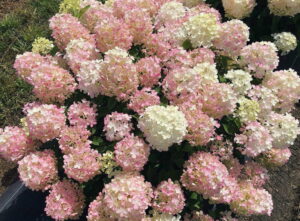
Hydrangea Fire Light Tidbit’s summer flowers.
Credit: Proven Winners
* Botanical name: Hydrangea paniculata ‘SMNHPK’
* What they are: Lots of compact, new, summer-blooming panicle hydrangeas have hit the market in the past few years. Among the best is Proven Winners’ Fire Light Tidbit variety.
Although plants stay a demure three feet tall and wide, the flowers are nearly as big as a full-size hydrangea. The stocky, cone-shaped flowers start out white in July and mature to rosy-pink and finally to rusty-brown by fall.
Stems are reasonably sturdy, but the weight of the flowers create a somewhat arching look in bloom. The flowers cut well for use in a vase.
Deer may browse most any hydrangea. Otherwise, panicle types seldom run into bug or disease trouble.
* Size: Grows about three feet tall and wide.
* Where to use: Dwarf panicle hydrangeas make excellent specimens in any sunny to partly sunny mixed garden or along an east, west or south foundation.
Another option: Group several to create a low, blooming, woody groundcover.
Fire Light Tidbit is compact enough to work well in containers. Full sun or part shade is fine.
* Care: Although panicle hydrangeas are more sun-, -heat- and drought-tough than June-blooming bigleaf types, they still do best in consistently damp soil. Give them a weekly soaking during hot, dry spells in summer (every day or two if you’re growing them in pots).
If size is OK, no pruning is needed. However, if you need to thin excess or crossing branches or reduce size, the ideal time to prune is end of winter, just before new growth begins. Panicle hydrangeas bloom on new wood that grows in spring.
Fertilizer usually isn’t needed, but if soil nutrition is lacking or a soil test indicates it, scatter a granular fertilizer over the bed at winter’s end.
* Great partner: Shrub roses are good flowering-shrub partners. Or plant around the base with pink vinca, white alyssum, purple angelonia, or pink or purple petunias (annuals) or pair with phlox, coneflowers, betony, dwarf catmint, salvia, lavender, and/or hardy geraniums (perennials).