




Sumac Tiger Eyes
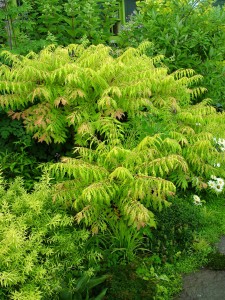
Sumac 'Tiger Eyes' ... you'll either love it or hate it.
* Common name: Staghorn sumac Tiger Eyes
* Botanical name: Rhus typhina ‘Bailtiger’
* What it is: A native, drought-tough, deer-resistant, bright-gold-leafed deciduous shrub with horizontal branches and opposite cut-edged leaves that give a lacy look to the plant. Fall color is vibrant orange/gold. Reminiscent of wild sumac or weedy tree-of-Heaven, so you’ll either love or hate this one.
* Size: 5 to 6 feet tall and wide
* Where to use: Sunny back or side border gardens or as a specimen in a warm-colored perennial garden.
* Care: Water to establish the first year, then nothing. If size is OK, no pruning needed. Otherwise, cut back long stems by one-third to a joint in March. Fertilizer usually not needed. Plant will send out some suckers from the base… dig up and transplant if you don’t want the mother plant to creep.
* Great partner: Use in front of tall evergreens or underplant with gaillardia ‘Goblin,’ ‘Fanfare,’ ‘Arizona Sun,’ ‘Oranges and Lemons’ or ‘Tizzy.’

My husband and I planted a shrub of the sumac tiger eye last fall. Without us realizing it, our local deer population have eaten it down to a stick. Recently noticed that the stick is actually producing little buds. Is this a good indicator that the plant survived, and what can we do to keep the deers away from it so that we can have a nice fall foliage this year?
Ruby,
It’s highly unusual for deer to pick on sumac. They generally don’t like that species and must have been very hungry and without many other options to eat yours.
It is a good sign that the plant is leafing out. It’ll most likely return to normal this season, albeit smaller than it would’ve been without the severe “pruning.”
To protect it next winter, surround the plant with a wire cylinder. Spot-fencing like that is more effective and less expensive than trying to keep repellents on it all winter. Once the trunk takes on some size (one or two more years ought to do it), you can probably stop protecting it. Deer lean toward young, tender growth.
Thank you for your quick response, and I appreciate you advice (&good info on your website). Will definitely give it a go. I try to buy deer resistance type of plants, but more often than not it tends to be a salads buffet for the local deer population. Here’s hoping for a better 2017 growing season. Cheers!
I too, have something chowing down on my sumac. My plants are 3 years old now and not doing good….still. I did put wire rings around them this year….but now that the new growth has begun to oroduce, I have had to remove so I do not damage what has grown. I still have noticed some nibbling, but was wondering if RABBITS could be the culprit? Also, mine do not like to be real wet….yet, in the heat, they seem to drop their beautiful stems. I am surprised this plant is as finicky as it is. Also, if it IS deer-resistant ( which is very low population on my neighborhood ) this plant may not be as resistant as stated.
Hi Ruby,
It’s probably not deer, but it’s possible it’s rabbits or groundhogs if the nibbling in low on the plant. Rabbits make very sharp angled cuts when they chew off a branch. Groundhogs make a rougher cut.
It’s not unusual for sumac to develop “bare legs” as the plant ages (unless you cut it back sharply at the end of each winter to encourage branching low on the stems). But it usually tolerates dry or damp soil and usually doesn’t run into animal or bug problems either.
Hopefully yours will improve as the roots fully acclimate. If it doesn’t look better in another year or two, I’d try moving it and see if a new location helps.
Hello
My tiger eye is 1 year old, and is sprouting new leaves but some are very droopy and ready to fall off. It is about 20 inches , a stick with leaves, in a 10 inch pot., Maybe I need to repot it? I keep it indoors for the winter. thanks
Carole,
Sounds like it’s root-bound. Sumac produces a vigorous root system and wants to “spread its wings.” This is a winter-hardy plant in central Pa. and would much rather be planted in the ground than grown in a pot with a move indoors over winter. At the least, it’ll appreciate a larger pot.
My Sumac was planted 10 summers ago. It grew into a full grown beautiful tree with raspberry & currant colored berries. It was stunning! Three years ago the bottom trunk developed spotting and a crusty-like disease on it. So each year after, the leaves grew smaller and smaller to the point the tree looked liked it was dying. This year (11th summer) in late April my husband cut the tree down to about 18″ or so from the ground. It’s been about 9 weeks and my beautiful Sumac is coming back! The shooters started growing out on the back of the tree-trunk and on the ground. The problem is - I need to move the 10 year tree trunk (now with 2 feet of new stems & leaves) about 1 1/2 feet away from the house. Can it be moved? If so, is there a possibility moving the tree can kill it?Should I just leave it alone and just trim it away from the house? Will it eventually stop growing against the house and begin growing in the opposite direction? Any advise would be greatly appreciated!
Thank you!
Vanessa,
That was actually a good rejuvenation strategy. Sumacs are very good about regenerating new growth from severe cutbacks. That kind of pruning solves the “leggy look” that sumacs usually take on by producing most of the foliage near the tips of the branches.
It’s possible to move this plant, but sumacs have vigorous root systems that’ll make it hard to get all or even most of it. That means you’ll no doubt be severing roots to free it for a move. The more big ones you sever, the more at risk the tree is of not surviving the move. So there’s definitely a risk you could kill the plant. But sumacs also are survivors. So I’d say if you dig as big of a rootball as possible, do the move at the end of winter (i.e. March) and not during summer, and then keep it well watered after transplanting, you’d have good odds.
Pruning is the safer option. You can regularly remove shoots from the unwanted direction without hurting the tree. It likely will continue to put out shoots in assorted directions (especially toward the sun side), but with pruning you can guide the shape and size you want.
Do you think that Tiger’s Eye Sumac would grow in Southern California (Los Angeles area)?
Nathan,
My guess is yes, but I don’t know that climate intimately. A good clue would be if it’s for sale in local garden centers.
I just planted a Tiger Eye Sumac today. It’s a real little guy-about 14 inches high. I have two questions:
1) How long will it take to reach feet?
2) can I trim the lower branches so it has some exposed trunk? I like the way some nature sumacs look like giant bonsai tree. We bought a tree with two trunks for this reason.
Laura,
Tiger Eye is a fairly fast grower that can reach 6 to 7 feet tall by the third season. It’ll keep growing beyond that if you don’t prune it, so start pruning each spring when it reaches the height you like.
And yes, you prune the lower branches as the plant grows to expose the trunk and create a tree-like look. Tiger Eye often does this itself by shedding lower branches as it grows to create what some people call “bare legs.”
Can you use the berries from a tiger eyes staghorn to make pink lemonade. I can’t find the answer to this question anywhere ?
Andrea,
I’ve never tried that, but Tiger Eyes is a type of sumac (Rhus typhina) that’s different from what’s commonly called poison sumac (Toxicodendron vernix). From what I’ve found, Rhus typhina plants and fruits aren’t toxic, although they’re bitter in flavor. So they don’t sound like a great beverage choice to me. I have no info on recipes.
I’ve heard you could cut the trunk or larger branch/”leg” of Tiger Eyes and transplant the upper portion to a new location, is this true? I’ve had some hybrid Willows that we could plant that way but didn’t know if I could do that for sure with these Tiger Eyes and actually have them survive. We have a couple of over grown Tiger Eyes and would like to shape/thin it more and move to the corner of the house away from the windows.
I planted one of these by the house. The second year there were all kinds of new plants coming up all over so I ended up digging it out. Do all these species send out runners and spread? I’d like to find a similar, colorful shrub that doesnt spread to have next to my house. Any suggestions?
Macabe,
Tiger Eye sumacs put out “runners” or “suckers,” which are shoots that come off of the parent plant. Once they begin to send out their own roots, these shoots can be severed and transplanted to become new plants.
May,
Yes, sumacs do that. If you’re looking for a golden-leafed shrub that doesn’t sucker, take a look at golden smokebush or golden elderberry. There are at least two cultivars of each that you should be able to find in garden centers. Or else ask if your favorite garden center can order you one of either of those.
Hi George, I have a nicely matured tiger eyes sumac next to our house and it is now growing a little more diagonal and horizontal across our walkway. How far down on the tree can I prune it in the early spring to try redirecting and encouraging a more vertical growth?
Mindy,
Sumacs can be pruned hard… they’re pretty tough. I’d let at least a couple of side shoots on each branch. Taking off one-third of the length is no problem at all, if that’s all you need to “skinny it up.”