
Hydrangea Eclipse
* Common name: Hydrangea Eclipse
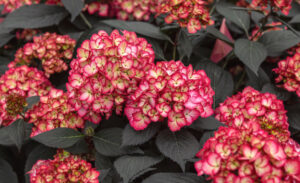
Hydrangea Eclipse’s bicolor flowers and dark foliage.
Credit: Bailey Nurseries
* Botanical name: Hydrangea macrophylla
* What it is: Dark leaves are trendy lately, and this new-in-2024 hydrangea offers some of the darkest foliage of any shrub – almost black. Bailey Nurseries, which developed Eclipse, points out that unlike some dark-leafed plants, this one holds the dark color throughout the season, even in hot weather.
Eclipse gets large, round, “mophead” flowers in late June to early July that are mostly cranberry-red but with creamy centers, making it read like a red bicolor. The color is striking amid the dark foliage.
Plants also have good leaf-disease resistance.
Eclipse turned enough heads at the 2023 mericanHort Cultivate show that it won a Retailers’ Choice award as a new plant with the potential to become a garden-center best-seller. It also won the 2024 National Garden Bureau Professional Choice Green Thumb Award as the year’s top new shrub.
* Size: Eclipse grows about five feet tall and wide.
* Where to use: Like most bigleaf hydrangea varieties, Eclipse will do best in sites with morning sun and afternoon shade. An eastern foundation is perfect. So is dappled sunlight under trees.
Eclipse plants can be grown in large pots, too. Just keep them consistently damp. Remove and plant plants in fall or insulate the pots with leaves along a heated wall to help potted plants better survive winter.
* Care: Water deeply once or twice a week in dry weather. An annual spring scattering of organic granular flower fertilizer helps flower production.
Prune right after the flowers fade if the plants are getting too dense or if you want to keep the size compact. Dead wood or dead tips can be pruned off in early spring once you see what all has survived winter. Avoid pruning live stems in spring because you’ll cut off flower buds.
* Great partner: Golden creeping sedum ‘Angelina’ or any gold- or chartreuse-leafed coralbells contrast nicely with the dark leaves of Eclipse. Ferns, sedges, gold-variegated liriope, and golden Japanese forest grass are good textural partners in wooded settings. Gold-foliage shrubs also are good partners or backdrops, such as golden Hinoki falsecypress, elderberry Lemony Lace, sumac Tiger Eyes, gold-variegated boxwood, and ‘Baggesen’s Gold.’