



American fringetree
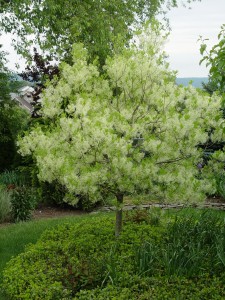
American fringetree in bloom.
- Common name: American fringetree
- Botanical name: Chionanthus virginicus
- What it is: A small native tree (or multi-stemmed large bush, depending on how you prune it) that gets very unusual shaggy white flowers in late May through early June. Nicknamed “old man’s beard” for the interesting flowers. Leaves turn yellow in fall.
- Size: 15 to 20 feet tall and wide but is a slow grower.
- Where to use: Makes a great front-yard specimen or centered out any oft-used window – especially when pruned as a single-trunk tree. Grows in sun or part shade and tolerates fairly damp soil.
- Care: Plant in loose, rich, acidy soil and keep well watered for the first year or two until the roots establish. Prune right after flowering to shape in early years, then little or no pruning needed. Remove lower limbs as tree ages. Fertilize in early spring with an acidifying organic fertilizer, such as Holly-Tone, if at all. Seldom bothered by bugs or disease.
- Great partner: Liriope makes a nice groundcover underneath. Spanish bluebells bloom at about the same time… their blue flower spikes pair well with the shaggy white flowers of fringetree.
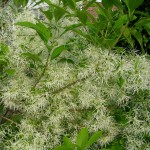
Closeup of fringetree flowers.

Hi George,
Above, when you say ‘centered out any oft-used window,’ what do you mean exactly? Does that mean it’s great in front of a window or off set, on the side of a window. I’m trying to decide between a fringetree, Little King birch, or a seven-son flower temple of bloom at the back corner of my house, in an 8-foot wide bed, with a window on the side of the house and the back of the house, right near the corner I’m planting. I want a little privacy because this corner is right on my patio but don’t want to completely block sunlight from the two windows it would be near. Any suggestions on which one to choose?
Sheila,
That means when you look straight out a window, the plant would be centered in that view.
All three of those trees are good small ones. Your bed isn’t that big, and since you’d like a little filtered light coming through, I’d go with the seven-son flower in this case with the American fringe tree as a close second.
The birch, even though dwarf, will still grow upwards of 12 to 15 feet in width (and it has fairly dense foliage). It also doesn’t bloom nicely like the fringe tree and seven-son flower, which is a nice feature of any window-view tree.
Hi George,
I have a very small yard in front of my townhouse. It gets full sun for most of the day. It is hot and dry. Would an American fringetree work there? I’m finding it difficult to find a native, drought-tolerant, sun-loving compact tree for my hot, dry, tiny yard!
Brooke,
If you keep the fringe tree well watered the first couple of years until the roots are established, then it should do fine in a full-sun setting. Give it two or three inches of mulch and in the long run a good weekly soaking only when it gets unusually hot and dry.
Serviceberry is another small native ornamental tree worth considering. It’ll do full sun as well as part shade.
Crape myrtles and crabapples are two other good small choices, although they’re not natives.
My front yard has western exposure and gets a lot of hot afternoon sun. We have dry, clay soil. Would this tree work there? Are there good native alternatives.
Jeff,
I like American fringe trees and just planted two in my front yard, which also is in open sun with a western exposure.
Since your soil isn’t the greatest, I would recommend improving it a little before planting by working one or two inches of compost or rotted leaves into the loosened top foot of soil before planting. Then keep the soil consistently damp the whole first year and whenever it gets hot and dry in the next two seasons until the roots are reasonably well developed.
I have deer, and they haven’t messed with them either.
Serviceberry is another good small native flowering tree that does well in sun, although it’s a bit more prone to leaf diseases and deer than fringe tree.
Hi George,
I got a fringe tree in tree format. I’m wondering how tall it can grow since I see some websites saying it could go to 30 feet.
I plan to plant it at the corner of the backdoor patio, about 12 feet from the house. I want to give some shade and privacy to the patio, but do not want it too big and tall. Will that be a good choice?
The other candidates are Japanese snowbell and kousa dogwood. Is there a small tree that grows fast and not taller then 15 feet?
Ada,
American fringe tree is a good choice and is one of the smallest tree selections. Planting 12 feet from the house is a good distance.
On eventual size, there is no maximum size when it comes to trees. They all keep growing until they die, although usually at a slower rate as they age. It’s possible a fringe tree could reach 30 feet, but I’d estimate it’ll take 50 years of growing to do it (if even then). A good planning size for fringe trees is more in the 18- to 20-foot range, which most will reach after about 20 or 25 years of growing.
It’s a little smaller in stature than snowbell and kousa dogwood.
Here’s a link to my list of 10 favorite small trees, which includes planning sizes for each at about 20-25 years out: https://georgeweigel.net/georges-favorite-plants-etc/top-10-small-trees
A landscaper planted a fringe tree 6 years ago in the late fall on the NE side of my property (we are in Northern VA). The tree was a “centerpiece” so to speak surrounded by established azaleas.
The leaves were gone and I wonder what type of condition the tree was actually in when planted. I have heavy rocky clay soil and I don’t think it was amended well. Also, there has been work done within a foot or two of the tree (drywell needed due to the heavy rain situation we now face) so roots have been compromised and the soil compacted from people doing work.
The area is shady with a little afternoon sun as it sets in the west, so the light requirements aren’t really exactly met. Also, we now have drought followed by heavy rain storms as the new normal. I try and keep my tree roots watered when it gets hot with no rain. I have not fertilized the tree. The conditions are extremely hot and humid in the summer which is hard on my landscape in general.
My fringe tree has always been sickly looking. It has never bloomed or so little you don’t see it. It barely has any leaves to speak of in the summer, it just looks bad but alive. Truly, the sad tree has been an eyesore.
Being that nothing has really been optimal except the acidic soil, what can I do to boost the health of this tree? Should I give up, take it out, try again with a tree I can choose and inspect? Should I try another tree with the same growth habit instead? Your help would be greatly appreciated.
Sue,
It sounds you have enough strikes working against your fringe tree in that spot that I would suggest moving it to a brighter location and improving the soil before the replant. After six years, your tree should be coming around if it’s even reasonably “happy.” You may just save its life and end up with a newly revived tree after a move to better conditions.
There’s not much you can do about bad weather, but you can control the light setting and soil quality. Hopefully your fringe tree will survive winter and give you a chance to do a transplant at winter’s end — ideally just before new growth begins (or should begin).