



The Best New Trees and Shrubs of 2016
February 2nd, 2016
A vine you’ve never heard of, a black-leafed version of a native shrub you’ve also probably never heard of, and even more twists to the huge lineup of hydrangeas is on tap at a nursery near you this spring.
Today we’ll finish off our annual four-part series on best new plants of the coming year, this time with the best of the new trees, shrubs and woody vines hitting the market in 2016.

Bush honeysuckle Kodiak Orange in fall
Credit: Proven Winners
Bush honeysuckle Kodiak Orange and Kodiak Black
Never heard of bush honeysuckle? Not many gardeners have, even though it’s a U.S. native shrub, known botanically as Diervilla. That’s entirely different from the Asian honeysuckles that are on most invasive-plant lists.
This bush honeysuckle is a 4-foot-tall leaf-dropping shrub with an arching habit and yellow early-summer flowers.
What’s special about the new Kodiak Orange and Kodiak Black varieties from Proven Winners is their colorful leaves.
Kodiak Orange’s leaves turn a glowing burgundy-orange in fall, while Kodiak Black has dark burgundy-black leaves all growing season.
The pair are at the top of the 2016 shrub list of Amanda Bastiaanse, the shrub buyer at the wholesale Quality Greenhouses near Dillsburg.
“These are excellent native selections that thrive in many different garden conditions and are deer resistant,” she says. “They have striking foliage color in both spring and fall. Kodiak Orange is a great alternative to the invasive burning bush.”
Both aren’t picky about light either, growing in shade or sun. And they’re good in droughts.
Silky dogwood Red Rover
Here’s another new twist to another under-used native shrub… this one the shrub-type silky dogwood (Cornus obliqua).
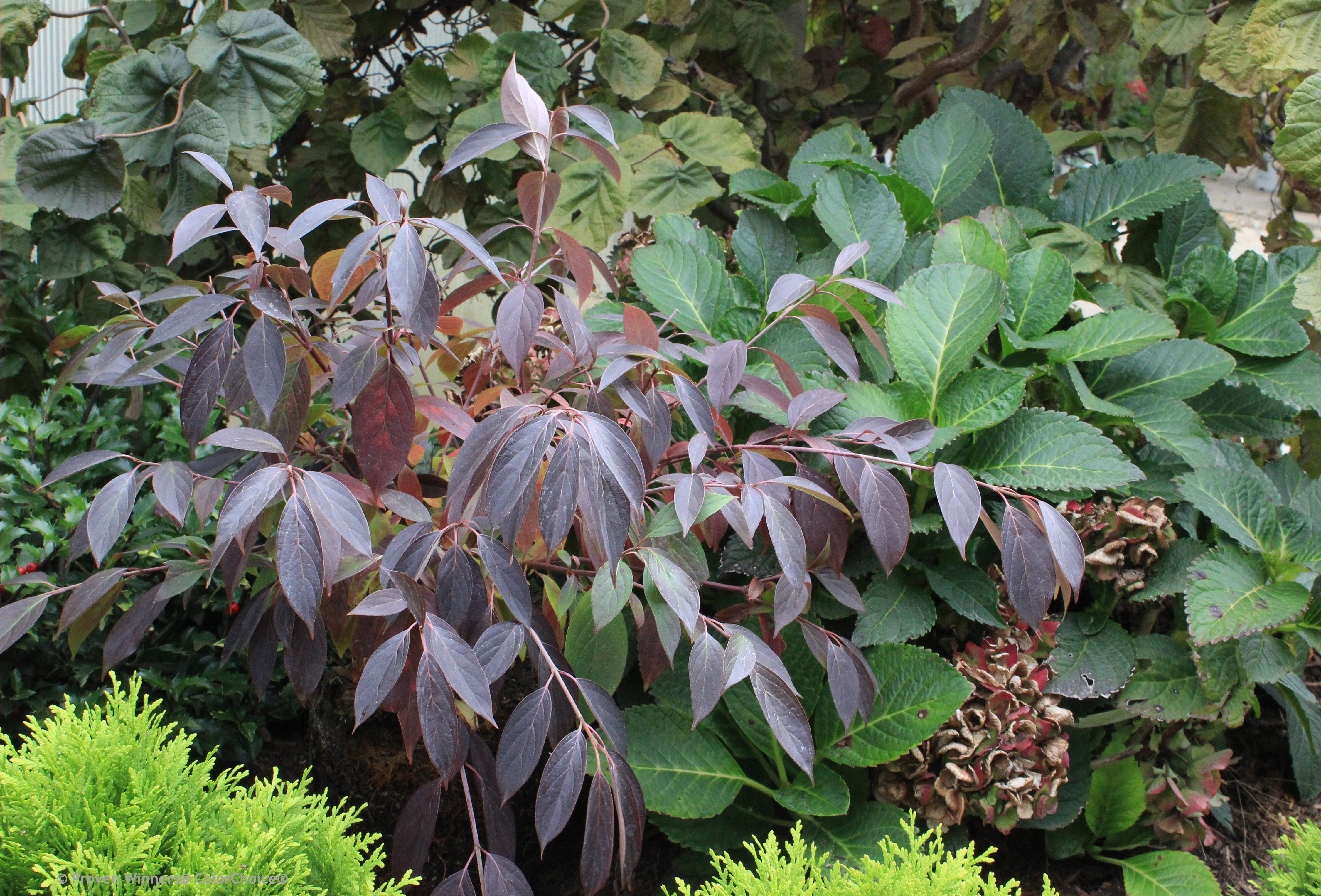
Dogwood Red Rover’s fall foliage
Credit: Proven Winners
Brandon Kuykendall, the tree and shrub manager at Ashcombe Farm and Greenhouses in Monroe Twp., likes Red Rover for its multi-season interest.
“I love the fall leaf color,” says Kuykendall. “It has an excellent glossy, dark-burgundy leaf in fall. The red stems give it nice color in the winter when you might need some color.”
Red Rover also gets umbrella-like clusters of white flowers in early summer and small blue fruits in fall that birds relish.
The multi-stem bush grows 4 to 5 feet tall with a 5- to 6-foot spread, takes part shade to full sun, and is tolerant of wet soil, making it a good choice for rain gardens and swales.
Chinese hydrangea vine Lacy Hearts
Hardly anybody knows the excellent Japanese hydrangea vine, much less the closely related Chinese hydrangea vine (Schizophragma elliptifolium) – a self-clinging, winter-hardy, woody vine with heart-shaped leaves and white lace-cap-hydrangea flowers in summer.
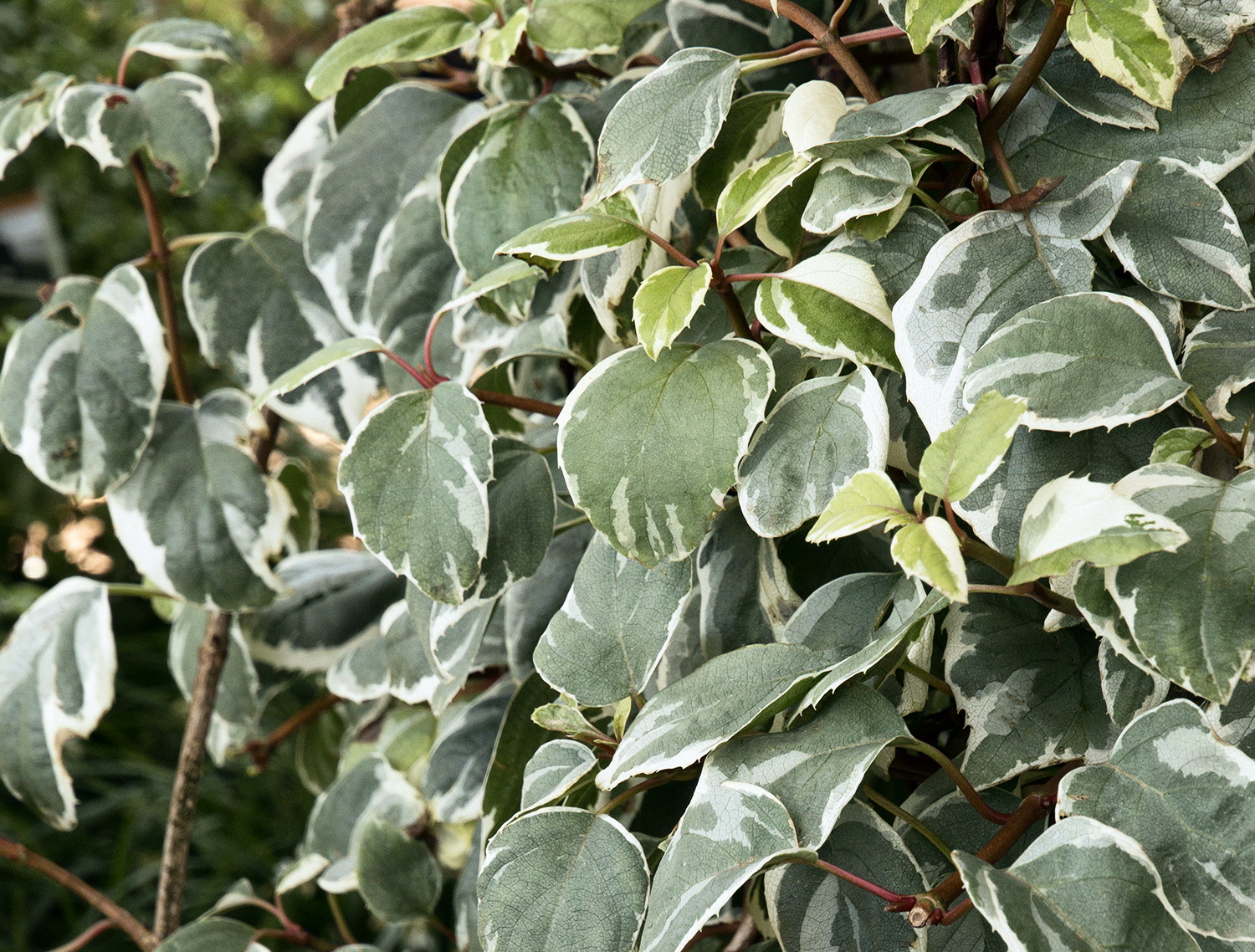
Chinese hydrangea vine Lacy Hearts
Credit: Doreen Wynja for Monrovia
Not only is this species a greatly under-used choice in partly shaded settings, but Lacy Hearts adds attractive variegated leaves.
“I think it’s a sensational plant… great foliage all summer as well as a season of flowers,” says plant hunter Dan Hinkley, who found this selection for Monrovia, the large California-based grower. “The vividness of the variegation is what I find extraordinary. There’s nothing wishy-washy about it at all.”
Hinkley says Lacy Hearts will make a good choice for “brightening up a dark corner in the garden while in blossom, but it will do the trick all summer by its foliage alone.”
Like most hydrangea vines, Lacy Hearts is a slow to get going but eventually will grab its way 10 to 15 feet up walls or supports.
Dwarf chastetree Blue Diddley
Chastetree or vitex is one of the few shrubs that flower blue. It looks a lot like butterfly bush, only it doesn’t typically “seed around” where not wanted.
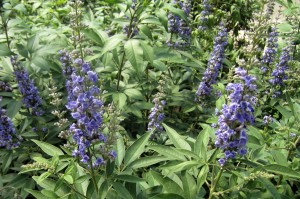
Chastetree Blue Diddley
Credit: Proven Winners
Erica Shaffer, the manager at Highland Gardens in Lower Allen Twp., likes this new dwarf version of chastetree from Proven Winners called Blue Diddley.
“Blue flowers are always a plus in the garden,” she says, “but these fragrant flower spikes also color up the late-summer garden when it needs a burst of something fresh. This is a super-cool plant that’s also fragrant and has bold foliage in a slate-green color.
“Deer don’t eat them either, and they love hot sun,” Shaffer says. “And the flowers attract butterflies and hummingbirds.”
Chastetrees sometimes die back to the ground in cold winters. They can also be pruned back at the end of every winter if you want to keep them as compact as possible.
Blue Diddley is naturally more compact than most at about 5 to 6 feet tall and wide.
Redbud Carolina Sweetheart
Our native redbud tree takes on a new look in 2016 with this variety from Chester County’s Star Roses and Plants. Its leaves change color.
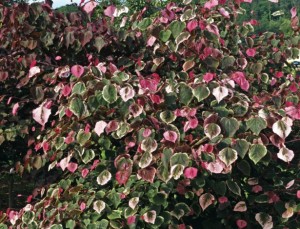
Redbud Carolina Sweetheart
Credit: Star Roses and Plants
Just as the early-spring pink flowers fade on the bare stems of Carolina Sweetheart, the season’s new leaves unfurl in a maroon color. The show progresses into prime eye-grabbing mode when the heart-shaped leaves turn green with white and rosy-pink variegation, giving it a three-tone look by mid-spring.
Carolina Sweetheart grows 20 to 25 feet tall by about 30 wide and does best in a morning-sun/afternoon-shade location.
Smooth hydrangea Invincibelle Spirit II
The original version of this native hydrangea attracted attention for its pink instead of normally white rounded flowers and because the introducer, Proven Winners, donated $1 for every Invincibelle Spirit sold to the Breast Cancer Research Center.
Breeders have darkened the foliage, increased the flower size, deepened the pink flower color, and strengthened the stems to make the shrub stand more upright.
The improvements are significant enough to roll out a “new and improved” hydrangea called Invincible Spirit II, debuting this spring.
“It’s a strong rebloomer that will deliver plenty of rich pink flowers through the summer and into fall,” says Proven Winners’ Mark Osgerby, adding that $1 for each new version sold again will go to the Breast Cancer Research Center.
This hydrangea blooms on new wood, which means it’ll flower even after a winter cold enough to kill flower buds on bigleaf hydrangeas.
Figure on a size of about 4 feet tall and wide. It grows in part shade to full sun.
Hydrangea L.A. Dreamin’
“This is the first bigleaf hydrangea that shows both blue and pink blooms on one plant at the same time,” says Katie Rotella of Ball Horticultural Co., the grower introducing this new hydrangea.
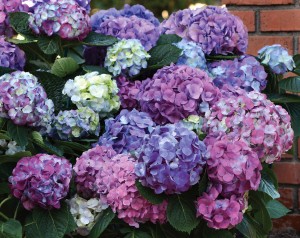
Hydrangea L.A. Dreamin’
Credit: Ball Ornamentals
“Plus, you get that desirable blue color without the need for treating the soil with aluminum sulfate,” she adds.
L.A. Dreamin’ is a rebloomer, too, meaning you’ll get a main bloom in June and then additional flowers from late summer into early fall.
Plan on a size of about 4 feet tall and wide. Like most bigleaf hydrangeas, the ideal site is one that gets morning sun and afternoon shade.
Hydrangea Everlasting Noblesse
Here’s a plant with striking enough flowers that it started out as a variety for the cut-flower market.
The main attraction is two-toned rounded flowers of celery-green and white.
“As the blooms mature, the white is not as prominent, turning a more saturated green,” says Angela Treadwell-Palmer, co-owner of Plants Nouveau, which is introducing Everlasting Noblesse.
She adds that this variety makes one of the best cut flowers – especially in bouquets – but it’s also a showy landscape plant or container shrub.
Everlasting Noblesse is another reblooming hydrangea that does best in morning sun and afternoon shade, but it’s more compact than most bigleaf hydrangeas at under 3 feet tall and wide.
English rose ‘Olivia Rose Austin’
David Austin roses are a line of fragrant, old-fashioned roses with new-fashioned performance and disease resistance. For spring 2016, the British breeder behind the line – David Austin – says his ‘Olivia Rose Austin’ introduction is “possibly the best rose we’ve ever bred.”
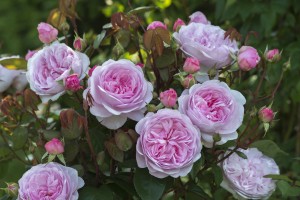
‘Olivia Rose Austin’
Credit: David Austin Roses
“It’s achingly beautiful, fragrant and as close to disease-free as we’ve ever seen,” says Michael Marriott, David Austin Roses’ senior rosarian.
This soft-pink bloomer with the big flowers also is early to get started, flowering 3 weeks earlier than most English roses while the lilacs and wisteria are still in bloom.
“All season, the blooms keep coming with full-blown flushes that follow in quick succession, hot on the heels of the one before,” says Marriott.
Figure on a bush about 4 feet tall with a 3-foot spread.

Comments