


Bottom 10 Trees
August 18th, 2015
I already told you about my Top 10 Small Trees and my Top 10 Shade Trees, so it’s only fair that I weigh in on my Bottom 10 Trees.
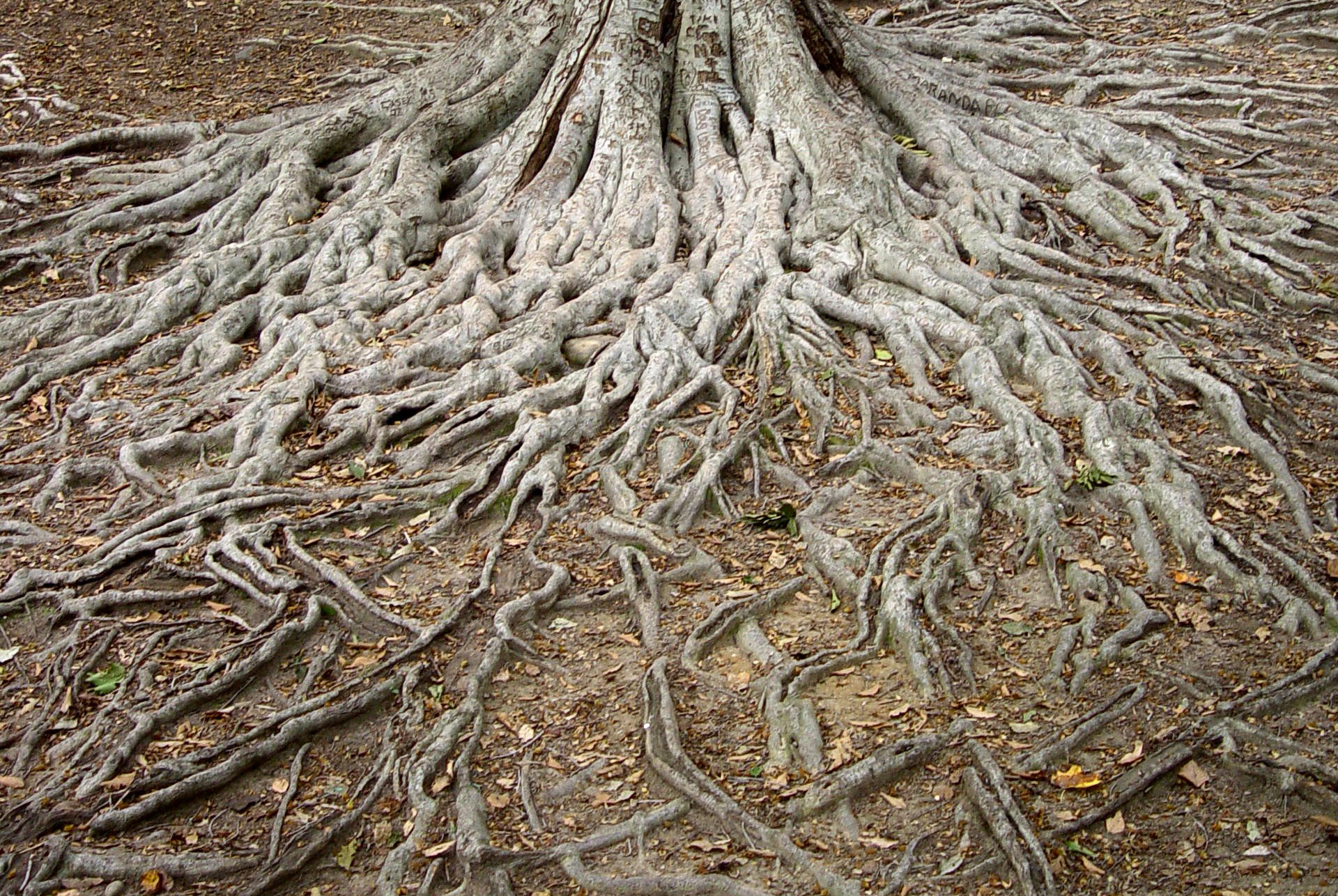
Not all trees make welcome yard guests.
These aren’t trees that I “hate” or that I’m saying no one should ever plant (at least for most of them). But the following all have some major drawbacks that you should be aware of before inviting them into your yard.
1.) Female ginkgo (Gingko biloba). Unless you enjoy dropping mushy fruits and the smell of vomit, avoid this tree anywhere near civilization.
Ginkgos come in male and female forms. Males are durable and attractive – especially in their golden-yellow fall foliage. Females, however, develop marble-sized fruits that smell like an army has barfed nearby.
That’s why nurseries attempt to sell only males. Double-check. Also be aware that the true gender may not expose itself for years, which is how females still sometimes end up being planted.
That happened recently on the HACC campus, where the staff had to cut down a 15-foot-tall but newly recognized female ginkgo – planted next to the dining hall, no less.
2.) Honeylocust (Gleditsia triacanthus). Let’s say you know about the long and very sharp thorns the native version of this tree has, so you opt for the thornless ‘Shademaster’ variety.
I still hear plenty of complaints from regretful planters who mention: the “messy” dropping seed pods; the suckers that keep popping up around the tree’s base; the surface roots killing off the grass; the mimosa webworm that builds late-summer webs in the canopy, and especially the tree’s plant-bug-fueled leaf drop that causes the little leaves to blow around for months on end.
3.) White birch (Betula papyrifera). Yeah, the peeling white bark is striking, and the burnt-yellow fall color is decent, too – if any leaves are around that long.
Like honeylocust, I’ve found this species is always dropping something, from the spent flower racemes in spring to the diseased and leaf-miner-attacked leaves from July on. It’s also very prone to a tree-killing borer, which shortens white birch’s life span.
Think about a river birch instead. And definitely do not plant a white birch near your patio.
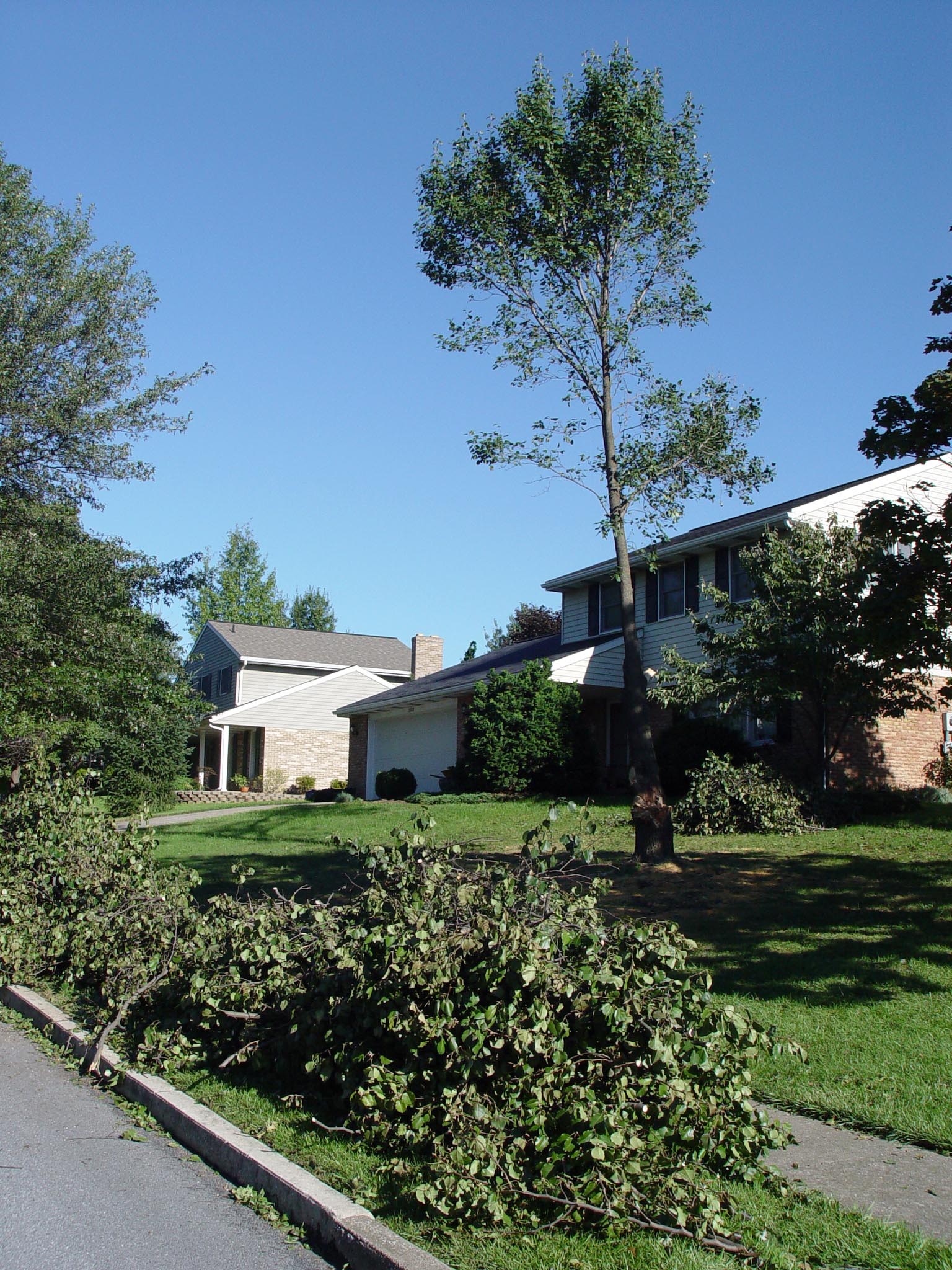
Here’s what you can expect to happen to an aging ‘Bradford’ pear.
4.) ‘Bradford’ pear (Pyrus calleryana). This was the miracle tree when it came out in the mid-1900s – fast-growing, pest-resistant, hard to kill, beautiful in bloom and brilliant glossy scarlet/mahogany in fall. No wonder they were planted everywhere.
Only one problem… after about a dozen years or so, most of them fall apart. Their fast growth makes them inherently weak-wooded, and the aging, brittle limbs start cracking off in even moderate winds. Some of the newer ornamental pear cultivars are only slightly better at staying intact.
Also, this type of pear’s pea-sized fruits have seeds that are spreading into the wild, earning it a spot on the Pennsylvania Department of Conservation and Natural Resources’ invasive plant list.
5.) Empress tree (Paulownia tomentosa). The big pinkish-lavender flowers are “empressive” to behold as well as mildly fragrant. The wood also makes great furniture.
However, this is another tree that grows too fast for its own good, often dropping limbs as fast as its big, spent flower petals in late spring and its big leaves in fall (traits that backyard empress-tree planters often consider to be “messy”).
There’s concern about this one becoming an overly aggressive seeder, too. It’s on DCNR’s invasive plant list.
6.) Norway and silver maples (Acer platanoides and Acer saccharinum). Lawn-lovers really won’t like these two big shade trees that have some of the most elaborate root systems you’ll find. While that’s good if you’re the tree, it’s bad news for grass anywhere close to the canopy.
Also be ready for lots of leaf drop in the fall, for the possibility of sidewalks and driveways to be pushed up as the maple roots spread, and for the potential for limb breakage and unwanted seeding.
7.) Ash (Fraxinus). The problem here boils down to a bug – the newly arrived emerald ash borer that’s been decimating most members of the ash family in an increasing number of states.
This wood-boring killer is now in central Pennsylvania, where it threatens both wild and yard-planted ash trees.
It’s probably a good idea to hold off planting new ash trees, at least until we see whether what happened elsewhere is going to happen here.
8.) Mimosa (Albizia julibrissin). Lots of people like the ferny, frilly foliage and puffy pink flower heads of this small tree.
However, it has a host of drawbacks, including the aforementioned mimosa webworm, weak wood that’s prone to crack-offs, a potentially fatal wilt disease, unwanted suckering, and dropping pods and seeds that come up where you don’t want.
It’s another species on DCNR’s Pennsylvania invasive plant list.
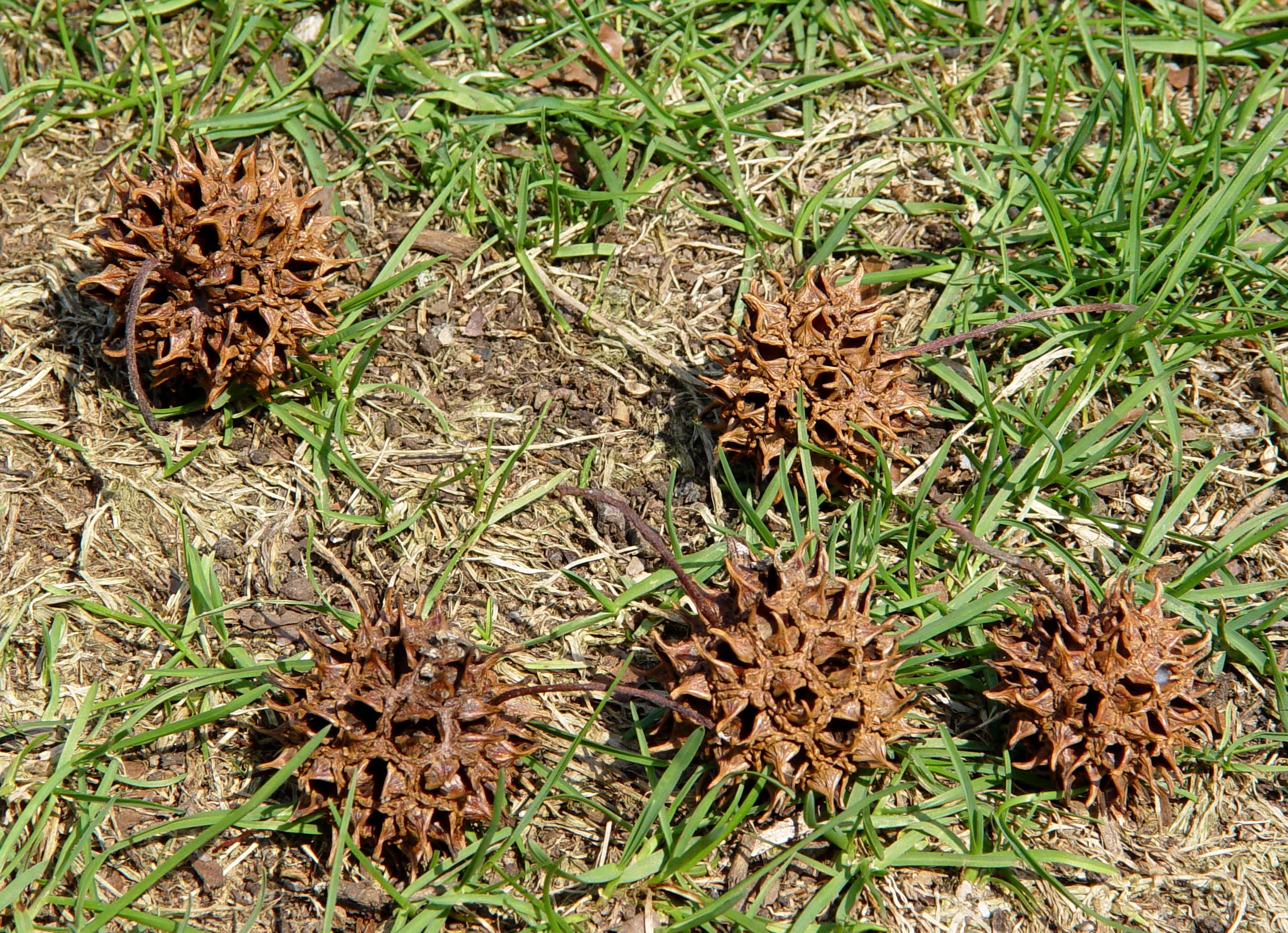
Fallen spiky seed pods of sweetgum tree.
9.) Sweetgum (Liquidambar styraciflua). This native tree has some of the most impressive fall foliage of any tree, but that’s negated by the gobs of spiky golfball-sized seed balls that make many a sweetgum planter (and barefoot walker) swear every fall.
The surface roots also make it difficult to grow plants under a sweetgum canopy, especially grass.
A good solution is to stick with sweetgum cultivars that produce no or few of those spiky balls, such as the columnar ‘Slender Silhouette’ or the smooth-leafed ‘Rotundiloba.’
10.) Walnut (Juglans). Here’s another tree with lots of good attributes, not the least of which is tasty nuts and some of the best furniture wood on the planet.
The main down side to keep in mind is that the walnut family produces a natural chemical (juglone) that can kill or stunt the growth of many other plants. It’s a defensive mechanism, developed by nature to help some species get an edge on territorial dominance over lesser equipped competitors.
That can be a problem if you’re trying to grow certain flowers, shrubs or tomatoes anywhere within twice the range of a walnut’s canopy.
Some people within walnut range also complain about the dropping of bug-ridden nuts and being particularly sensitive to walnut pollen flying around in spring.
I’m out of space, so let me say quickly that I’m also not keen on Russian olive (invasive), mulberry (weak-wooded and too messy for most people), poplar and box elder (bug-prone and weak-wooded), and for Heaven’s sake, the tree of Heaven, that woody weed that should be called the tree of Hell.

Perhaps the mulberry deserves at least a few points for the wonderful fruit it produces in such abundance, even at just a few years growth?
Marcus,
Those redeeming fruit points kept mulberry out of my bottom 10. But I hear a lot of people with mulberry in their yard complain about the “mess” while threatening to cut it down. One person’s fruit is another’s mess…
There are details on 10 trees and mention of 5 more in your excellent article. There are three evaluations with which I respectfully disagree.
A Female Ginkgo - The Sweet gum Tree - The Mulberry Tree.
You can see I do not mind a mess or what most consider a nasty smell akin to that of vomit. For some reason I have always found that smell attractive. Perhaps it was encountered during a very high point in my life and the association has remained.
My Ginkgo is too young to determine sex. Does one need a male and a female tree nearby in order to produce fruit?
I live alone on a 10 acre piece of land, so I need satisfy only myself.
Thank you for your kind and prompt expected response.
Disagree away! Plant likes and dislikes are pretty subjective.
On the ginkgo, it’s most likely a male if you bought it at a nursery. It can take years before the tree is old enough to flower and determine whether it’s male or female, though. If you have a female, you’ll need a male to set fruit… unless someone else’s male is within a mile or so.
You left out Siberian elm,Ulmus pumila: Disease ridden, insect-lov’in, surface root’in, top-heavy invasive tree species.
Otherwise, I agree with most of your list.
W.S.
Will,
Yeah, that’s another one I’m not too keen on. Its limbs also crack apart fairly easily in an ice storm. I’ll have to expand my list to Bottom 20 Trees…