


Plant Sunburn
July 17th, 2012
Somebody ought to invent sunscreen lotion for plants.
These bouts of glaring sun and near-triple-digit heat are punishing to plants, particularly ones native to climates that don’t act like this. Plants that prefer a bit of shade but that you’ve got out in full sun aren’t faring any better.
As you might’ve noticed in the last few weeks, it’s not just dry conditions that can take a summertime toll on plants.
Flat-out heat and broiling sun can cause botanical suffering even when soil moisture is good.
This is usually the answer to the forlorn gardening question/apology, “But I don’t understand why my shrub (or tree) is turning brown. I’ve been keeping it watered.”
It also answers why your hydrangeas have been wilting even though you’ve been watering them. If they’re perked up in the morning, it’s not the dry soil causing them to wilt. It’s the heat.
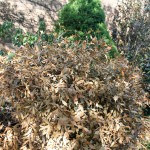
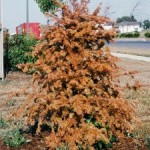
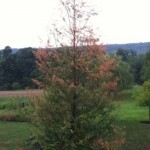
In my own garden, I’ve got a couple of dwarf conifers that have been partly browning over the top. One is the dwarf Korean fir ‘Cis,’ and the other is a fine-needled dwarf sawara cypress ‘Cumulus.’
I’ve seen similar symptoms on bird’s nest spruce — a low form of Norway spruce.
The common denominator is that none of those like super-hot summers. They’re happy in the Pacific Northwest or New England or Norway — not Dallas, which is more like we’ve been having lately.
Water helps a little in these heat-related brown-outs. It not only sidesteps the double-trouble of dry soil and high heat, but water also cools the soil and by extension, the plant roots.
A couple of inches of mulch over the soil also helps, as does erecting a burlap, screen or shade-cloth protector to block the afternoon sun. I’ve employed a couple of patio chairs to give this kind of afternoon help to a recently transplanted crape myrtle in my yard that’s been wilting. But the real answer here is for the temperature to return to saner levels.
Our bake-oven conditions also have fried shade plants that are out in too much sun.
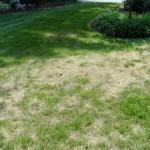
The most graphic example I’ve seen lately is also in my back yard. Up until this past winter, I had a patch of pachysandra groundcover growing nicely under a 25-year-old apple tree. But voles girdled the trunk over the winter and killed the poor tree. Without the shade-giving canopy, the pachysandra in this now-sunny area has literally melted into gasping brown the past two weeks. Just a few feet away — where the same planting is still under the canopy of an American fringetree — the pachysandra remains green, dense and unfazed.
Pachysandra in new sunlight has turned brown. Notice it's still green and unfazed where there's still shade.
Now that we got a 1.25-inch soaking on Sunday, I’m going to cut back the pachysandra and hope it regrows a more sun-tolerant set of leaves until my young replacement tree (a dove tree) replenishes the shade. Otherwise, the alternative is to yank the pachysandra and replace it with something more sun-preferring now that the conditions have changed.
Oh well. It’s all part of gardening.
Things change. And both we and the plants either roll with the punches or throw in the trowel.
But at least with the heat, WE get to go inside in the air-conditioning.

What did you do to get rid of the voles I just found them in my garden The rabbits are eating my vegtables, the voles are eating my bulbs and the deer have emptied my pots on my front porch. Besides that the summer is going great. miss seeing you and Sue,hope your summer is going well
Hi Diane,
What, you don’t like free pets? Sounds like you might be best off just calling the garden a zoo and selling tickets.
I’d have to say dealing with animals is the most frustrating and hard-to-overcome challenge of gardening. Whole books have been written on the assorted ways of discouraging animal damage.
It basically boils down to fencing (probably best but not always practical or cheap) and then repelling and trapping (ongoing struggle). I also gave up on plants animals seem to like best, like pansies (dessert for rabbits) and strawberries (birds eat every last one without netting).
I’ve got articles on dealing with groundhogs and deer as well as rodents eating bulbs under the “Mayhem in the Garden” section of my web site’s “Storage Shed” (address is http://georgeweigel.net/category/favorite-past-garden-columns/mayhem-in-the-garden). And my Pennlive Q&A blog hass dozens of posts on all sorts of animal issues at http://blog.pennlive.com/gardening/index.html. Hit the “Animal Problems” button in the menu along the left side to see the posts in descending chronological order.
Happy zoo-keeping.
George
I was given the best cure for voles (and I think chipmunks). Take 1 1/2″ PVC pipe and cut in 1 foot lengths. Attach 90 degree angle pieces on each end (no need to glue). Buy a package of “One Bite” at the Agway store. I cut it into pieces about the size of a quarter and put a piece in each end so no other critters will get it. Place in an obvious problem area. I made about 10 of them for all around the yard. The voles had been devastating everything-and now I have no problem-but the bait keeps disappearing. Also the chipmunks that undermine my concrete walk seem to be gone as well.