


Gold Medal Plants for 2017
September 13th, 2016
The discussing is done, the votes are in, and the Pennsylvania Horticultural Society has officially named its Gold Medal award-winning plants for 2017.

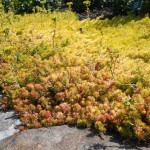
Creeping sedum ‘Angelina’ — my favorite groundcover for sun — was named a 2017 PHS Gold Medal winner.
These are some of the best but under-used landscape plants for the mid-Atlantic region as picked each year by a panel of 15 PHS-appointed plant experts. (For more on the inner workings of the panel – I’m on it – and why it’s so useful to Pennsylvania gardeners, check out the post I wrote here last week.)
The 2017 winners include a small flowering tree, a holly-like evergreen, a family of woody vines, three perennial flowers, and a colorful groundcover for hot, sunny areas.
Below are the details. Keep reading beyond the 2017 winners for a custom list I put together offering the best of all-time Gold Medal winners by how they’re best used.
For a full list of the nearly 160 Gold Medal-winning plants named since 1979, check out PHS’s website or the list under George’s Favorite Stuff here.
The 2017 Gold Medal plants:
Crape myrtle ‘Natchez.’ This is a 20- to 25-foot flowering tree that blooms white from July into September – after most trees are done. The bark peels into shades of tan and chocolate, and the leaves turn yellow-red in fall. It’s also one of the cold-hardiest crape myrtles, making it a good choice for central Pa. (Best in full sun.)

Holly tea olive ‘Gulftide.’
Photo by Pleasant Run Nursery
Holly tea olive ‘Gulftide’ (Osmanthus heterophyllus). The good news is that this upright English-holly look-alike has attractive, glossy evergreen leaves, excellent shade tolerance, and isn’t attractive to deer. The down side is that it may not survive an unusually cold central-Pa. winter. Give it the warmest microclimate and the best winter-wind protection you can. Grows to 6 feet tall by 4 feet wide.
Clematis Viticella group. Garden centers are filled with beautiful, self-climbing clematis-vine choices, but for the most reliable performance and least chance of running into the dreaded wilt disease that turns leaves brown in summer, look for Italian or Viticella types. Varieties include ‘Madame Julia Correvon,’ ‘Polish Spirit,’ ‘Etoile Violette,’ ‘Betty Corning’ and ‘Wisley.’ These bloom from late June to September and produce profuse quantities of 3-inch blooms in two different flower shapes. Clematis viticella varieties bloom on new growth, so prune them hard at winter’s end. The roots are happiest shaded, while the tops prefer full sun.
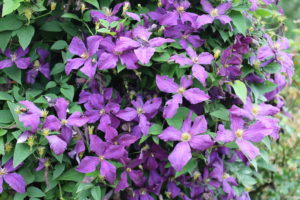
Clematis ‘Polish Spirit’ in bloom.
Giant hyssop ‘Blue Fortune’ (Agastache). This drought-tough, deer-resistant perennial has lavender-blue flower spikes from mid-summer to fall. Butterflies, bees and hummingbirds all find it attractive. Leaves have a minty-anise fragrance. (Full sun to part shade, about 2 feet tall.)
Ornamental onion ‘Summer Beauty’ (Allium senescens var. montanum). Technically a rhizome, ‘Summer Beauty’ produces strap-like leaves in spring, topped by soft-pink round flower clusters on long stalks from June into August. Being an onion-family plant, it’s deer- and rodent-resistant. (Sun to part shade, about 18 inches tall.)
Salvia ‘Caradonna’ (Salvia nemerosa). From the same family as the popular ‘May Night’ salvia, ‘Caradonna’ is a heat- and drought-tough perennial with violet-blue flower spikes on tall, dark-purple stems. Deer don’t like it, but hummingbirds do. (Full sun, grows 24 to 30 inches tall.)
Creeping sedum ‘Angelina’ (Sedum rupestre). I nominated this one since it’s my favorite groundcover for sunny spots. ‘Angelina’ has striking chartreuse to gold needle-like evergreen foliage, topped by yellow flowers in June. Plants turns orange-red in winter. Very drought-tough and pest- and animal-resistant. (Full sun to part shade, 3 to 4 inches tall.)
PHS staff recently built an upgrade to its Gold Medal website to make the overall winner list more usable. You’re now able to check off criteria boxes (size, light, bloom color, etc.) and get a customized list of winners that meet your situation.
I thought I’d group a few of my favorite Gold Medal winners into five troublesome situations that gardeners often face. For your fall-planting fun, here you go with that:
On a hot, sunny bank: Crabapple ‘Donald Wyman,’ crape myrtle ‘Pink Velour,’ Japanese tree lilac ‘Ivory Silk,’ hawthorn ‘Winter King,’ Persian ironwood (trees); dwarf lilac ‘Palabin,’ sumac ‘Gro-Low,’ rose-of-sharon ‘Diana,’ spirea Mellow Yellow® (shrubs); Eastern redcedar Emerald Sentinel®, dwarf Japanese cedar ‘Globosa Nana,’ juniper ‘Silver Mist’ (evergreens); aster ‘October Skies,’ threadleaf bluestar, great coneflower, switchgrass ‘Northwind’ (perennials).

Spirea Mellow Yellow is an excellent shrub that deer don’t like.
In dry shade under trees: Beauty briar, fothergilla ‘Mt. Airy,’ viburnum ‘Erie,’ St. Johnswort ‘Blue Velvet’ (shrubs); blue holly Blue Maid™, boxwood ‘Green Velvet,’ privet honeysuckle, Japanese plum yew ‘Duke Gardens’ and ‘Prostrata’ (evergreens); barrenwort ‘Frohnleiten,’ Christmas fern, Autumn fern ‘Brilliance,’ coralbells ‘Autumn Bride,’ variegated Solomon’s seal, August lily (perennials).
In deer country: American fringe tree, blackgum ‘Wildfire,’ Japanese hornbeam, paperbark maple (trees); beautyberry, deutzia ‘Nikko,’ fothergilla ‘Mt. Airy,’ sumac ‘Gro-Low,’ St. Johnswort ‘Blue Velvet,’ spirea Mellow Yellow®, spicebush, viburnum ‘Winterthur,’ witch hazel ‘Diane’ or ‘Pallida’ (shrubs); arborvitae ‘Green Giant,’ boxwood ‘Dee Runk,’ boxwood ‘Green Velvet,’ dwarf Hinoki cypress ‘Nana Gracilis,’ juniper ‘Silver Mist,’ weeping Alaska-cedar (evergreens); barrenwort ‘Frohnleiten,’ Christmas fern, Autumn fern ‘Brilliance,’ Japanese forestgrass, threadleaf bluestar, coralbells ‘Autumn Bride,’ switchgrass ‘Northwind,’ aster ‘October Skies’ (perennials).
In damp spots: Dwarf river birch Little King™, river birch ‘Heritage,’ sweetbay magnolia Moonglow™ (trees); bloodtwig dogwood ‘Midwinter Fire,’ red chokeberry ‘Brilliantissima,’ summersweet ‘Hummingbird’ and ‘Ruby Spice,’ winterberry hollies ‘Winter Red,’ ‘Sparkleberry’ and ‘Red Sprite,’ sweetspire ‘Henry’s Garnet’ (shrubs); inkberry holly ‘Densa’ (evergreen); threadleaf bluestar, switchgrass ‘Northwind,’ bugbane ‘Hillside Black Beauty’ (perennials).
For screening property lines (all evergreens): American holly, arborvitae ‘Green Giant,’ Japanese cedar ‘Yoshino,’ Eastern redcedar Emerald Sentinel®, Oriental spruce, Nordmann fir.

Hi George,
Great information - thank you! I’m glad to see a crape myrtle on the 2017 Gold Medal Plant list! It’s interesting that ‘Natchez’ was chosen over ‘Sarah’s Favorite’ for a larger growing, white flowered crape myrtle tree. It is my understanding that ‘Sarah’s Favorite’ came from the same batch of seedlings as ‘Natchez’ did; however, ‘Sarah’ was selected as being special due to its’ earlier fall leaf coloring period. My understanding is that ‘Natchez’ colors up later in the fall, which makes it more prone to our fall freezes (if a crape myrtles’ leaves are exposed to a freeze, around 32 F, they will fall off, even if still completely green, thus eliminating a colorful fall display). Also, ‘Sarah’s Favorite’ is reportedly even more cold hardy (some say to -12 F) than ‘Natchez’. I guess what may have been the winning point for ‘Natchez’ is its’ multi-colored, peeling bark, which is supposed to be one of the most striking of all the tree crape myrtles. (There are three ‘Natchez’ trees planted out in front of my office building; so, I get to enjoy this feature almost daily.)
Best regards,
Hylton
We went round and round with that pick. The main sticking point was whether ‘Natchez’ was good enough to pull out as a winner or whether we should name a group of plants with good cultivars as examples (as we did with the whole family Clematis viticella).
I think ‘Sarah’s Favorite’ is just as good of a white crape myrtle in our area (not to mention a lot of others from the U.S. Arboretum and beyond), so I leaned toward not singling out just ‘Natchez.’
Maybe we’ll add more cultivars over time…
So many good plants out there that most people just don’t grow.