





Best New Edible Plants of 2015
January 17th, 2015
2015 looks to be an exceptionally groundbreaking year for new-plant introductions.

Are you ready for the ‘Ketchup ‘n’ Fries’ TomTato, a plant that produces cherry tomatoes and potatoes on the same plant?
Credit: Territorial Seed Co.
Not only are numerous improved varieties ready to debut, but breeders have come up with several all-new plant types by crossing two species with one another.
Are you ready for the Kalette, a combination of kale and Brussels sprouts?
How about the echibeckia, a cross between a coneflower (Echinacea) and the black-eyed susan (Rudbeckia)?
Or how about the gordlinia tree, a marriage of the gordonia and franklinia?
All are coming to catalogs and garden centers near you this spring.
Over the next four weeks, we’ll look at some of most intriguing newcomers of 2015, starting with the best new veggies and herbs today, then the best new annual flowers, then the best new perennial flowers, and then best new trees and shrubs.
Kalettes. Kale has been the trendy crop in the last year or two. Now comes this new creation of a Brussels sprouts/kale pairing by British seed breeder Tozer Seeds.
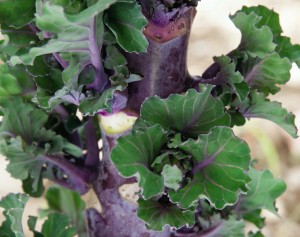
Kalettes are a cross of kale and Brussels sprouts.
Credit: Johnny’s Selected Seeds
A Kalette plant looks and grows like a 3-foot-tall Brussels sprout plant, except instead of producing tight balls all along the stem, it produces open, flower-like clusters of baby green-and-purple kale leaves.
Johnny’s Selected Seeds is introducing seeds of three varieties of this new cross.
Autumn Star (the earliest maturer) and Mistletoe (a mid-range maturer) are the two likeliest to do well in Pennsylvania gardens.
Start seeds in early to mid-May so transplants are ready for the garden June through early July for a fall harvest.
Grafted tomato/potato ‘Ketchup ‘n’ Fries.’ Take a shoot of a young, tasty, red cherry tomato and graft it to a white potato and you get two crops – tomatoes above ground and potatoes below.
This has been a not-so-productive novelty for years, but breeders apparently have perfected the process to create the first commercially available ‘Ketchup ‘n’ Fries’ TomTato, being offered in the 2015 Territorial Seed Co. catalog.
Territorial claims yields of more than 500 cherry tomatoes and nearly 5 pounds of potatoes from a single plant, which is going for the salty price of $20 each. They were a hit in their British debut last year.
Spaghetti squash ‘Small Wonder.’ This is turning out to be the year of multiple new squash introductions, one of which is this spaghetti type that’s the favorite new edible of Erica Shaffer, manager at Highland Gardens in Lower Allen Twp.
“I tried this one last year and was so pleased with the more compact plant,” she says. “But it had all of the production power of a larger space-taking squash. These little squashes were perfect cut in half for a side-dish vegetable with a little butter and some fresh garlic topping.”
Fruits mature in about 80 days after direct-seeding and are 3-pound, gold-orange ovals with creamy-yellow flesh. Available from Park Seed Co., Territorial Seed Co., J.W. Jung Seed Co. and Harris Seeds, among others.
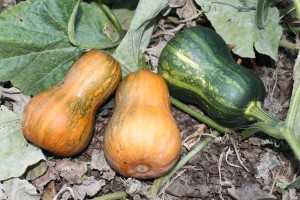
Squash ‘Honeynut’ maturing.
Butternut squash ‘Honeynut’ and ‘Butterscotch.’ These are very similar new and super-sweet varieties of butternut squash with 1- to 2-serving-sized fruits that have tan skins and orange flesh.
‘Honeynut’ is just now becoming widely available, and I grew it for the first time last summer.
The yield was impressive, but the best part was a sweeter flavor than any squash I’ve ever eaten. My wife even made a pie out of two of them, which tasted like a fresh pumpkin pie.
‘Honeynut’ is available from Harris Seeds, Renee’s Garden Seeds, High Mowing Seeds, and John Scheeper’s Kitchen Garden Seeds, among others.
‘Butterscotch’ was bred by Johnny’s Selected Seeds and scored well enough in national trials to earn a 2015 All-America Selections honor.
Besides the sweet flavor and 1¼-pound fruits, the vines are compact (suitable even for container growing), and the plants are resistance to powdery mildew – a common squash-family disease.
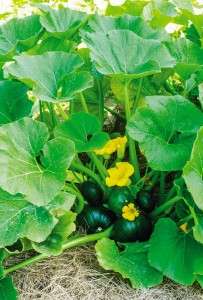
Squash ‘Cupcake.’
Credit: W. Atlee Burpee Co.
Squash ‘Cupcake.’ Yet another squashed improvement is this prolific fruiter with 2- to 5-inch, dark-green, roundish fruits that look a bit like, well, cupcakes.
This W. Atlee Burpee Co. summer-squash exclusive is also a quick producer, offering fruits less than 2 months after direct-seeding.
“The plants are more vining than most summer squash, so fruit sets along each node of the plant,” says Chelsey Fields, Burpee’s vegetable product manager. “This habit grows a tremendous number of fruits and also creates ease of harvest. You aren’t battling to the center of the plant to retrieve fruit.”
Tomato Heirloom Marriage. The twist with this new series from the breeders at PanAmerican Seed is that two top-tasting heirlooms have been crossed to create a hybrid (an “heirloom/hybrid,” if you will) with better yields, earlier-ripening fruits and fewer blemishes than either of the parents.
Genuwine, for example, is an early-maturing red slicer that’s a cross of ‘Costoluto Genovese’ and the taste-test all-star ‘Brandywine.’
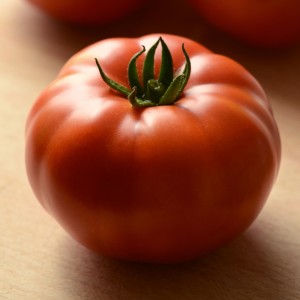
Tomato Happy Marriage ‘Genuwine.’
Credit: National Garden Bureau
Big Brandy is a pink beefsteak type that’s a cross of ‘Big Dwarf’ and ‘Brandywine.’
Perfect Flame is a saladette tomato that’s a cross of ‘Peron’ and ‘Flamme.’
And Jersey Boy is a red slicer marriage of ‘Rutgers’ and ‘Sudduth’s Brandywine.’
I tried two of these last summer and found the flavor was good but the disease resistance was similar to most heirlooms (i.e. not so good).
The Heirloom Marriage line will debut in plant form (no seeds) in garden centers this spring under the Burpee Home Garden label.
Basil ‘Ruby Frills.’ Here’s an edible plant that’s as good-looking as any ornamental.
‘Ruby Frills’ is being introduced as another in the 2015 Burpee Home Garden plant lineup.
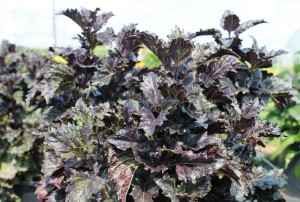
Basil ‘Ruby Frills’ is attractive enough to grow as an ornamental.
You might not even recognize it as a basil because the leaves are larger than most, they’re pointed and frilly in shape (somewhat like a small maple leaf), and most striking of all, the leaf color is a dark plum-purple that’s almost black.
The color adds nice contrast to the vegetable or herb garden, but it’s easily attractive enough to grow in patio pots, where the leaves can be snipped any time you’re doing a dish that calls for basil.
The plant grows about 18 inches tall and develops its darkest color in full sun.
Petite Snap-Greens. If you’re looking for something offbeat, this is a type of pea in which you eat plant parts other than the peas or pea pods.
Johnny’s Selected Seeds is introducing the idea, which is to harvest the tendrils, leaves, flowers and even stems of this pea variety.
The plants produce edible pods, but they’re slow to form and not as heavy-yielding as most other peas on the market.
Petite Snap-Greens is the first introduction from a line being dubbed “Calvin’s Peas,” which are novelties and new varieties being developed by Idaho pea breeder Dr. Calvin Lamborn, the “father of the snap pea” and creator of several All-America-winning snap-pea varieties.
The vines of this one grow 3 feet tall and need little to no support.





Comments