
Garlic
* Common name: Garlic
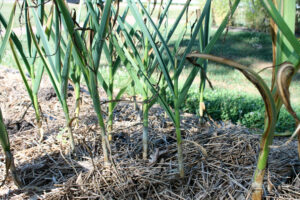
Garlic getting close to harvest.
* Botanical name: Allium sativum
* What it is: Garlic is a flavorful, nutritious, and long-keeping onion-family plant that’s unusual in that it’s best planted in the fall to harvest the following summer.
Individual cloves that are split from golfball-sized bulbs are ideally planted in Pennsylvania in mid to late October. Columbus Day is a good garlic-planting memory guide (as is St. Patrick’s Day for planting peas).
The cloves put down roots and remain dormant underground until spring, when strappy foliage emerges, followed by flowering stalks (scapes) in June.
New bulbs are ready to harvest in early to mid-July.
Stiff-neck or hard-neck garlic grows best in Pennsylvania as opposed to soft-neck types.
It’s best to start with commercially grown bulbs that are disease-free and bred for best garden growth and yield. (Store-bought garlic may not be ideal varieties for Pennsylvania and may have been treated to maximize shelf/storage life at the expense of new growth.)
* Size: Plants grow about 18 inches tall. Space cloves six to eight inches apart.
* Where to use: Garlic is usually grown in vegetable gardens, but there’s no reason you can’t plant a few in any garden, so long as it’s sunny and the soil is well drained. (Garlic cloves can rot in wet clay soil.)
Garlic also can be grown in large pots or half-whiskey barrels.
* Care: Loosen soil and work an inch of compost into it to create slightly raised and improve drainage.
Plant cloves with the pointed end up (root side down) about two inches deep. Cover soil after planting with two to three inches of straw or chopped leaves and soak the ground.
Fertilizer isn’t needed at planting time, and no care is needed over winter, other than watching to make sure freezing and thawing hasn’t “heaved” any of the cloves above the soil line. If that happens, replant, tamp the soil, and make sure the soil is covered with those two or three inches of leaves or straw.
Scatter a balanced, granular, organic fertilizer over the bed in early spring. The flower stalks and buds should be cut off (they’re edible) or snapped over to encourage energy to go into underground bulb development as opposed to flower and scape-top seed production.
Keep the ground consistently moist during the growing season but never soggy, and pull any weeds that try to elbow in.
Your cue to harvest is when the foliage starts to yellow and die back – usually by early to mid-July. Use a shovel to loosen the surrounding soil, then lift up on the plants to remove the bulbs from the ground.
Harvest before the bulbs begin to split apart.
Let the bulbs air-dry in a shaded, rain-free spots for two weeks, then cut off the foliage, clean off dried soil, and the bulbs are ready to store for months.
Keep a few of the biggest bulbs to use in new plantings next October.
It’s best to rotate garlic locations from year to year to limit chance of bugs or disease and to prevent over-use of the same nutrition profile.
* Great partner: Garlic can be planted in its own rows or blocks – no partner needed.
Some gardeners like to scatter garlic, though, throughout different parts of an edible garden because the scent repels most insects and maybe even bunnies.
Others like to maximize production and plant small, fast-maturing crops such as radishes or leaf lettuce among the bulbs in early spring.