
• Home
  • Contact
  • Site Map
George Weigel - Central PA Gardening
  • Landscape 1
  • Landscape 2
  • Landscape 3
  • Landscape 4
  • Garden Drawings
  • Talks & Trips
  • Patriot-News/Pennlive Posts
  • Buy Helpful Info

Navigation

  • Storage Shed (Useful Past Columns)
  • About George
  • Sign Up for George's Free E-Column
  • Plant Profiles
  • Timely Tips
  • George’s Handy Lists
  • George's Friends
  • Photo Galleries
  • Links and Resources
  • Support George’s Efforts


George’s new “50 American Public Gardens You Really Ought to See” e-book steers you to the top gardens to add to your bucket list.

Read More | Order Now


George’s “Survivor Plant List” is a 19-page booklet detailing hundreds of the toughest and highest-performing plants.

Click Here


Has the info here been useful? Support George’s efforts by clicking below.


Looking for other ways to support George?

Click Here

George's Current Ramblings and Readlings

Are You a Crazed Gardener?

September 10th, 2013

   I spent a morning last week with Lower Swatara Twp. uber-gardener Joe Mateer, whom I’m going to write about in an upcoming Patriot-News/Pennlive garden column.

Joe Mateer inspecting his 'Mr. Stripey' tomatoes... before they go in a marked bag, of course.

Joe Mateer inspecting his ‘Mr. Stripey’ tomatoes… before they go in a marked bag, of course.

   Joe told me he liked a column I wrote a while back in which I used the term “crazed gardeners” to refer to the, ah, well, more “avid” colleagues who enjoy working the soil.

   “It seems logical that the next step would be to define whether you qualify as a CGer,” Joe said.

   To save me the trouble, this retired middle-school principal came up with a qualifying exam, which I’m pretty sure is one he passed.

   See if you match up with any of these:

   1.) You buy a 20-kilowatt generator to protect your 1,000-watt pump that runs the koi pond.

   2.) You spend more on mulch than you do on groceries.

   3.) You have one edger to do your sidewalk, another to edge your curb, still another to edge your trees and a fourth for backup.

   4.) You put your tomatoes in marked bags so you can decide which variety tastes best.

   5.) You think it’s a tossup which creature is the most vile in the history of the Earth – a velociraptor or the groundhog.

   6.) The fence you constructed around your garden to keep out the groundhog resembles San Quentin.
Read More »


Sneaky Dry

September 3rd, 2013

   The biggest issue I’ve had in the garden since mid-summer has been the sneaky dryness.

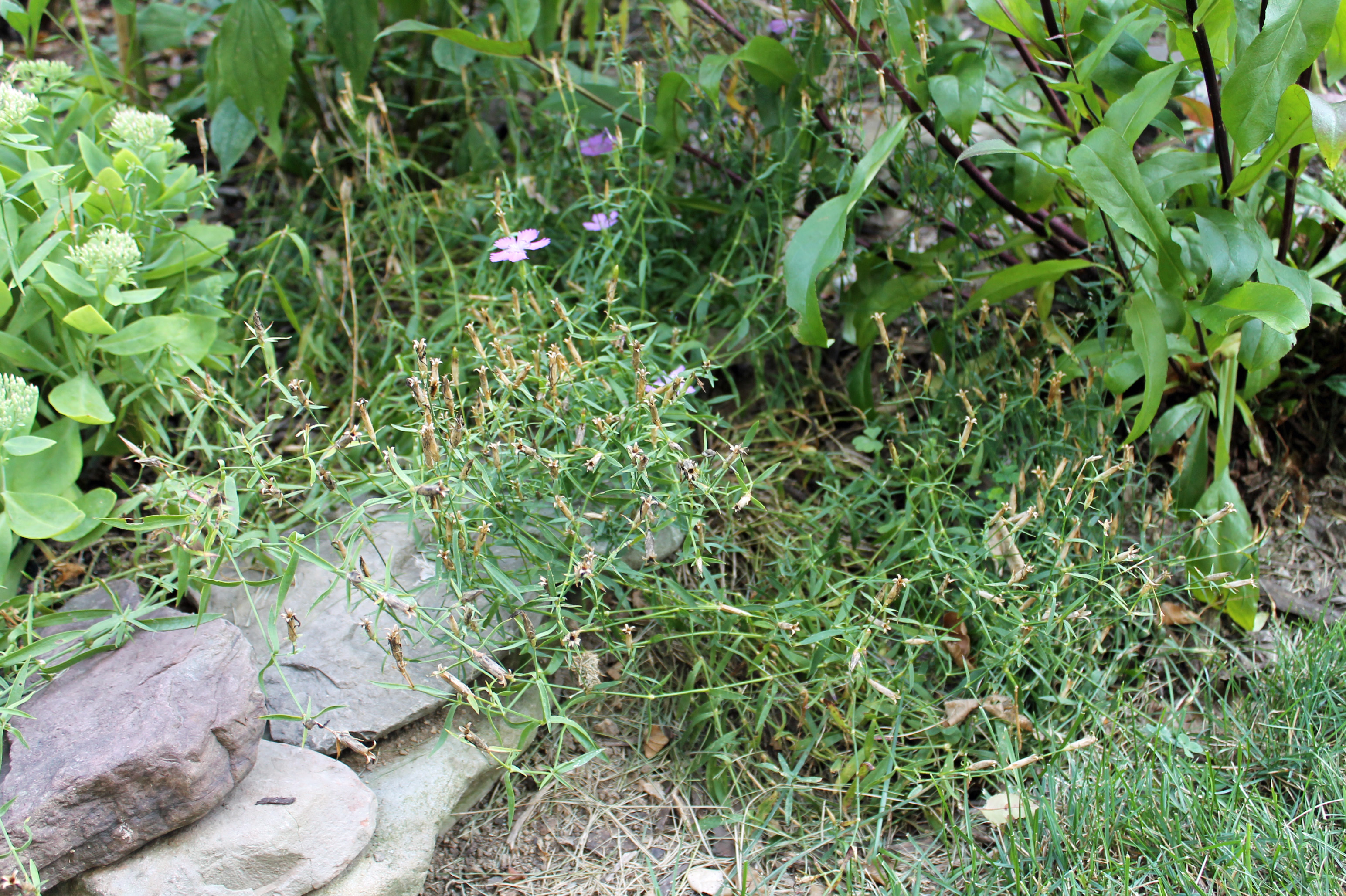
How do you like my annual dianthus in the sneaky dryness?

How do you like my annual dianthus in the sneaky dryness?

   Some years we get weeks of heat, sun and not a drop of rain, and everyone knows it’s dry.

   Plants wilt, the leaf edges of trees and shrubs turn brown, and the lawn goes crunch when you walk on it.

   Hard to miss that.

   But this summer has had a lot of cloudiness, it hasn’t been that brutally hot, and a lot of days have looked like it could rain at any time.

   A fair number of days, it did actually rain a bit.

   No need to water in those conditions, right?

   The fake-out with that kind of weather is that moisture never really does work its way down into the root zone where it can do its magic.

   A trace of rain does nothing more than wet the soil surface or the mulch, making it look like the ground is damper than it really is.

   I was surprised several times last month when I dug down into my soil a few inches down, only to find dust… not much different than those 95-degree Augusts when it doesn’t rain for 3 straight weeks.

   That explains the paltry growth and bloom I’ve seen on a lot of my annual flowers. The ones along my front walk – within the canopy of two large oak trees – are still pretty underwhelming despite two or three sprinklings I’ve given them since July.

Read More »


A Book by George

August 27th, 2013

   Pardon me if I seem a little distracted the rest of this season.

The 2002 version of Pennsylvania Gardener's Guide by Liz Ball.

The 2002 version of Pennsylvania Gardener’s Guide by Liz Ball.

   I just signed a contract to write a plant book for Cool Springs Press, and the manuscript is due by the end of the year.

   The book will be called the Pennsylvania Getting Started Garden Guide, and it’s actually a new version of the Pennsylvania Gardener’s Guide that my eastern-Pa. friend and garden-writer colleague Liz Ball did for Cool Springs in 2002.

   It’s part of a nationwide regional series aimed at helping new gardeners and casual yardeners pick the best plants for their yards.

   I like that approach because plant selection is such a regional thing. What does well in one area might be invasive or bug-prone or wimpy in one another.

   That’s why I sometimes joke that I can’t move because I’d be out of a job in a different growing zone. I’d be back to square one trying to figure out the plants of Florida or New England or whatever.

   The bulk of the Pennsylvania Getting Started Garden Guide will be detailed profiles on the 170 best plants for Pennsylvania landscapes. I get to pick the lineup.

   Each profile gets a full page, including sizes, bloom times, colors, growing tips and specific varieties or cultivars that I think are the best of the best.

   It’s a  bit along the lines of the 18-page plant list that I give to all of my Garden House-Calls clients and that’s available here as a $5.95 download or a $10.95 mailed-out paper copy.

   I’ve also got about 300 plants profiled on the Plant Profiles section of this site, in case you’ve never seen that.

Read More »


Plants As You’ve Never Seen Them

August 20th, 2013

   Plants are objects of great beauty when they’re artfully arranged in a garden and skillfully maintained.

The huge "Mother Earth" Mosaiculture at this summer's Montreal Botanical Garden competition.

The huge “Mother Earth” Mosaiculture at this summer’s Montreal Botanical Garden competition.

   Then there are Mosaicultures. 

  If you’re not familiar with that term or have never seen a Mosaiculture, picture metal frames stuffed with tightly packed potting mix and planted with assorted colorful plants to create a living piece of art.

   A Mosaiculture is somewhat like a topiary, but instead of being an evergreen trimmed into a shape, it’s a creation of living plants limited only by what the plant artist can imagine.

   Some Mosaicultures are so big and impressive that they’re beyond anything you’ve likely seen a plant do.

   The technique isn’t very well known in the United States, but there’s an international competition in Mosaiculture that’s held every 3 years.

   This summer, the competition is taking place in the Montreal Botanical Garden in Canada, where 48 different Mosaicultures are on display until Sept. 29.

   I’m just back from seeing it, and I’d rate it as the most amazing horticultural event I’ve ever seen.

Read More »


Pittsburgh Garden Involved in Big Stink

August 13th, 2013

   Flowers are supposed to smell nice. At least we like them when they do.

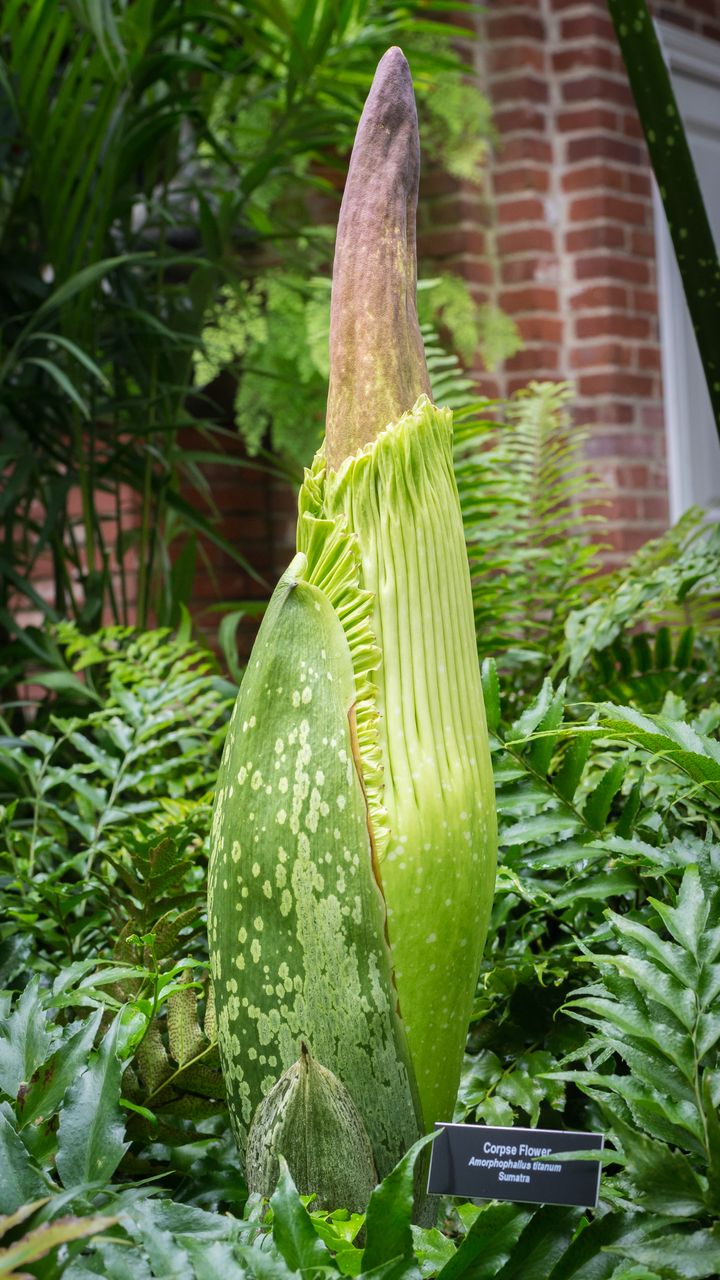
Phipps Conservatory's "Romero" getting ready to bloom. (Credit: Paul g. Wiegman)

Phipps Conservatory’s “Romero” getting ready to bloom. (Credit: Paul g. Wiegman)

   So go figure that the planet’s stinkiest flower – one that smells like rotting flesh – attracts more attention than just about any other botanical experience.   The top-stink honor goes to a fortunately rare plant called the “corpse flower.” Pittsburgh’s Phipps Conservatory happens to have one of them.

   This Indonesian native only flowers maybe once every 6 to 10 years, and Phipps’ specimen is about to put on a reeking good show.

   Sometime late this month, the Phipps’ corpse flower will extend a single appendage upward to roughly 8 feet and then open into an odd sheath-around-a-column flower of flesh-toned crimson.

   That’s when the stink both attracts and repulses legions of fascinated plant-gawkers (not to mention fifth-grade boys).

   When a similar corpse flower opened in July at the U.S. Botanic Garden, some 130,000 visitors came to see it. Another 650,000 viewed it online via a live webstream. Check out time-lapse films of that one opening: http://www.usbg.gov/return-titan and http://www.youtube.com/watch?v=zg28auR8nbI.

   The Phipps folks are expecting a similar attention boost.

   “We plan to stay open until 2 a.m. on the night it blooms since it’s a night-blooming plant and only smells for 12 hours,” says Liz Fetchin, Phipps’ director of marketing and communications. “We want as many people to see it as possible.”

   Phipps already is keeping the stink-anticipating public abreast of the plant’s progress through its web site, Facebook page and Twitter (@PhippsNews or https://twitter.com/PhippsNews).

Read More »


« Older Ramblings and Readlings Newer Ramblings and Readlings »

  • Home
  • Garden House-Calls
  • George's Talks & Trips
  • Disclosure

© 2026 George Weigel | Site designed and programmed by Pittsburgh Web Developer Andy Weigel using WordPress