




The Best New Annual Flowers of 2016
January 19th, 2016
This week it’s time to see what breeders and growers have cooked up in the way of new and interesting annual flowers for 2016.
Here’s a look at some newcomers worth considering as the catalogs roll out and garden centers finalize orders for spring arrivals:

Milkweed ‘Monarch Promise’
Gardening for butterflies is chic these days, and one of the trendiest plants is the milkweed family – the must-have, egg-laying plant for monarchs.
New for 2016 is an annual butterfly milkweed (Asclepias curassavica) that will attract monarchs for breeding and gardeners for its bright flowers and novel variegated leaves.
Kerri Laudig, Ashcombe Farm and Greenhouses’ greenhouse manager, thinks this Hort Couture introduction will grab gardeners’ attention on both fronts and be in hot demand come spring.
Chris Wallen, a grower at the wholesale Quality Greenhouses near Dillsburg, also ranks this as his top annual-flower newcomer.
“It’s an absolutely stunning variegated annual butterfly weed,” he says. “It has green leaves edged in white, blushed with pink, orange and red. The flowers are bright orange-red on top of 2- to 3-foot-tall plants.”
‘Monarch Promise’ does well in heat and sun and isn’t usually bothered by deer or rabbits. It may get aphids, though, which are typically temporary and a sign that the plant hasn’t been sprayed (which monarch caterpillars appreciate).
Salvia ‘Black and Bloom’
The predecessor to this – salvia ‘Black and Blue’ – is a hummingbird magnet. The little buzzers love the pollen inside the tubular flowers as much as gardeners adore the two-tone dark blue flowers with black bases.
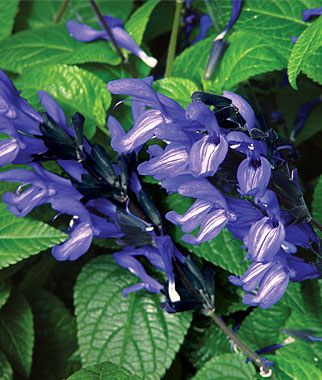
Salvia ‘Black and Bloom’
‘Black and Bloom’ is an improved version with bigger blooms, thicker leaves and blacker stems that’s likely to displace ‘Black and Blue,’ which is starting to suffer from viral problems anyway.
“It’s a powerhouse of bloom from late spring to early fall,” says Steve Norman, director of merchandise for Stauffers of Kissel Hill Garden Centers, which plans to carry ‘Black and Bloom’ in 2016.
As with ‘Black and Blue,’ ‘Black and Bloom’ grows about 3 feet tall and is very heat-, drought-, bug- and animal-resistant. It blooms best in full sun, either in pots or in the ground, and overwinters in a pot stored in an unheated garage.
Digiplexis Illumination Flame
One of the showiest and most unusual newcomers is this new species, created by England’s Thompson and Morgan seed company by crossing digitalis (foxglove) with isoplexis (a colorful cousin native to the Spanish Canary Islands).
The flower spikes on this 3-foot-tall 2015 American Garden Award-winner literally glow in a blend of colors – primarily red, hot fuchsia, orange and yellow.
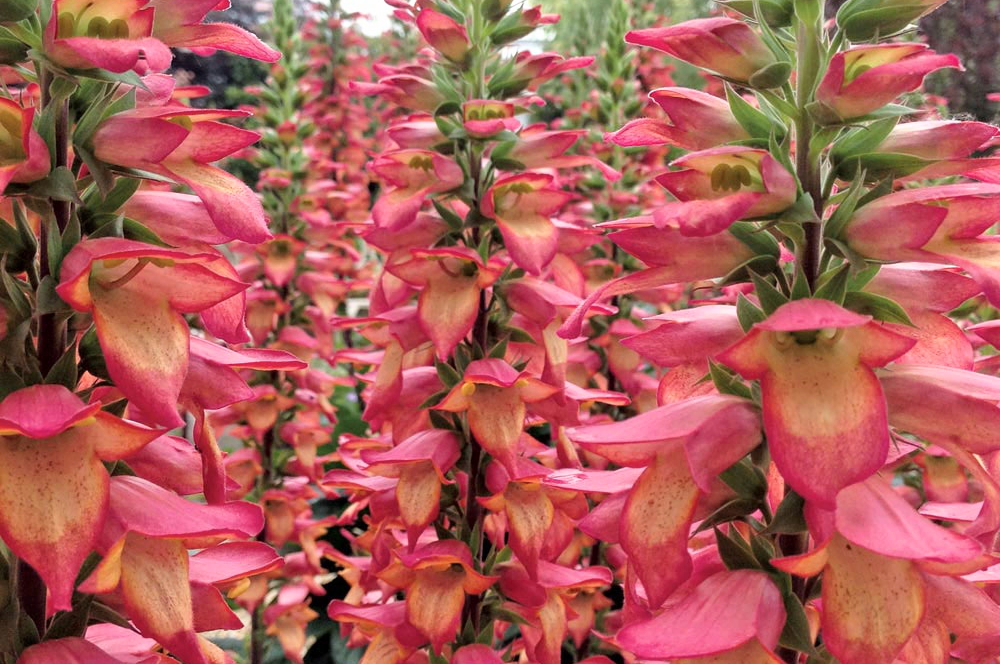
Digiplexis Illumination Flame
Credit: American Garden Awards
Illumination Flame debuted in limited quantities last year but should be more widely available in garden centers this spring since it’s been turning so many heads.
A bed of them looked great on HACC’s Harrisburg campus last summer, but they’ll also perform superbly as the centerpiece in a sunny flower pot.
You might also run into an even newer digiplexis called ‘Berry Canary,’ which blooms hot pink with creamy yellow throats.
Note: Like its parent foxglove, digiplexis is toxic if eaten, so take that into account if you have pets or small children.
Petchoa SuperCal Cherry Improved
Petchoas are crosses between petunias and calibrachoas and look a lot like petunias with smaller flowers.
Sinclair Adam sees a ton of annuals as director and evaluator at Penn State’s Trial Gardens in Lancaster County, but this particular choice turned his head more than any other in the 2015 trials.
Adam says petchoa SuperCal Cherry Improved “bloomed their heads off all season. It was a very good performer. We had some trouble with alternaria (disease), but that guy had no trouble with it.”
SuperCal Cherry Improved grows about a foot tall and stretches out about 2 feet in a mass of cherry-red tubular flowers from planting until frost.
Petunia Tidal Wave Red Velour
This petunia is a blooming machine that climbs and sprawls if you give it something to grab onto.
Winner of a 2016 All-America Selections award, Tidal Wave Red Velour has deep-red, velvety flowers (and lots of them) that keep going all summer until frost finally takes them down.
Katie Rotella of Ball Horticultural Co., which grows the Wave petunia line, says Red Velour has “fabulous and stunning color. It’s also a vigorous spreading petunia that rarely needs deadheading. New blooms continuously pop up to cover the old, spent blooms. It quickly covers a large area beautifully.”
I test-grew these last year and was impressed at the flower power and vigor as mine climbed up and intertwined with the blooms of a dwarf panicle hydrangea and a reblooming weigela.
Give Red Velour ample sun, plant them 2 feet apart, and fertilize as often as weekly to maximize bloom.
Caladium Painted Frog series
Colorful, tropical-looking and elephant-ear-shaped leaves are the main attraction of this new three-plant series whose name was inspired by the showy coloration of tree frogs.
Angela Treadwell-Palmer, co-owner of Plants Nouveau, the company introducing these caladiums, says they’re also more sun-tolerant than most caladiums.
“The Painted Frog series is at its best in partial sun, opening new possibilities for use in the garden and mixed containers,” she says. “They have huge potential for decorating, combined with begonias, ferns and other shade-loving plants for the perfect texture combination.”
The series has three varieties: ‘Poison Dart Frog,’ which has glossy green leaves with rosy-pink splotches; ‘Red-Bellied Tree Frog,’ which has waxy blackish-red leaves with green perimeters, and ‘Tie-Dyed Tree Frog,’ which has green and white mottled foliage.
Figure on plants that grow 18 to 24 inches tall.
Zinnia ‘Zinderella Peach’
You might not even recognize that this new flower is a zinnia with its blend of flower shapes – some single-petaled, some double-petaled, and some in between.
Andrea LaBonte of Maine-based Johnny’s Selected Seeds, which is introducing seeds of ‘Zinderella Peach,’ calls it a “novelty zinnia with scabiosa-type blooms.”
The color is also unusual – sort of a salmon hue with cream-to-rose petals and a dark eye.
Plants grow about 4 feet tall, do best in full sun, and start churning out the showy flowers about 80 to 90 days after the seeds are up.
Vinca Soiree ‘Kawaii Pink’
Annual vincas are some of the best performers in the hottest, sunniest spots, and this one is no slouch in that department.
But what caught my eye about this one out of the massed hundreds of different flowers in last summer’s Penn State Trial Gardens in Lancaster County was the dainty blooms.
The whole Soiree series has what are being called “microblooms” for the narrower, star-patterned petals that give vinca a new look.
I liked ‘Kawaii Pink’ best for its glowing pink color. You won’t go wrong with any of the five colors in the Soiree series.
The foliage is glossy and dark green, and the plants grow a compact 10 inches tall.
Verbena Meteor Shower
Plant geeks know and love the tall, wispy Verbena bonariensis, a 3-foot-tall violet-blooming annual that sometimes doesn’t know when to quit seeding around.
Proven Winners’ breeders went to work and managed to come up with this new introduction, which is not only sterile (non-seeding) but more compact.
Meteor Shower tops out at a more compact 2 feet tall and has the same violet-hued flowers, only more of them than the original species.
Even though it’s not a native flower, bees and hummingbirds like it.
Angelonia Archangel ‘Dark Rose’
If you haven’t tried the orchid-looking angelonia yet, this would be a good choice for starters.
The Archangel series has been one of the best-performing types at Penn State’s Trial Gardens, and ‘Dark Rose’ was one of the highest scoring flowers of any kind last summer.
As the name implies, the spiky foot-tall flowers are rich, deep rose. It’s also a very heavy and tireless bloomer and does well in heat, drought and sun to boot.
Archangel ‘Raspberry Improved’ (pinkish-lavender) also scored very well in the 2015 Penn State trials.



Comments