

Season of Disease’n
July 28th, 2015
As gardeners, we’re required to complain about the weather, you know. It’s always too much or too little of something, and this year it’s the excessive raininess and humidity leading to all kinds of plant disease (not to mention incessant weed-sprouting).
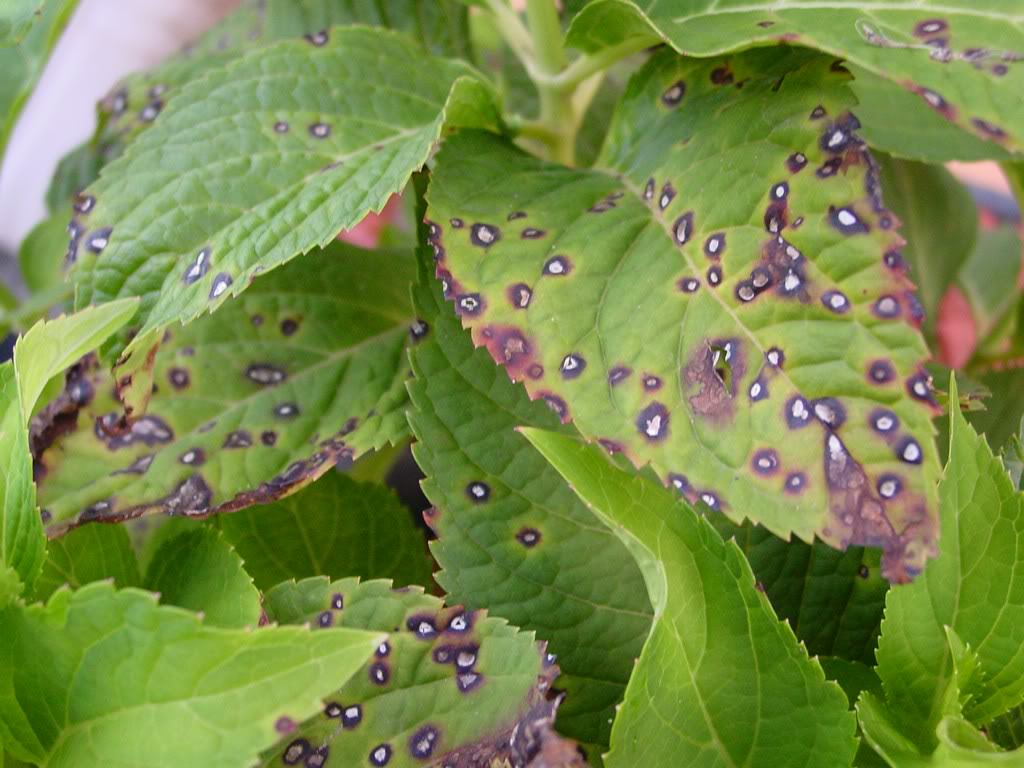
Leaf spotting is usually a fungal problem fueled by wet or humid weather.
Up in Halifax, Cheryl and Paul Fulk already have lost a couple of their competition huge pumpkins to rot.
Over in Lower Swatara Twp., Joe Mateer lost his whole set of tomatoes in a matter of days to blight.
And I’m seeing a profusion of moisture-fueled plant issues ranging from powdery mildew on heliopsis to leaf spotting on pear trees to assorted mushroom fungi popping up in lawns.
As Penn State University plant pathologist Dr. Gary Moorman once told me, a wet year is a good year for a plant pathologist: “You never want to see a plant pathologist smiling.”
I think plant pathologists are smiling a lot these days.
Three conditions are needed to kick plant disease into high gear.
One is a plant that’s susceptible to a particular disease.
Second is the presence of a disease organism (pathogen) to infect the plant.
And the third is weather and environmental conditions that favor the pathogen’s growth.
A lot of yards have hit that trifecta this year.
This raises three questions for home gardeners.
1.) “Will this disease kill my plant?”
2.) “Will it spread all over the yard?”
3.) “And, should I do something about it?”
Unfortunately, there’s no blanket answer since some diseases are mainly cosmetic and ignorable while others might kill plants if not treated.
The key is getting an accurate diagnosis in the first place. (See below for more on that.)
Sick plants are even harder to diagnose than sick people because plants can’t tell you where it hurts or what was going on when the trouble started.
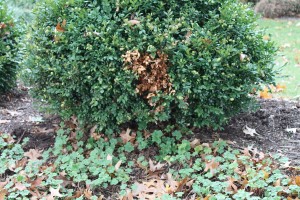
Disease on this boxwood? Not quite. This brown spot is from a dog peeing on the bush.
It’s not any easier sorting out whether a problem is truly disease or damage left behind by bugs or mites or by direct damage from weather or even collateral damage from herbicide spray drift.
Once you nail down the disease and decide that action is needed, treatment isn’t particularly easy either.
The Catch-22 of disease control is that fungicide sprays work best as preventatives. They don’t cure disease so much as protect uninfected leaves from infection.
Apply them after full-blown, raging disease is under way and at best they just slow or prevent additional damage. Apply fungicides “just in case” and it’s expensive, time-consuming and potentially wasteful and polluting.
Also critical: picking a spray that’s effective against the disease you have. Not all fungicides control all fungal diseases, and not all diseases are caused by fungi in the first place. Fungicides are useless against bacteria and viruses.
If there’s any bright side, it’s that most plants will bounce back from most diseases.
That powdery mildew on the heliopsis, beebalm, phlox and lilac, for example, might look nasty, but plants generally grow through the setback to bloom again another year.
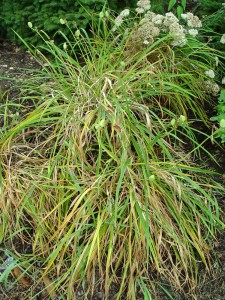
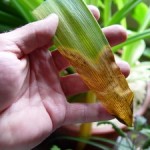
This diseased daylily (leaf streak) can be cut to the ground, and it’ll regrow new foliage.
Likewise, daylilies with leaf streak can be cut back even to the ground in mid-summer, and they’ll just send up a fresh new set of leaves in a few weeks.
Another plus is that most diseases are plant-specific. They target only certain plants.
That means there’s no need to worry that the whole landscape will rot away just because one or two plant types are diseased.
Short of spraying, gardeners can take several cultural steps to deal with disease.
If you can catch a problem early and pick off the diseased leaves, that can slow a disease’s progression almost as well as a fungicide.
Clearing the garden of fallen, diseased leaves takes away potential for spores to overwinter in the soil and reinfect plants the following year.
And when you do have to water, water the ground and not over top of the leaves. Or at least water early in the morning instead of before dark; leaves will dry faster in the morning.
A few other anti-disease cultural aids:
1.) Give plants room to grow. Leaves can dry out faster when they’re not crowded.
2.) Prune to thin out overly dense growth. Adequate air flow through a bush or tree also allows leaves to dry out faster.
3.) Control bugs. Some of them spread disease from plant to plant, such as the cucumber beetle that’s been spreading bacterial wilt that’s been killing cucumbers lately.
4.) Keep plants healthy. Plant them in good soil, match their needs to the site, and keep fertilizer at adequate levels. Like people, stressed plants don’t fight off disease as well.
5.) Seek disease-resistant varieties. Some plants seldom get any disease, while some varieties of certain plants are more prone to disease than their cousins. Spend time on homework up front to save spraying later. See my Plant Profiles page for more than 300 of my favorites, or order my “Pennsylvania Getting Started Garden Guide” or “George’s Survivor Plants for Central Pennsylvania” for more local plant-picking help.
6.) Check your plants when you see a plant pathologist smiling.
Some help sources for diagnosing plant disease:
County Extension offices. Most have Master Gardeners and educators who can diagnose problems and suggest treatments. Find your county’s office on the PSU Extension website.
Garden centers. Some, if not most, have staffers who can diagnose problems and recommend solutions. Take a cutting or leaf sample.
Penn State Plant Disease Clinic. Samples can be sent to Penn State University’s plant disease lab, which sends a report back. It’s free for Pennsylvania home gardeners.
Disease fact sheets. Penn State’s plant pathology department has a lineup of fact sheets on various landscape-plant diseases.
Diagnostic web sites. One of the best interactive sites that lets you zero in on exact problems and decide what to do is the University of Maryland’s Landscape Problem Solver. It’s free.
A diagnosis self-help book. “What’s Wrong With My Plant?” by David Deardorff and Kathryn Wadsworth (Timber Press, 2009, $24.95) is an excellent book with sketches, photos and an elaborate but easy-to-use key system that helps you nail down a problem.


George,
Great article! I was just thinking yesterday about how GOOD my garden looks this year DESPITE all the rain and humidity we’ve had! I think of all your points above, #1, #4, and #5 have helped me the most. Giving plants ample room to grow and mature is key - I have to work hard to resist adding “just on more” plant every time I stop by a nursery!! I’ve also worked to keep the soil and plants well fed, boosting their natural disease-fighting capabilities. I use Miracle Grow in the early spring, the organic Plant/Rose/Holly Tone in the late spring/early summer, and Super Thrive right now. The beds have been well mulched with shredded bark mulch, competing weeds have been pulled out, and the plants’ watering needs have been met. For me, the presence of fungal diseases this year has been minimal.
Regarding selecting disease-resistant varieties, I fully agree that doing your homework (or asking a knowledgeable friend/neighbor) can save much time for you in the future. For instance, I’ve only added roses that have a decent level of disease resistance - in my yard, I’ve found ‘Double Delight’ ‘Veteran’s Honor’, ‘Apricot Nectar’, ‘Sunsprite’, ‘Christopher Marlowe’, and the red and scarlet varieties of the ‘Flower Carpet’ roses to be some of the best, with minimal black spot on their leaves. ‘Voodoo’ and ‘Iceberg’ have been okay, but are showing a bit more black spot on their leaves than the others. None of these rose varieties has any powdery mildew on them. Due to lack of time, I have not been spraying my roses this year with fungicide.
For the crape myrtles, I’ve chosen ones based on winter-hardiness AND powdery mildew resistance - ‘Muskogee’, ‘Sarah’s Favorite’, ‘Tonto’, ‘Hopi’, ‘Acoma’, and ‘Dynamite’ are among the ones doing really well in my yard.
On the bright side, this warm weather, high humidity, and ample precipitation has been a PLUS for the more “southern” species in my garden - the palms (windmill, needle, and saw palmetto), bananas (Musa basjoo/Japanese fiber banana), gardenias (winter-hardy varieties - ‘Crown Jewel’, ‘Frost Proof’, and ‘Double Mint’ and non-hardy/tropical ones - ‘Mystery’), camellias (winter-hardy varieties - ‘Korean Red’, ‘April Remembered’, and ‘Winter’s Star’), agapanthus/Nile lily (the winter-hardy ‘MidKnight Blue’), hardy hibiscus, common edible fig (‘Celeste’), and oleander (a large, potted pink one that comes inside over the winter) have all been growing like mad, are covered in flower/growth buds, and have absolutely no fungal diseases whatsoever! Of course, their “attention” time comes when I have to “protect” them from our usual January and February cold weather…
Thanks for the feedback… and for the assurance that there are gardeners out there growing a whole lot of different plants and doing well at it.
You’ve figured out the “secrets” to good gardening, which aren’t really secrets at all. They’re just good common-sense techniques that anyone can learn and put to use. It just takes experience and some motivation to get out there and try.
Keep up the great gardening!