


A “Meadow” of Annual Flowers
July 13th, 2013
Some gardeners like the riot of free-range color that comes from a meadow or a loosely planned perennial-flower garden.
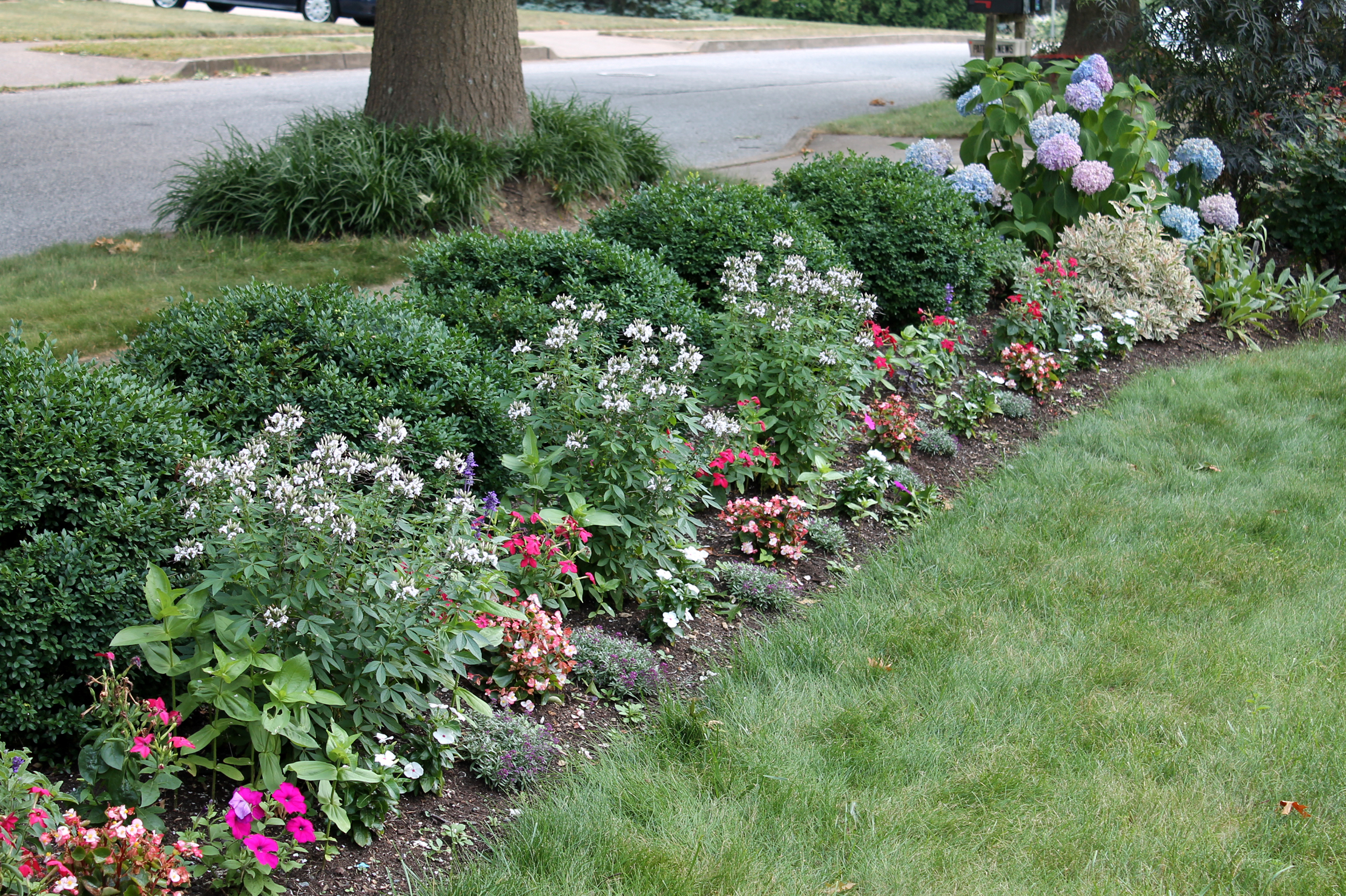
My front bed of annuals, planted in a sort of “meadow” way.
Others prefer their flowers lined up to measuring-tape precision.
Neither way is “right” or “wrong.” After all, beauty is in the eye of the planter, and since it’s your yard and your flower budget, you get to decide.
One thing I’ve noticed, though, is that when it comes to annual flowers – the ones you plant each spring and yank each fall – order almost always prevails.
Annuals tend to get planted in singular lines or neat, small pockets here and there.
Usually, it’s one type per garden – say, red geraniums or pink petunias or yellow marigolds.
Mixing and matching isn’t common.
Actually, annuals aren’t common in any quantity in any way these days.
The first reason I hear is that it’s a lot of work replanting them every year.
Then you have to water them, fertilize them, sometimes deadhead spent blooms and finally yank them after frost each fall – and that’s all assuming the rabbits don’t eat them right off the bat.
Cost is another drawback.
The best performers – and there really are lots of better-than-ever varieties these days – sell in 4- to 6-inch pots for $3 to $7 per plant. Here’s a list of some of my favorites.
If you’re trying to fill a yard or garden with those, you’ll rack up a hefty bill in no time.
Both of those explain why for the most part, the trend has been to get annual color by spotting annuals in a few well placed pots.
You need fewer plants, the care is easier (mainly watering) and even a couple of splashy pots add impact to an otherwise blah front patio or back deck.
But let’s assume you’d like to do more.
I’ve been experimenting with a look that gives my front yard plenty of annual color but without the big budget of a trunkload of $4 New Guinea impatiens.
I call it my “meadow-annual” look, and it involves interplanting a mix of about 8 to 10 different annual-flower varieties.
A few of them are the pricey divas. But most are the much cheaper 4-packs and 6-packs as well as two or three varieties that I direct-seed.
The result is a 24-foot front border that gives me color all summer long at a fraction of the cost of a traditional mass planting.
Mass planting goes back to Victorian times when gardeners would plant “ribbon beds” of one kind of annual. Or they’d pair two or more masses so long as they were planted in patterns and color-coordinated.
It’s an impressive approach and is hard to beat for eye-popping impact.
I have to admit I like the look. I’m not as fond of the garden where everything is doing its own thing, kind of like an orchestra without a conductor or sheet music.
Yet I do like the variety and season-long color of a meadow garden or English cottage-style garden.
The compromise that works for me is an orderly meadow-annual garden, if there is such a thing.
Rather than plant randomly, I plant the 8 to 10 different varieties in repeating patterns along the 24 feet.
It helps that I’m starting off with a backdrop of seven dwarf boxwoods planted 3 feet apart. That gives order or “rhythm” to the garden, much like the beat of a bass drum.
I start by placing one particular annual, say, a frilly dwarf cleome or spiky blue salvia, in front of each boxwood.
Then in the gaps between, I’ll put together a grouping of two or three annuals that look good with one another. Each end gets capped with a repeated combo, too.
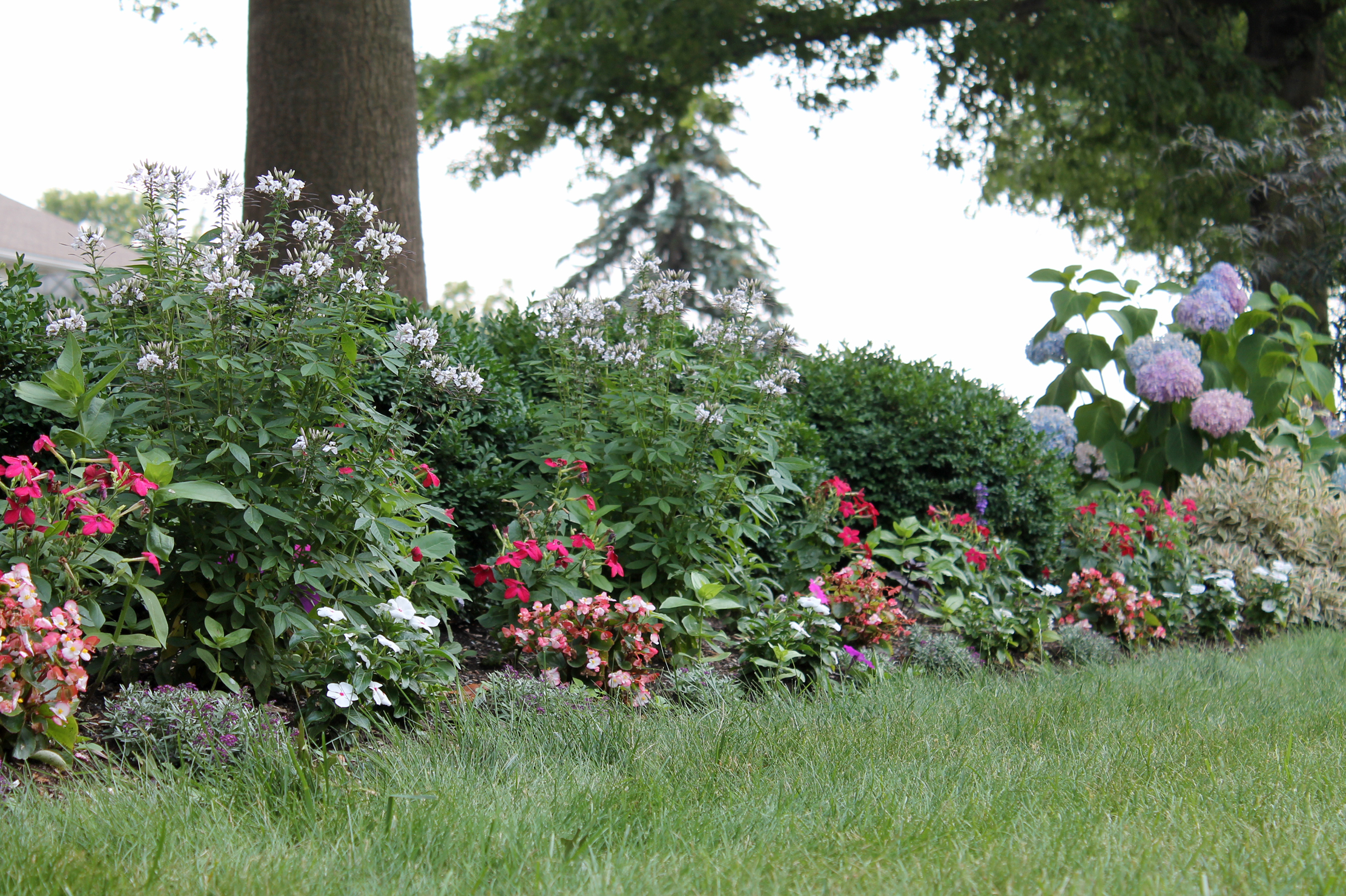
Put together combos and repeat them.
Combo example 1: direct-seed taller rosy-pink zinnias behind a combination of shorter purple alyssum and white petunias.
Combo example 2: direct-seed pink cosmos behind dwarf white angelonia and rosy-pink wax begonias.
Combo example 3: plant lime-white nicotiana (flowering tobacco) behind purple verbena and pink vinca.
I use each combo in at least two gaps for orderliness, but if you’re a little farther down the meadow continuum than I am, plant a different combo at each gap or at equal distances throughout your garden.
If you’re closer to the precision end, pick just one combo and repeat it throughout.
Combinations are almost limitless, given the plentiful choices on the garden-center plant benches and seed racks.
Try to vary your textures, coordinate your colors and plant taller choices behind the shorter ones.
Read the plant tags and hold up candidates next to one another at the garden center before deciding, if you’re not familiar with what does what.
This system lets you change the look of your garden each season.
It also lets you take advantage of sale prices, especially later in spring when garden centers are marking down annual packs but only have a few of this and a few of that left.
Most important, it hedges your bet against things that go wrong in the garden.
Many a gardener learned that lesson last year with the new downy mildew disease that suddenly came along and killed off impatiens. Previously a bullet-proof shade annual, impatiens were often planted in those singular masses.
When you plant a garden of 8 or 10 different annuals, something may eat or kill one or a few of them, but it’s unlikely something will go wrong with every last one.
After a few years of experimenting, you should find out which ones work for you and which don’t.
Then do your mixes out of those survivors.
Br’er Rabbit then will have to find another yard for his favorite dishes.
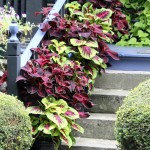
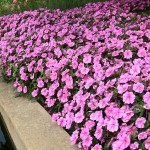
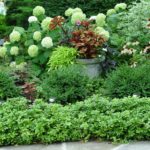

I love your front annual garden for two reasons. First, it’s beautiful and second, it “validated” my own approach to a new back border that we created this year by digging forward from a row of trees and edging the whole thing. I started with a centerpiece of a large merlot-colored dahlia and then created each side with different annuals in colors that mirrored each side. For example, put orange zinnias to the left with orange marigolds to the right; yellow marigolds to the left with yellow strawflowers to the right. Following the plan, used purple salvias, vivid pinks, and some small mixed dahlias on each side. The whole thing was accented with low multi-colored coleus in front that tied everything together. Left “anchor” is a small knockout rose and the right is some large colorful pots. Background is a long row of dutch iris which, even after bloom finished, left a nice tall row of high foliage separating the garden from the trees. Bought everything on sale and spent under $100, including the rose and some soil. The result is a wildly colorful garden that still has a sense of order. Can’t wait to do all over again next year! Thanks for wonderful articles that offer great advice.
Hi Susan,
Sounds beautiful… and even nicely color-coordinated! More important, it sounds like you had a grand time doing it. I think you’re one of those gardeners who doesn’t “work” in the garden… you “play” in it. Enjoy the blooms.
George
You’re absolutely right, George. That’s why I call the backyard my playground!
I second the motion George! Normally I would plant several flats of various Impatiens along my 30 foot back patio bed here in the Hershey “forest” and be done but the blight took care of that this year. So I got various 6 packs of small Begonias, Coleus, Ligularia (a perrenial)and most importantly large Begonia bulbs as well as Calladium bulbs. The bulbs allow me to get the large, “showy” plant at a much more resonable price. The result is the best display we have had. I am sure I will plant Impatiens again when the blight allows but they will have to share the garden from now on. And by the way, you, George, are a Central Pennsylvania treasure.
John,
Sounds really nice. Those are excellent impatiens-alternate shade plants.
Thanks for the compliment. Treasure? Come to think of it, I do feel buried a lot of days…
George
There are many trees dying in Susquehanna twp and lower Paxton twp. Do you have any idea what is happening? There are several types of trees such as sumac and maples. Most of them seem to be along the roads rather than in yards.
Cecelia,
I hadn’t noticed and also haven’t heard anything in particular that’s going on with trees – other than the diebacks from our usual array of pests, erratic weather and lousy soil.
I ran it by Annette MaCoy, the Master Gardener coordinator and Extension educator in Cumberland County, and she said the main woe she’s aware of is leafminer attacks on roadside black locusts and several other species.
“The larvae of these beetles form mines in the foliage, which turns them brown,” she explains. “The adults feed on black locust foliage, skeletonizing it also. And the adult beetles will also feed on other trees, such as oak, birch, beech, cherry, apple, elm, and hawthorn… I guess if they run out of locust leaves to feed on.
“I had a sample of skeletonized pin oak that someone brought in the other day with locust leafminer beetle adults on it. There are two generations per year, so this is the second adult generation that will overwinter. The damage is mostly cosmetic. The trees will leaf out just fine next spring.
“The other possibility, for smaller trees and shrubs, such as sumac growing along roadways, is contact herbicides that might’ve been sprayed along the roads,” MaCoy says. “I’m seeing that also.”
George,
Thank you for your response to my tree question. My friends and I appreciate it and will watch to see if we see any other signs.
I am also the librarian at the Harrisburg Area Civic Garden Center and appreciate your wonderful donation of books a couple of months ago. They were more updated than many that we have and gave me the opportunity to clean out some of our old ones. Our library is open Tuesday through Friday from 10:00 a.m. to 1:00 p.m. and it would be nice to see more people use it. Cecilia Sevon