

• Home
  • Contact
  • Site Map
George Weigel - Central PA Gardening
  • Landscape 1
  • Landscape 2
  • Landscape 3
  • Landscape 4
  • Garden Drawings
  • Talks & Trips
  • Patriot-News/Pennlive Posts
  • Buy Helpful Info

Navigation

  • Storage Shed (Useful Past Columns)
  • About George
  • Sign Up for George's Free E-Column
  • Plant Profiles
  • Timely Tips
  • George’s Handy Lists
  • George's Friends
  • Photo Galleries
  • Links and Resources
  • Support George’s Efforts


George’s new “50 American Public Gardens You Really Ought to See” e-book steers you to the top gardens to add to your bucket list.

Read More | Order Now


George’s “Survivor Plant List” is a 19-page booklet detailing hundreds of the toughest and highest-performing plants.

Click Here


Has the info here been useful? Support George’s efforts by clicking below.


Looking for other ways to support George?

Click Here

George's Current Ramblings and Readlings

Those Browning Houseplants

January 21st, 2014

   This is the time of year when forced-inside gardeners look at their houseplants and get frustrated at how so many of them seem to turn brown around the leaf tips and edges.
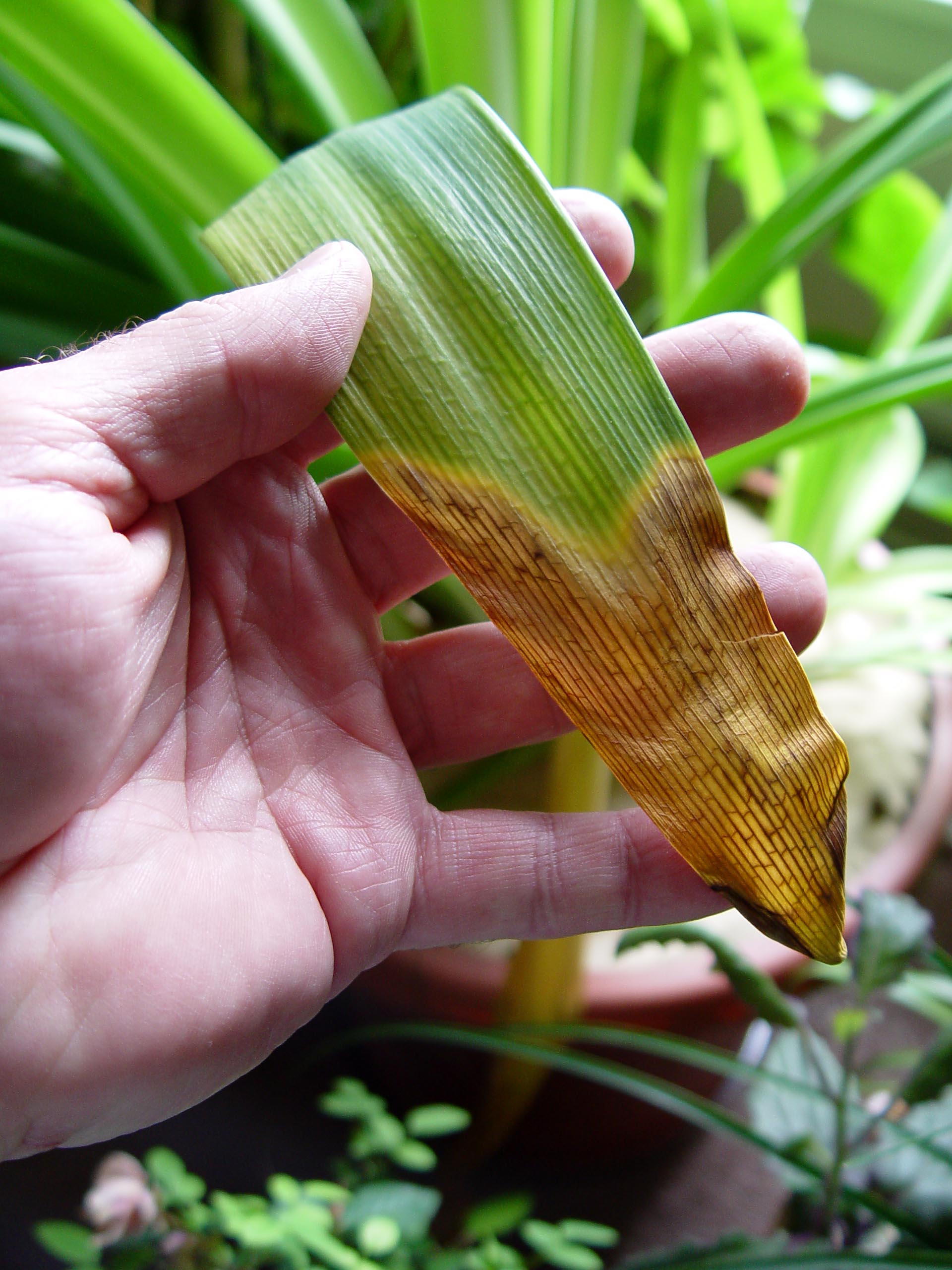
Browning leaf tips that's common in houseplants.

Browning leaf tips that’s common in houseplants.

   Most people chalk it up to their own “brown thumb” or to some mysterious secret that they haven’t yet figured out.

   Usually, it’s a matter of two very basic and fixable issues – water and soil.

   Simple lack of water is often the main reason those leaf tips dry and die. Go away or forget to water for a couple of weeks, and that’s enough for root death to start.

   Compound that with the usual dry winter air in our heated houses, and the conditions are a far cry from the humid tropics that most houseplant species call home.

   Yet a lot of people swear they water regularly and still see that infernal tip browning.

   That’s entirely possible, too… for two main reasons.

   One is if you water so much that roots are rotting, the roots die, leaving fewer to take up water even when the soil is adequately damp.

   The other is the quality of the water, which can relate back to the soil.

   Many homes have water softeners, which typically use sodium to counteract the calcium that makes our water “hard.”

Read More »


T’was the Gardener Before Christmas

December 24th, 2013

   I can’t even begin to guess how many people I’ve written about in 35 years of newspapering.

The Mateers' backyard labyrinth.

The Mateers’ backyard labyrinth.

   One of them was Joe Mateer, an uber-gardener from Lower Swatara Twp., whom I profiled along with his wife, Norma, earlier this year after they built a humongous labyrinth in their back yard.

  So far as I can remember (which isn’t very far these days, thanks to a rapidly aging brain), none of my subjects has ever turned the tables and written about me.

   Until now. After being driven inside by lousy weather, Joe diverted his time into composing a Christmas poem involving yours truly.

   I was surprised, touched and humored – all at once.

   He obviously put some thought into it, too. Either that or he’s been sniffing the compost again.

   For your Christmas amusement, I thought I’d share Joe’s Georgian composition. Here you go:

Read More »


Apples for Christmas

December 17th, 2013

   It’s incredible what you can do with 18,540 apples.

Longwood's floating apple tapestry.

Longwood’s floating apple tapestry.

   If you’re Longwood Gardens and have a marble ballroom floor the size of a basketball court, you can make a “floating apple tapestry” out of them.

   I’d never seen anything quite like it before last week, and if you haven’t either (but would like to), you’ve got until Jan. 12.

   The apple tapestry is the highlight of this year’s A Longwood Christmas, the 1,050-acre garden’s annual holiday extravaganza.

   The display starts with a plywood pattern that you can’t see. It’s fitted with a 6-inch-high fence in a tapestry pattern and laid on the marble floor, now obscured by apples.

    Four Longwood gardeners then spent a day laying red ‘Rome’ apples inside the fence and green ‘Granny Smith’ apples outside the fence to create a tapestry pattern.

   A short Plexiglas fence surrounds the perimeter in a rectangular form to keep the ‘Granny Smiths’ contained.

   The last step was flooding the floor with 4 inches of water to make the apples float.

   The result? A red and green tapestry of floating apples.

   You never know for sure what’s going to happen when you try something novel like this. It’s even an adventure for folks of Longwood caliber.

Read More »


A Nice Little House

December 10th, 2013

   What does a bachelor need with 43 bathrooms?

The front of North Carolina's Biltmore House.

The front of North Carolina’s Biltmore House.

   If your name is Vanderbilt, and your house adds up to 4 acres of inside floor space, I guess you can make an argument for that many.

   The house I’m talking about is the Biltmore House, America’s largest privately owned house and the “little mountain escape” that George Washington Vanderbilt built in the late 1800s near Asheville, N.C.

   I’m just back from leading a 3-day trip there with a busload of mid-staters to see the place decorated for Christmas.

   You want a decorating inferiority complex? Compare your 6-foot tree and homemade wreath to Biltmore’s miles of garland, thousand poinsettias (changed out every few weeks), 65 wreath-adorned fireplaces and 56 decorated live Christmas trees.

   The coup de grace is the 40-foot Fraser fir that towers over the home’s main banquet hall. It’s also changed out midway through Biltmore’s Christmas season, which runs Nov. 1 to Jan. 2.

   More awesome to me is the view of the Blue Ridge Mountains out the back of the house. This mountain range really does glow a powdery blue, the result of volatile organic compounds off-gassing from the mountain’s evergreens (mostly spruce and fir).

   Biltmore also has about 4 acres of formal gardens down a terraced slope to the left of the home’s estate grounds. (It’s too grand to call it the “side yard.”)

Read More »


Making Sense of Seeds

December 3rd, 2013

   The annual rite of seed catalogs used to be a mainly right-after-Christmas thing, but like everything else, the timetable keeps moving up.

The Pinetree Garden Seeds catalog -- first out of the 2014 gate.

The Pinetree Garden Seeds catalog — first out of the 2014 gate.

   The mainstream supply of them now arrives before Christmas.

   At least paper catalogs are still around, although I don’t get as many as I used to.

   I do some variety-snooping online, but it doesn’t come close to sitting in a comfy chair and leafing through page after page of alluring veggies in their glorious glossiness.

   Trying to figure out where to buy what can get confusing fast, not to mention the fact that seed-buying has become more of a moral/ethical/political matter than it used to be.

   One controversy is the hybrid-vs.-heirloom question.

   Most of the varieties in traditional catalogs are hybrids, the result of breeding or selecting offspring of two different parents to come up with superior traits.

   Lately, there’s been renewed interest in open-pollinated and heirloom varieties. Open-pollinated seed comes from plants that are pollinated naturally (i.e. wind and insects), while heirlooms are open-pollinated varieties that have been around for at least 50 years (or prior to 1951 or World War II or just by virtue of being open-pollinated, by alternate definitions).

   With open-pollinated and heirloom varieties, you can save the seed and get pretty close to the same plant. With hybrids, the saved seed reverts back to the parents or usually something noticeably different from the original hybrid – if the seed isn’t sterile.

   Heirloom backers talk about taste and continuing a practice that worked well for eons. Hybrid backers talk about improved yield and better disease resistance.

   Me? I think there’s room for both. Hybrids aren’t inherently evil and do offer some practical advantages, but keeping heirlooms alive is also important. So I grow some of both.

   The more recent and heated controversy is over using genetically engineered varieties.

Read More »


« Older Ramblings and Readlings Newer Ramblings and Readlings »

  • Home
  • Garden House-Calls
  • George's Talks & Trips
  • Disclosure

© 2026 George Weigel | Site designed and programmed by Pittsburgh Web Developer Andy Weigel using WordPress