

Dealing with Winter’s Wrath
May 23rd, 2014
We’re far enough along in spring now that it’s finally become apparent what croaked from our brutal winter and what was merely set back.

A formerly beautiful variegated ‘Goshiki’ osmanthus that’s now winter toast.
I think that overall, most plants are going to recover, despite the worst winter in 25 years for plant damage. (For more on that, see the post I wrote on what caused all of the botanical destruction.)
Way more leaf browning and dropping happened this winter than usual, but I’m seeing a majority of denuded branches pushing out new leaves in the last couple of weeks.
In the case of hydrangeas, butterfly bush and crape myrtle, most of them survived, but the top growth generally died. That means you’ll have to cut off dead branches back to the new growth that (hopefully) is emerging from around the base of the plants.
It’s taken nearly 2 to 3 weeks longer than usual to determine what’s dead and what’s not because of the cool, slow start this season.
Normally, even the last of the spring waker-uppers is back to life by mid-May.
When the latest emergers finally poke out their new shoots or leaf buds, that’s a sign that everything else that’s alive should be showing new growth as well.
Just as forsythia is a good indicator shrub at the season’s beginning, crape myrtle and nandina are good indicators at the back end.
Black locust is one of the last trees to leaf out, and hardy hibiscus is one of the last perennials to show its face. If you’ve got a fig, that’s about as late to leaf out or poke up new shoots as anything.
When you see those plants back to life, you should be seeing life in other plants damaged by winter.
Of course, the indicator plants also could be dead. So even in a late year like this, if nothing is happening by mid-June, you can figure your lifeless plants are, as Garden Talk radio host Bob Carey terms it, “toast.”
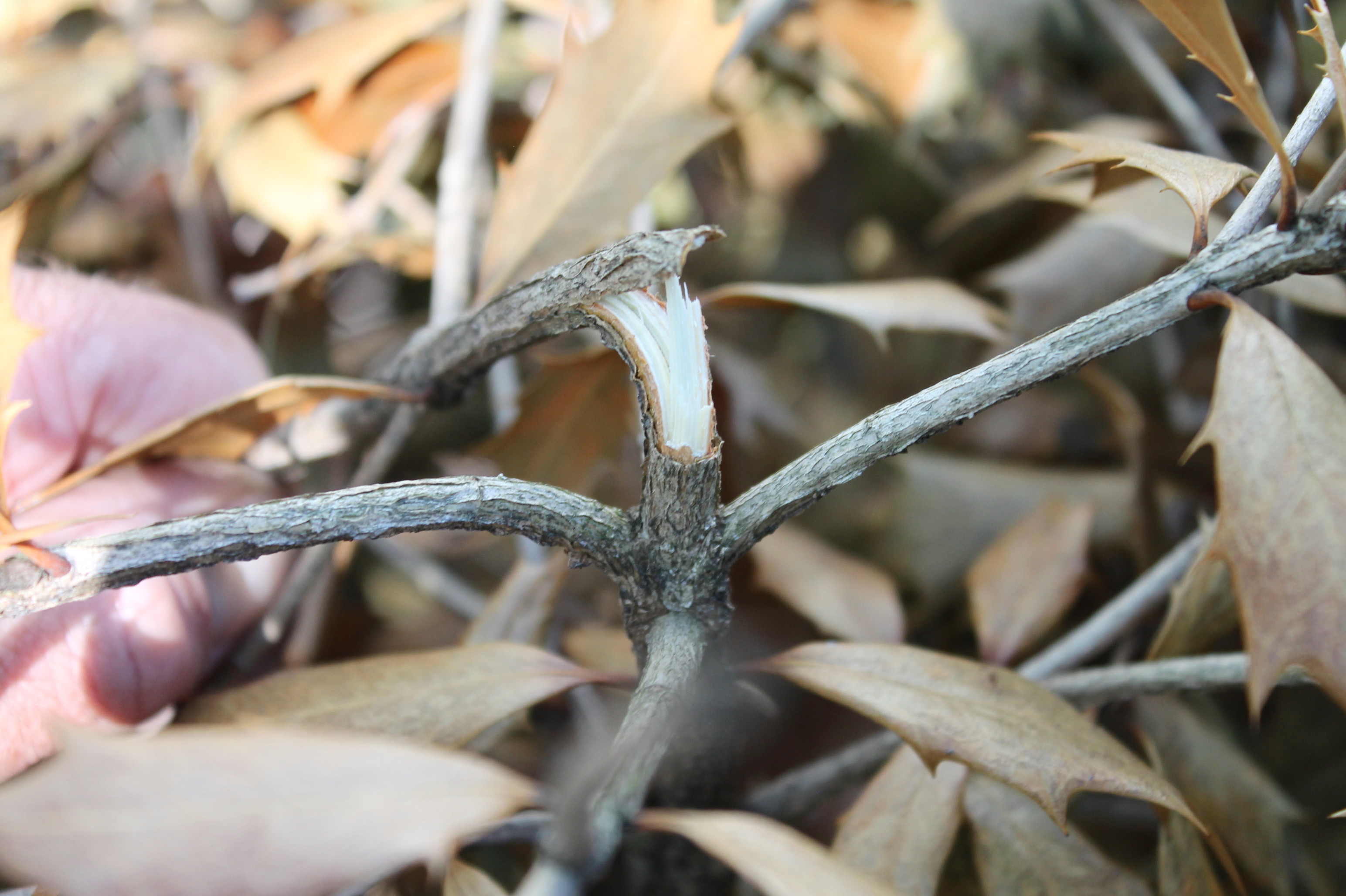
This branch has failed the bend/snap test.
Other death signs are that your leafless branches will snap instead of bend. And when you scratch off the bark, you’ll see brown, not green.
If all of those check out, it’s time to throw in the towel and think about a replacement – either now (if you keep the replacements well watered through summer) or at our next good planting window (right after Labor Day through October).
So what do we do now with our winter-ailing plants?
Here’s a case-by-case rundown:
Things That Suffered Foliage Damage Only. These are plants (primarily evergreens and especially broad-leaf ones) that suffered winter “windburn.”
Unable to take up new moisture from the frozen ground to replace that being lost through foliage, windburned plants first show browning around the leaf edges or needle tips. In more severe cases, the leaves completely brown and eventually drop.