
• Home
  • Contact
  • Site Map
George Weigel - Central PA Gardening
  • Landscape 1
  • Landscape 2
  • Landscape 3
  • Landscape 4
  • Garden Drawings
  • Talks & Trips
  • Patriot-News/Pennlive Posts
  • Buy Helpful Info

Navigation

  • Storage Shed (Useful Past Columns)
  • About George
  • Sign Up for George's Free E-Column
  • Plant Profiles
  • Timely Tips
  • George’s Handy Lists
  • George's Friends
  • Photo Galleries
  • Links and Resources
  • Support George’s Efforts


George’s new “50 American Public Gardens You Really Ought to See” e-book steers you to the top gardens to add to your bucket list.

Read More | Order Now


George’s “Survivor Plant List” is a 19-page booklet detailing hundreds of the toughest and highest-performing plants.

Click Here


Has the info here been useful? Support George’s efforts by clicking below.


Looking for other ways to support George?

Click Here

George's Current Ramblings and Readlings

Dying Douglas Firs

August 9th, 2016

You’re not imagining it if seems like your Douglas fir trees are getting thinner and thinner. And you’re not alone either.
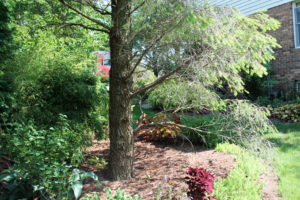
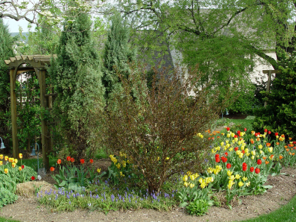
This is my Douglas fir, in the process of dying from Swiss needlecast.

This is my Douglas fir, in the process of dying from Swiss needlecast.

This popular species of screening evergreen is running into increasing disease trouble lately, leading to widespread drop of needles and the bare look that accompanies the loss.

A pair of fungal diseases called rhabdocline and Swiss needlecast are thinning Douglas firs mercilessly all over central Pennsylvania and killing some of them after years of infection.

We had a bigger-than-usual August needle drop due to a dry summer last year, but if your trees didn’t improve noticeably this spring, odds are you’re dealing with needlecast.

I wrote a detailed piece on this problem for PennLive last December, but the bottom line is that if you have needlecast, you’re either looking at spraying fungicides three to four times each spring or watching your Douglas firs get barer and barer each year from the bottom up.

I’m seeing that happen now to the Douglas fir that our kids brought home as a little whip from school more than 20 years ago. It’s about 35 feet tall now and had been doing well until about 3 or 4 years ago.

Now, it’s looking bare and sickly for the first 20 feet – including dead limbs up to about 6 feet. I’m not going to spray.

When limbs drop needles and die, about all you can do is prune them off. You can tell they’re dead if you scratch off a little bark and notice brown or gray tissue inside instead of green. Dead wood also snaps instead of bends.

The problem with pruning off lower limbs is that leads to a very difficult planting place. Not a lot of plants will do well or even survive in the dry shade and root competition underneath a limbed-up evergreen.

Even tougher is when the tree is in a sunny area, allowing direct rays to penetrate the ground underneath the raised limb structure. That’s now dry sun along with root competition – kind of the equivalent of Death Valley to plants.
Read More »


Planting Every Last Inch

August 2nd, 2016

They dig up their entire front lawns, and turn them into perennial gardens.

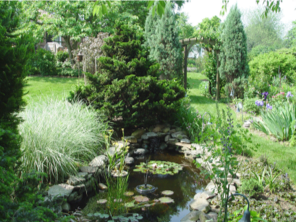
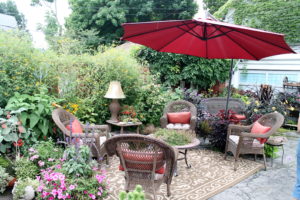
Here's the gorgeous outdoor living room built by Joe Hopkins and Scott Dunlop in Buffalo.

Here’s the gorgeous outdoor living room built by Joe Hopkins and Scott Dunlop in Buffalo.

They fill their postage-stamp back yards with vine-covered arbors, espaliered trees and pots full of annuals and tropicals.

And when every last inch of ground space is gone, they hang flower baskets from their fences, mount wooden boxes full of basil on their kitchen walls, and even plant whole vegetable gardens on their garage roofs.

This is the city of gardening-gone-mad called Buffalo, N.Y. Nowhere else have I seen so many rabid gardeners make better use of space than there, specifically in the six neighborhoods of the city that put on the annual Garden Walk Buffalo.

Garden Walk Buffalo has grown to become America’s biggest garden tour since it began 22 years ago. This year’s Walk just happened over the weekend. If you want to see some of the gardens, I just posted a Photo Gallery from the bus trip I led there.

More than 400 gardeners (yes, 400+!!!) open their gardens for the world to see the last weekend of every July.

There’s no charge either. You just show up and start looking at gardens for six hours during each of two days.

Since there is no judging and no guidelines that gardeners have to meet to be on the tour (other than they can’t sell anything), you’ll see some fairly ordinary places. But you’ll also see plenty of no-lawn places that are packed with wall-to-wall living color – head to toe.

Most of the homes are on small city lots, some with back yards no bigger than a typical kitchen.

This forces the residents to be very resourceful in how they use their precious little outdoor living space.

And that they are, coming up with their own style that’s a blend of creativity, thrift and quirkiness that I haven’t seen anywhere else.

Read More »


The Summer Storm Fakeout

July 26th, 2016

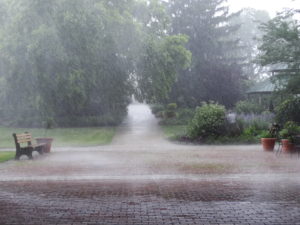
Don’t be lulled into hoselessness by those quick-hit summer storms.

Those summer downpours might look like they're helping plants, but a lot of the water may be running off. Credit: Sonny Bender

Those summer downpours might look like they’re helping plants, but a lot of the water may be running off.
Credit: Sonny Bender

Also don’t assume that just because the grass isn’t brown and crunchy that there’s no need to worry about watering the plants.

It’s been very hot and very dry lately, and the soil down in the root zone may not be as damp as you think – especially if you’re in those unfortunate pockets that keep missing the storms.

Summer storms can be major fakeouts on three fronts:

1.) They’re spotty. It’s entirely possible for one area to get a 2-inch dumping but then nothing falls a half-mile away.

2.) Summer storms often look like they’re delivering more rain than they really do. I can’t tell you how many times I’ve seen heavy winds and heavy rains roll through, only to find a quarter-inch of water in my rain gauge.

3.) The rain can come down so fast that more of it ends up in the sewer system than around your hydrangea roots.

What really counts is how much moisture is in the soil where the roots are.

Those 10-minute downpours often deposit only enough water to wet the mulch or to penetrate the lawn surface – just enough to keep the grass green. That’s why it’s not a good idea to let the color of the grass act as your “rain gauge.”

Get a real rain gauge to see exactly how much rain fell in your yard. It doesn’t matter if the official measurement from Harrisburg International Airport says a storm dropped an inch if all you got was a misting.

Even better, stick your finger in the ground in different beds to see just how damp the soil is at what depth. You could also buy a moisture meter, but I’ve found that a good, old, low-tech index finger works just as well.

Read More »


Can You Plant in Summer?

July 19th, 2016

One question I get fairly often this time of year – a point when people tend to notice that their yard is, ah, “lacking” – is whether it’s possible to plant in summer.

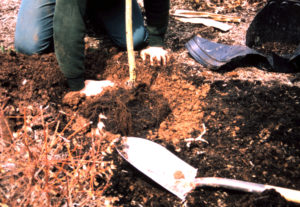
Both container-grown and balled-and-burlapped trees can be planted in summer.

Both container-grown and balled-and-burlapped trees can be planted in summer.

The short answer is that although it’s not the ideal time, yes, you can plant most plants in summer.

The key, as I’ll get to in a minute, is vigilant watering.

The two prime planting windows in central Pennsylvania are between the end of winter and the end of May and then again right after Labor Day through October. That’s because temperatures are typically cooler then, rain happens more often, and the sun’s rays aren’t as direct.

All of that helps mitigate the shock that young plants experience when they’re suddenly moved from the cozy pots and coddling of nursery life to the harsher conditions of your lousy soil, erratic weather, and bug, disease and rodent vulnerability.

That doesn’t mean that summer planting is a bad idea, though. It just means you’re going to have to pay more attention to overcome the challenges that spring weather helps overcome better than summer weather.

Consistently damp soil makes the difference between plant life and death – especially during the first 6 to 8 weeks when those shocked plants are trying to re-root and acclimate to the new conditions.

Read More »


Glorious Harvest (Mostly)

July 12th, 2016

This is the time of year when the vegetable garden is (or should be) coughing up plenty of goodies in return for our springtime work.

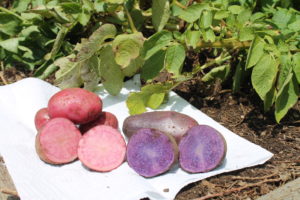
'Adirondack' potatoes have colorful flesh as well as colorful skin.

‘Adirondack’ potatoes have colorful flesh as well as colorful skin.

Although the cloudfest that was May set things back a bit this year, I’m enjoying an excellent bounty now.

The broccoli is down to side-shoot production, the lettuce has all been bagged (it just bolted last week), and I’ve been picking golfball-sized “new” potatoes for 2 weeks.

Shortly, I’ll be harvesting full-sized ‘Adirondack Blue’ and ‘Adirondack Red’ potatoes, which have purple and rose-colored flesh, respectively, and not just colored skins. The picking cue for me is when the foliage flops over and goes from green to yellow to brown.

I’ve never grown ‘Adirondacks,’ but they sounded like a good trick to get my 3-year-old granddaughter to eat potatoes other than french fries since I can refer to them as “big grapes” or “big cherries.”

I also got them free from my friend, Roger Springer, who brings big bags of seed potatoes into church every spring. Roger is general manager of the Pennsylvania Cooperative Potato Growers. (And no, I didn’t pick the church because I heard free seed potatoes were a bonus.)

Anyway, I’m also about ready to pull a block of carrots that I planted back around the end of March. I know these are ready by pulling dirt back from around the shoulders and gauging the size.

Read More »


« Older Ramblings and Readlings Newer Ramblings and Readlings »

  • Home
  • Garden House-Calls
  • George's Talks & Trips
  • Disclosure

© 2026 George Weigel | Site designed and programmed by Pittsburgh Web Developer Andy Weigel using WordPress