
• Home
  • Contact
  • Site Map
George Weigel - Central PA Gardening
  • Landscape 1
  • Landscape 2
  • Landscape 3
  • Landscape 4
  • Garden Drawings
  • Talks & Trips
  • Patriot-News/Pennlive Posts
  • Buy Helpful Info

Navigation

  • Storage Shed (Useful Past Columns)
  • About George
  • Sign Up for George's Free E-Column
  • Plant Profiles
  • Timely Tips
  • George’s Handy Lists
  • George's Friends
  • Photo Galleries
  • Links and Resources
  • Support George’s Efforts


George’s new “50 American Public Gardens You Really Ought to See” e-book steers you to the top gardens to add to your bucket list.

Read More | Order Now


George’s “Survivor Plant List” is a 19-page booklet detailing hundreds of the toughest and highest-performing plants.

Click Here


Has the info here been useful? Support George’s efforts by clicking below.


Looking for other ways to support George?

Click Here

George's Current Ramblings and Readlings

Gardens, Scenery and Food of Arizona

September 3rd, 2019
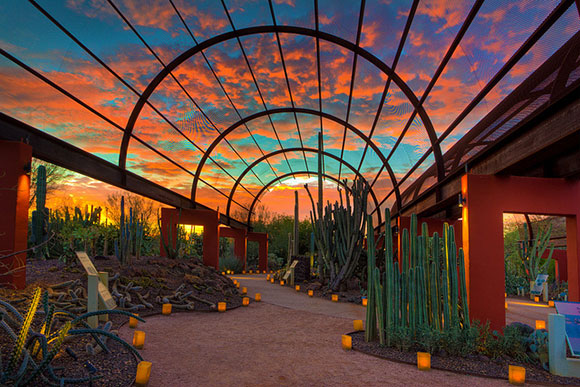
Sun sets on the Desert Botanical Garden in Phoenix. (Credit: Desert Botanical Garden)

   Just because a climate is hot and dry doesn’t mean its plants are boring.

   The amazing botanical world has managed to come up with a surprisingly diverse array of beautiful and sometimes curious plants that have adapted to arid environments.

   We’re going to have a closeup look at it all this December during a nine-day, garden-focused trip to Tucson, Phoenix, and Sedona, Arizona, custom-planned by Lowee’s Group Tours and me.

   We’re also going to spend a day at the Grand Canyon, see some of Arizona’s iconic scenery, sample some of the foodie-approved dishes of the Southwest, and do some touristy things, too, like visit Frank Lloyd Wright’s Taleisin West desert laboratory, Tucson’s unique Mini Time Museum of Miniatures, and a cowboy ranch (for a horse-drawn wagon ride and cowboy cookout).

   The trip runs Dec. 3-11, 2019, and costs $3,650 per person double, which includes round-trip airfare, hotels, on-tour transportation, admissions, guides, baggage-handling, and 17 meals.

   You’re invited! The full details and booking are available through the Lowee’s Group Tours website or by calling Lowee’s at 717-657-9658.

   We timed this trip so you can enjoy the warmth and gardens while things are likely turning cold and snowy in Harrisburg. You’ll still have two weeks to get ready for Christmas when you get back.
Read More »


Bugged by Bugs? Plant More Plants

August 27th, 2019

   I wrote a garden column for the Patriot-News a few years ago on a talk that University of Maryland entomologist Dr. Michael Raupp did at a plant conference.

Bugs are part of a healthy ecosystem… and they’re not all bad.

   He made the interesting argument that bugs are a healthy part of any ecosystem (including home gardens) and that the key to keeping them from defiling your plants is not to spray but to plant more plants.

   Raupp’s advice is just as timely today as it was then. So if you’re fed up with bug damage by this point in the growing season, here’s what I wrote…

   Frustrated by the many bugs eating your measly few plants?

   Your best bet isn’t to reach for the sprayer.

   It’s to plant more plants.

   That bit of seemingly backward logic comes not from a plant-seller but from one of America’s top bug guys, University of Maryland entomologist Dr. Michael Raupp.

   Raupp, who moonlights as bug consultant for the TV show “Bones,” has spent much of his career trying to figure out why bugs behave the way they do in home landscapes.

   His main conclusion: plant-damaging bugs are winning because we’ve largely wiped out the other bugs that would’ve controlled them.

   We’ve done that in two main ways.

Read More »


This Plant Is Itching to Get Us

August 20th, 2019

   Plants are generally pretty docile and defenseless creations.

Here’s a clump of poison ivy growing up a chain-link fence.

   If your dog wants to dig up a daylily or you feel like decapitating a cabbage for dinner, there’s really not much the plants can do about it.

   Then there’s Toxicodendron radicans, better known as poison ivy.

   This is a plant that not just defends itself but goes on the offensive.

   Judging from the number of people I’ve heard complaining about it, this season seems to be a banner year for this gardener’s plague.

   Poison ivy’s key weapon is a potent oil called “urushiol,’ which causes an annoying to dreadfully painful skin rash in an estimated 85 percent of people who come into contact with it.

   The plant itself is a tough, adaptable, native vine that lurks most everywhere, from shady wooded areas to roadside banks to that forgotten corner of the backyard.

   The dreaded itching usually begins within 24 to 36 hours of getting the oil on your skin. Exposed areas turn red and may blister, then typically crust over and heal within two weeks.

   That’s bad enough. But for about one in 10 people, the rashes are severe, painful and in extreme cases, even life-threatening.

   Randy Connolly found that out when he was 7 years old. He nearly died when he breathed in smoke from a neighbor who was burning brush that included poison-ivy vines.

Read More »


Survivor Landscaping

August 13th, 2019

   Way back when I was a Cub Scout leader, we started the year by having the boys discuss what the pack’s rules should be.

Too many plants meet this fate.

   The 8-year-olds’ first suggestion was, “No killing.”

   I wouldn’t have thought of that, but it was definitely a good place to start.

   That also happens to be a good place to start with your planting/replanting plans.

   Unfortunately, we kill way too many plants.

   Many factors contribute to this botanical destruction.

   The leading problem is flat-out horrid “soil,” which in most yards is more like a clay-shale blend or subsoil left behind by earth-moving equipment.

   That can be mitigated by working 2 or 3 inches of compost or similar organic matter into the loosened top foot, which gives you slightly raised and more root-friendly beds.

Read George’s articles on rethinking how we plant, part one and part two

   The second killer is too-deep planting. Way too many trees and shrubs are buried rather than planted, which has the effect of suffocating roots.

Read George’s PennLive post on how to correctly plant a tree

   A third killer is water – or lack of it.

   Planting in poorly drained areas rots out many landscape plants. So does overwatering to the point of sogginess. That’s just as deadly as not watering enough.

   Packing on too much mulch (2 or 3 inches is plenty) or stacking it onto trunks is a fourth good way to kill plants.

   And those are just “operator-error” factors that don’t count killers such as deer-munching, ice slides off the roof, uprootings in wind storms, bug attacks, and assorted plant diseases.

   Yes, a lot can go wrong.

   That’s why I’m a disciple of the Mayhem School of Landscape Design. Its leading principle is to first select tough plants that are likely to survive abuse, then worry about color, texture, forms, bloom times, etc.

   After all, a dead plant is a bad plant (except possibly for a leafless Harry Lauder’s walking stick or a Japanese maple painted silver in an Ikebana arrangement).

   No matter how cool the plant looks in the pot or how common it is in garden centers, if it’s got a good chance of croaking, it’s not a great choice.

Read More »


“Real” Impatiens Are Back?

August 6th, 2019

   Maybe I’m a little premature, but me thinks good, old-fashioned impatiens are back.

These Beacon impatiens are looking pretty good — and mildew-free — at Penn State’s Trial Gardens.

   Impatiens walleriana were our top-selling annual flower up until 2012, when a deadly downy mildew disease swooped in and killed just about everybody’s plants in a matter of weeks.

   Because the water mold that causes the collapse is as durable overwintering in the soil (5 years or more) as it is virile in spreading by wind, planting impatiens has been a risky/lost cause ever since.

   This spring, Syngenta Flowers introduced the first new line of impatiens that purportedly has a high degree of natural resistance to downy mildew. It’s called impatiens Imara XDR.

   Coming on the heels of that is another line of resistant impatiens from PanAmerican Seed called Beacon. These are a U.S./Dutch collaboration due out next spring.

   I’ve been trialing Imara ‘Rose’ this season in my home garden, planted next to an older variety of cheapie rose-colored impatiens I bought at a grocery store.

   The Penn State Trial Gardens in Lancaster County are trialing eight colors of Imara impatiens and seven colors of Beacon impatiens in containers alongside a few old-style impatiens for comparison.

   In both places, all of the newcomers are chugging along nicely while the older types are going downhill to downy mildew.

   The older ones are yellowing, stunted, dropping leaves, and displaying the telltale sign of a grayish coating on the leaf undersides. Late July is when mildew symptoms usually start to show up.

   I also saw Beacon impatiens growing nicely in the trial gardens in Buffalo, N.Y., and at Burpee’s Fordhook Farm trial gardens, although those gardens didn’t have older impatiens nearby as a control.

Read More »


« Older Ramblings and Readlings Newer Ramblings and Readlings »

  • Home
  • Garden House-Calls
  • George's Talks & Trips
  • Disclosure

© 2026 George Weigel | Site designed and programmed by Pittsburgh Web Developer Andy Weigel using WordPress