
• Home
  • Contact
  • Site Map
George Weigel - Central PA Gardening
  • Landscape 1
  • Landscape 2
  • Landscape 3
  • Landscape 4
  • Garden Drawings
  • Talks & Trips
  • Patriot-News/Pennlive Posts
  • Buy Helpful Info

Navigation

  • Storage Shed (Useful Past Columns)
  • About George
  • Sign Up for George's Free E-Column
  • Plant Profiles
  • Timely Tips
  • George’s Handy Lists
  • George's Friends
  • Photo Galleries
  • Links and Resources
  • Support George’s Efforts


George’s new “50 American Public Gardens You Really Ought to See” e-book steers you to the top gardens to add to your bucket list.

Read More | Order Now


George’s “Survivor Plant List” is a 19-page booklet detailing hundreds of the toughest and highest-performing plants.

Click Here


Has the info here been useful? Support George’s efforts by clicking below.


Looking for other ways to support George?

Click Here

George's Current Ramblings and Readlings

Veggies, ratty daylilies and tortured maples

September 4th, 2010

   Now’s not the beginning of the end for vegetables. It’s the time to yank petered-out summer crops and reload the garden with fall crops.

   Few people do this. As the tomatoes fizzle and the cukes die from wilt, most gardeners wind down for the season. Not me. I take advantage of the 8 weeks or so of frost-free weather still to come by planting crops that’ll mature in cooler weather.

   The next two weeks are fine to direct-seed beets, carrots, lettuce, spinach, radishes, turnips, kale and maybe even fast-maturing beans. We should still have time to squeeze in crops of transplanted broccoli, cabbage, cauliflower and Brussels sprouts.

   Just keep newly seeded and planted veggie beds regularly watered. It’s been ridiculously hot and dry.

Ratty daylilies

    Daylilies are good survivor plants in central-Pa. landscapes, but that doesn’t mean they’re trouble-free.

A daylily browning out from leaf streak, a fungal leaf disease.

   I’ve seen lots of daylily leaves that turned yellow, then brown, and end up looking pretty ratty by this time of year.

   The problem usually is a fungal disease called leaf streak. It typically attacks daylilies soon after bloom finishes.

   Some varieties are more prone to it than others, and weather plays a factor.

   A good solution is to just cut off infected leaves – even if means cutting whole plants down to a stub. Daylilies are durable enough that they’ll regrow fresh foliage that usually doesn’t get reinfected.

   Don’t compost the diseased leaves, though. Get them out of the yard.

   Dividing your clumps might also help, if you haven’t done that in a few years. Tightly packed plantings are more prone to this disease.

   A fresh coat of mulch each spring can help keep disease spores from splashing up onto the leaves.

   Preventative sprays (every 7 to 10 days starting in late spring) include trifloxystrobin, thiophanate-methyl and chlorothalonil. Neem oil is an organic option that might help.

Wind and maples

    Cutleaf Japanese maples are beautiful specimen plants, but their leaves also sometimes look ratty this time of year.
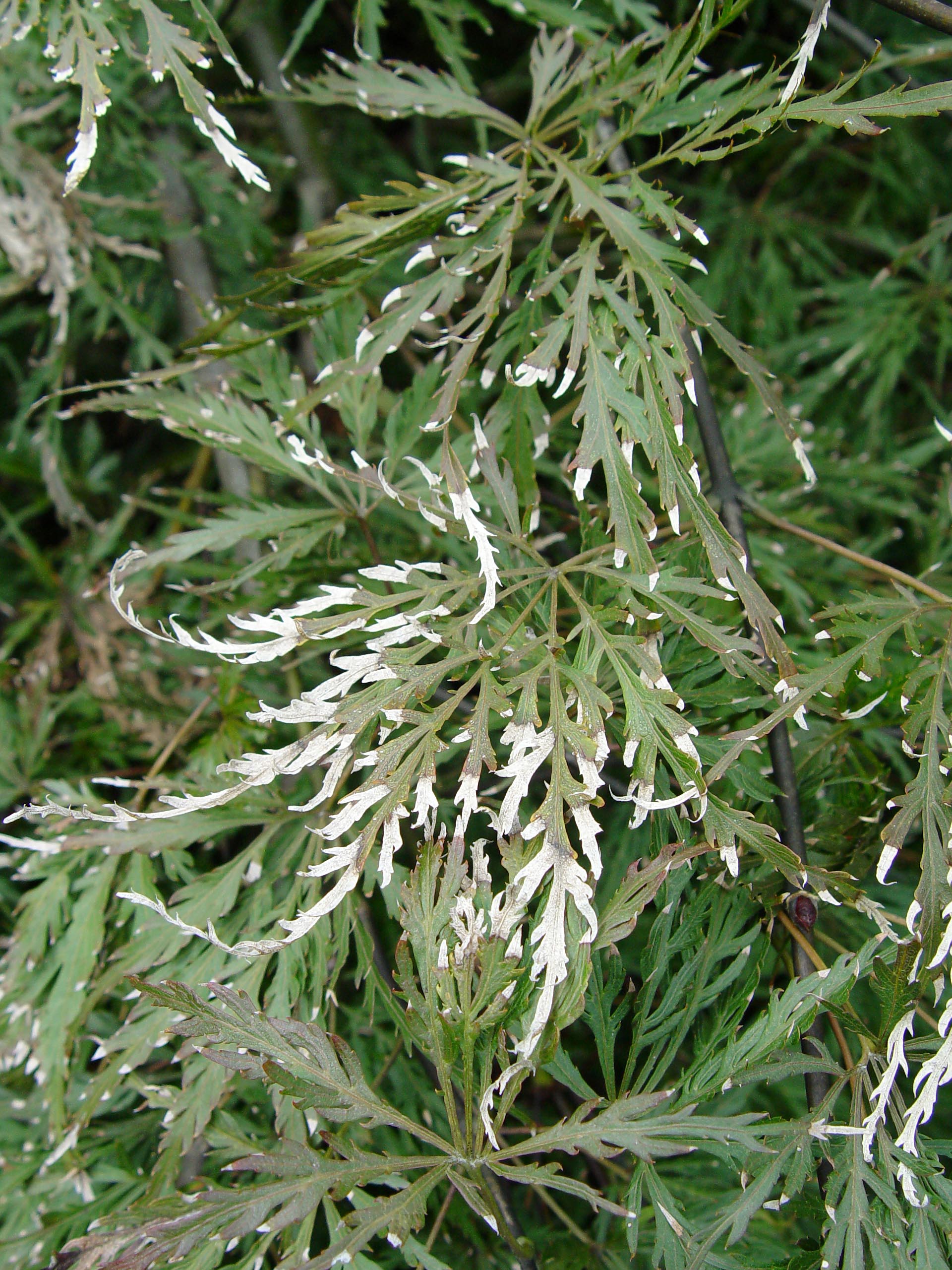
Leaf tips of a cutleaf Japanese maple beat up by wind.

   The intense heat washed out the color of many of them this year, but wind also can shred their leaves.

   Cutleaf Japanese maples are exceptionally thin-leafed, which means they’re quicker to dry out than, say, a thick-leafed sedum or a waxy-coated holly.

   When leaves dry, they brown around the edges. That happens especially to Japanese maples sited in full sun and especially during hot, dry summers.

   Watering counteracts some of this damage. So does mulching the ground with 2 to 3 inches of bark or leaf mulch. But much better is planting Japanese maples in wind-sheltered spots out of direct afternoon sun in the first place.

   Japanese maples also are a favorite target of Japanese beetles. So you might even be seeing some of that left-behind damage still, too.
It’s not natural, but…

August 19th, 2010

   I’ve always been fascinated by bonsai, that combination of art, horticulture and contortion that somehow manages to grow shrunken trees in little pots.

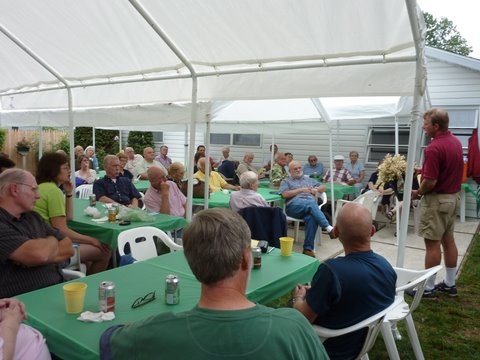
George yakking to the plant geeks at the Bonsai Club Picnic.

   It’s unnatural and seemingly impossible. To me, it’s hard enough to get regular plants to grow in regular soil, much less in those skinny little pots. So bonsai fascinates me, but not to the point of actually doing it. I can’t bring myself to sacrifice the poor, innocent plants I know I’d kill.

   What kind of people DO bonsai? Well, I spent an afternoon with about 50 of them last weekend at the Susquehanna Bonsai Club’s annual picnic at George Gracey’s house in New Cumberland.

   They’re actually fun and reasonably normal people… OK, at one point one of the members put a potted mistletoe fern on top of his head and drew a near kiss from one of the club founders, whose name and Linglestown bonsai studio I won’t mention. But other than that, the oddest common trait seemed to be incurable plant-geekism.

   The ringleader of the bunch is Gracey, who’s now 87 and still a character. If you picture a bonsai-ist as a quietly focused, monk-like, white-robed Oriental fellow, this does not describe George even remotely.

   I interviewed him once for a Patriot-News garden column, and I remember him telling me that he was attracted to bonsai because he “likes to grow stuff.”

   He also said bonsai took more work than pet care and that “anyone that does bonsai and says he’s never killed a plant is a liar.”

   Every year, Gracey invites the whole club over to his fenced-in New Cumberland back yard for some pulled pork, a program (which was me this year) and an auction, which seemed to be somewhat of a mass reshuffling of everyone’s plant cuttings, excess bonsai pots and bonsai magazine collections.

   Dozens of George’s bonsai specimens ringed the fence – mini forests in pots, solo foot-tall trees that looked to be ancient and several conifers pruned to simulate being windswept.

   Very interesting. And definitely not as easy as George and crew make it seem.

   I also found out that some bonsai clubbers actually have healthy, living mountain laurels growing in their yards. Very few people manage to pull that off. Despite being our official state flower, mountain laurels are notoriously hard to cultivate in home gardens. They really don’t appreciate clay, subsoil, alkaline foundations, 99-degree heat in the full sun and the many other abuses typical to suburban midstate gardening.

   It adds up, though. If you can grow an elm tree in your kitchen in 1 inch of gravel, you can probably figure out how to keep a shrub alive in the back yard.

   If you’d like to test the bonsai waters, the Susquehanna Bonsai Club meets monthly at Nature’s Way Nursery, 1451 Pleasant Hill Road near Linglestown. Nature’s Way is the epicenter for all things bonsai around here, what with classes, supplies, speakers, plants, etc. For info on either/all, call 545-4555, email natureswaybonsai@comcast.net or visit www.natureswaybonsai.com.

   To read the column I wrote about George Gracey, click here.

   And to read a piece on bonsai-ing I wrote after spending some time with Jim Doyle at one of his Nature’s Way classes, click here.


National Fame for Local Garden

August 16th, 2010

   You know you’ve earned your gardening wings when a Better Homes and Gardens publication features your landscape.

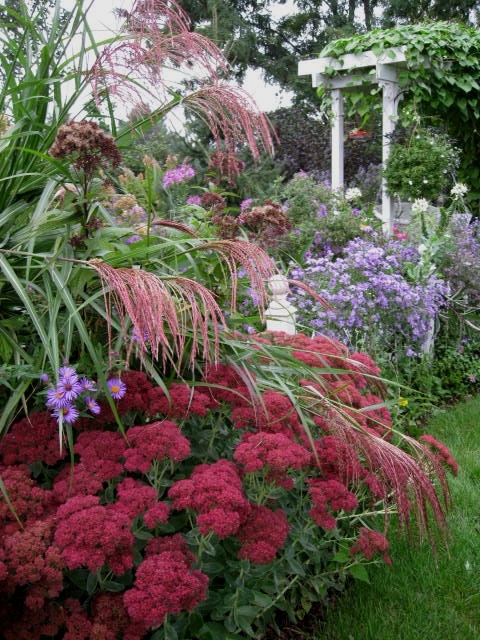
A stunning grass and sedum combo in Kathy Engle’s Shippensburg yard.

Take a look in this month’s issue of Country Gardens magazine — on newsstands now — and you’ll see the half-acre landscape of Kathy and Don Engle of Southhampton Twp., just outside of Shippensburg.

Country Gardens editors waded through entries for the magazine’s garden-award competition and picked the Engle gardens as one of their featured gardens for 2010.

Garden photographer Rob Cardillo photographed the gardens last fall, and author and contributing writer Nancy Ondra interviewed Kathy for the article.

The yard’s mixed borders and island beds contain 400 types of trees, shrubs and perennials.

Kathy is the head gardener and chief designer. Don is more the structure-builder, compost-hauler, bed-tiller and golfer.

“Twenty-two years ago we built our home on what was once a cornfield,” says Kathy. “The topsoil was about 3 inches deep, under which was clay and limestone fill.”

Truckloads of compost later, the Engles had their first 8-by-25-foot bed.

In the early years, the yard was primarily a playground for the Engle girls and their neighborhood friends — swingset, pool, sandbox, etc.

But as so often happens when gardeners lurk, lawn space shrunk little by little, and garden beds began appearing everywhere.

“My husband has been amazing,” says Kathy. “He built the garden house and arbor for me… and he golfed. I would ask him to rototill a new garden for me. He would say, ‘No more gardens,’ and head out the door to golf. I would head into the garage for my shovel and dig a new garden. I haven’t dug any new gardens recently, but mysteriously they have gotten larger.”

Strange how that happens.

Some of the Engles’ flower borders.

Gardeners also will relate to how Kathy is constantly moving plants around. She says she’s been doing that since she was little and prone to transplanting her dad’s plants more to her liking.

“What’s funny is that as soon as they were done with the photo shoot, I got out my shovel and started moving things around,” says Kathy.

Just goes to prove that when you’re an obsessed gardener, even perfection isn’t perfect.

Congratulations on making the big-time, Kathy!


Overheated Landscapes

August 9th, 2010

   This unrelenting, brutally hot growing season is causing all kinds of havoc for people, plants and water bills. It looks like we’re not done yet.

Heat alone can kill plants that prefer cooler climates, even firs and spruce when we get into Dallas temperatures.

   I don’t know about you, but I’ve switched from keep-it-nice mode to survival in my landscape. I’ve got a well and don’t want to run it dry. So I’m only going to spot-water plants I really don’t want to lose from here on out.

   A lot of the damage we’re seeing isn’t just from lack of water. It’s from the flat-out ridiculously high day-after-day temperatures. When temperatures approach 100 degrees, pollen dies, fruits and fruiting veggies stop yielding, growth slows to a crawl and some cool-preferring species simply croak.

   Pansies and lobelia are two annuals that typically fry in our normal summers, but this year I’m seeing even fir trees browning in the heat. I’ve got several birds nest spruce that have been in the ground for a dozen years, and they’re even turning to toast.

   Lots of vegetable gardeners have been asking me about poor bean, squash and tomato yields. The heat fries the pollen, and without pollination, the flowers fall off. The sorry state of our bee population doesn’t help either.

   Watering helps only marginally and temporarily when it’s really intense heat doing the damage.

   High temperatures increase a plant’s water needs, so when rain isn’t happening, the two conspire to kill that much faster. Watering with a hose, watering can and even sprinklers just doesn’t do the thorough moistening job of a good, soaking rain.

   What we really need from here on out is for the temperatures to go back down to at least the mid-80s and for a daylong soaking rain.

   Some areas have been getting quick dumpings here and there. Other areas (like my yard) have missed them all, except for that one storm that dropped 3 inches of rain in a few hours. While that’s better than nothing, heavy downpours don’t help gardens much because so much of the rain runs off. Three inches of rain that comes one inch at a time over three weeks is infinitely more helpful than 3 inches in 2 hours.

   So I’m going to focus first on trees and shrubs that have been planted in the last three years. Those are the most expensive, long-term investments and are more likely to suffer because their roots haven’t fully established. One deep soaking a week should salvage them.

   Scout your landscape, and if you see any deciduous trees or shrubs wilting, losing color, browning at the tips or edges, turning color already and/or shedding leaves, you should have watered yesterday. (Note that some plants, especially hydrangeas, wilt from heat even when the soil moisture is OK.)

   Needled evergreens often give you no warning. They just turn brown seemingly all of sudden. When that happens, they’re already dead.

   The second focus for me is going to be new and less drought-tolerant perennials that are showing signs of stress. I don’t want to lose those either.

   Next is the vegetable garden. If I have to choose between water for a tomato plant or a petunia plant, I’ll go with the tomato.

   I’m trying to keep my pots watered with recycled water from the kitchen sink. I usually use water from the rain barrel, but that’s been empty for weeks.

   A good bit of my landscape is doing fine since I’ve picked durable and drought-tolerant species in the first place. I haven’t given any water, for example, to my ‘Knock Out’ roses, ornamental grasses, liriope, ninebarks, coneflowers, dwarf lilacs, hollies, Virginia sweetspires, catmint, barrenwort, spirea and amsonia, to name a few.

   In-ground annuals are on my sacrifice list. I’d rather not see them die in August, but if something has to give, the rationale is that these will die come frost anyway.

   At the bottom of the list is the lawn. Mine has been patchy-brown for weeks (like most people’s). Lawns just take too much water to keep green in dry weather, so I don’t even try. I’ll see what comes back in fall and just reseed/overseed what doesn’t.

   At least grass seed is a lot cheaper than replacing a fringetree.


Are you ready for a black petunia?

August 2nd, 2010

Petunia 'Black Velvet'

   It’s one of those love-it or hate-it plants, but the new-for-2011 annual flower that’s generating the biggest buzz is Ball FloraPlant’s petunia ‘Black Velvet.’

   As the name implies, this is a petunia that blooms black. And from the ones I’ve seen growing at trial gardens in Buffalo and at Penn State’s Lancaster County research farm, ‘Black Velvet’ really is pretty darn close to true black. It’s not really a deep burgundy plant like so many of the so-called black plants.

   Don’t get too excited, though. ‘Black Velvet’ might be a novel color, but it doesn’t appear to be a very high-performing variety.

   At both trials, it paled noticeably compared to the many super-blooming petunias of series such as ‘Supertunia,’ ‘Ray,’ ‘Sanguna,’ ‘Cascadia,’ ‘ Petitunia,’ and of course, the various ‘Waves.’ The ‘Black Velvets’ I saw were putting out maybe a third coverage while most other trial petunias were total balls of bloom.

   Also coming out next year are two black-and-cream striped petunias named ‘Phantom’ and ‘Pinstripe.’ These are also eye-grabbers because of the unusual look, but they were only slightly better in flower power than ‘Black Velvet.’

Petunia 'Pinstripe'

   Go ahead and give a few a try if you’re a sucker for anything new and different. But don’t expect ‘Wave’-like performance.

   Not everyone will even like the color. At Penn State’s trials, I saw some people raving over the ‘Black Velvets’ while others turned up their noses.

Interesting upcoming gardening events

   Two local events that you might want to put on your calendar…

   Coming up Wed., Aug. 25, from noon to 5 p.m. is the 9th annual Master Gardener Tomato Tasting Day at the Franklin County Extension Office, 181 Franklin Farm Lane, Chambersburg.

   Master Gardeners slice up three dozen trial varieties from Penn State’s test garden and let the public go down the line and sample every last one of them. You then get to rate your favorites.

   The varieties are coded during the tasting, but you find out which you liked best in the end. Then the MGs tally up the totals and announce overall favorites.

   Last year, for instance, people really liked ‘Brandy Boy,’ ‘Blosser Pink,’ ‘Grandma’s Garden,’ ‘Brandywine’ and ‘Black Brandywine.’

   New this year is a salsa contest at 2 p.m.

   It’s all free. Just show up ready to eat tomatoes and salsa.

   Then on Sat., Sept. 11, the Manada Conservancy is staging its fifth annual Fall Native Plant Sale from 9 a.m. to 2 p.m. at Meadowood Nursery, 24 Meadowood Drive, Hummelstown.

   The event features nothing but natives — trees, shrubs, grasses, ferns, woody vines, aquatic plants and plenty of wildflower choices. Proceeds go to Manada’s land-preservation and education work.

   More details and a list of what will be on sale can be found at the group’s website at www.manada.org. If you’re not familiar with Meadowood, its website is at http://www.meadowoodnursery.com.


« Older Ramblings and Readlings Newer Ramblings and Readlings »

  • Home
  • Garden House-Calls
  • George's Talks & Trips
  • Disclosure

© 2026 George Weigel | Site designed and programmed by Pittsburgh Web Developer Andy Weigel using WordPress