• Home
  • Contact
  • Site Map
George Weigel - Central PA Gardening
  • Landscape 1
  • Landscape 2
  • Landscape 3
  • Landscape 4
  • Garden Drawings
  • Talks & Trips
  • Patriot-News/Pennlive Posts
  • Buy Helpful Info

Navigation

  • Storage Shed (Useful Past Columns)
  • About George
  • Sign Up for George's Free E-Column
  • Plant Profiles
  • Timely Tips
  • George’s Handy Lists
  • George's Friends
  • Photo Galleries
  • Links and Resources
  • Support George’s Efforts


George’s new “50 American Public Gardens You Really Ought to See” e-book steers you to the top gardens to add to your bucket list.

Read More | Order Now


George’s “Survivor Plant List” is a 19-page booklet detailing hundreds of the toughest and highest-performing plants.

Click Here


Has the info here been useful? Support George’s efforts by clicking below.


Looking for other ways to support George?

Click Here

George's Current Ramblings and Readlings

Gardening without a Garden

May 24th, 2011

   Don’t let a minor setback like no soil and no space stop you from gardening.
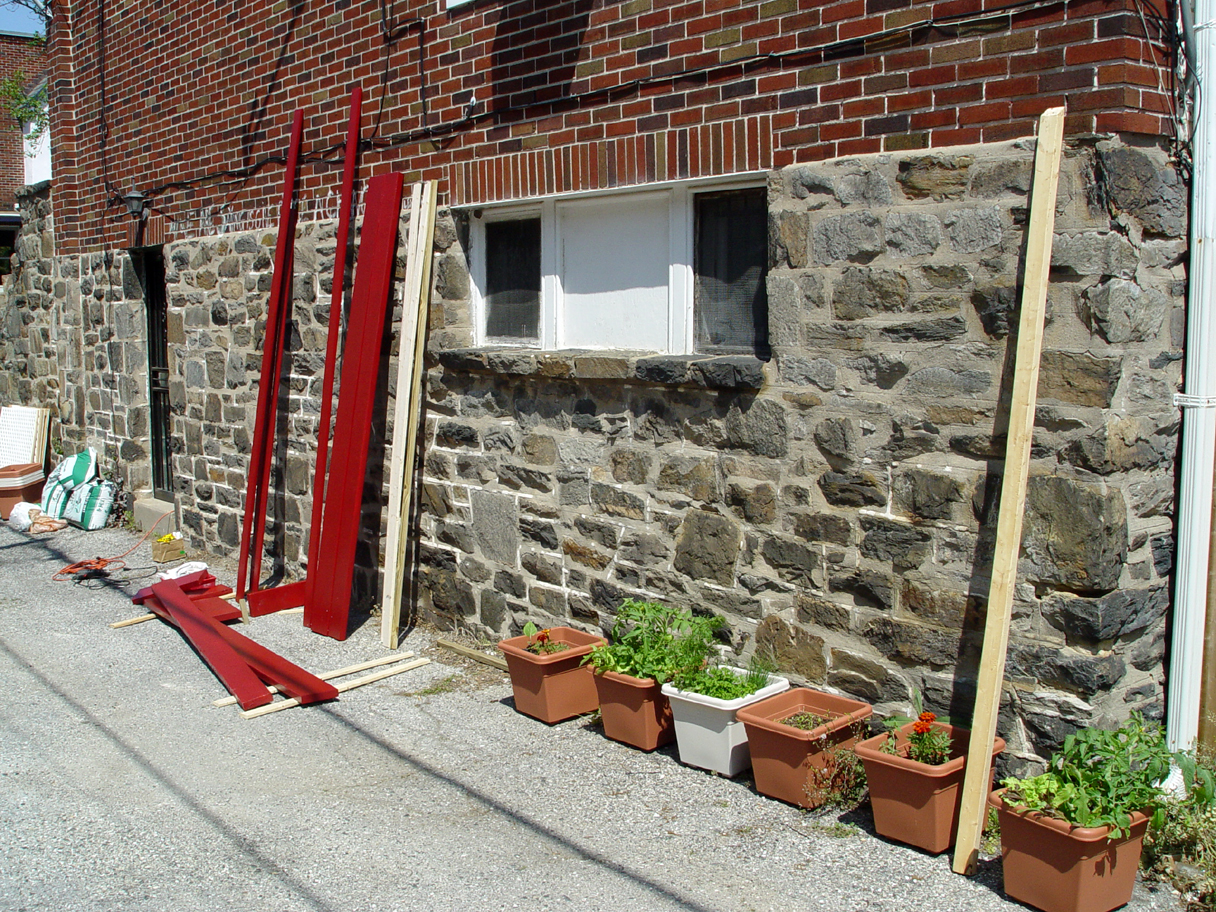
Getting ready to assemble Erin's alley garden.

   Where there’s a will, there’s a way to grow a few cucumbers and an herb or two or three.

   Our daughter, Erin, lives in Baltimore in a tightly packed urban neighborhood with postage-stamp yards and a lot of asphalt and concrete.

   Actually, she lives kind of under a 2-story house in a basement apartment that opens directly into an alley.

   Erin mentioned one day that she wished she had a little garden or at least a few containers where she could grow a tomato plant, some fresh herbs, some of those extra-long cucumbers that go for more than $1 each at the grocery and maybe a few flowers.

   So for her birthday last month, Sue and I delivered. After all, we can’t let a budding gardener not bud.

   What we came up with was a series of square, 15-inch plastic pots, all lined up along her house wall and contained by a wooden planter box.
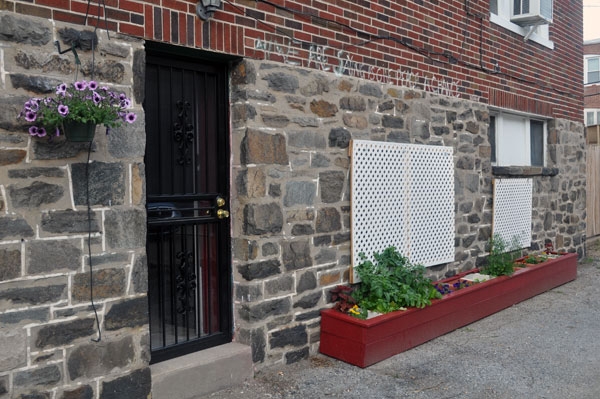
The finished product.

   Sue painted the box an earthy red. It looks like one continuous raised-bed planter, even though it’s really just a bunch of pots sitting on asphalt, hidden by the box.

   It only extends 18 inches out from the wall, so it doesn’t eat much into the alley space – certainly no more than the trash cans people sit out.

   The trim strip across the top serves two purposes. One is to give a nice finishing touch to the box. The other real reason is to discourage people from pulling out the pots and vandalizing them.

   I mounted three lattice panels on the wall to give the climbing crops something to grab onto.

   So far, so good.

   This alley gets some nice afternoon sun. And Erin and the two little neighbor girls are keeping everything watered with the pink plastic-pig watering can we bought as a classy garden accessory.

   It’s amazing how much stuff we’ve managed to cram into this 16-foot-long line of pots.

   There’s a cherry tomato, an ‘Early Girl’ tomato, several ‘Orient Express’ cukes, a half dozen kinds of herbs, a couple of peppers and eggplants, a dozen leeks, a few marigolds and petunias for color, and a ton of lettuce, spinach, mesclun and assorted salad greens.

   Erin is harvesting some of it already.

   Something else sprouted along with the plants.

   Neighbors came out of the woodwork to compliment Erin on her new garden. She met more new folks the first day the garden went in than she did the whole year she’s been living there.

   Most of them said how much nicer it is to look at flowers and veggies growing in the alley than the previously weed-infested rat haven.

   Speaking of rats, a couple of the garden-savvy neighbors warned that the New York City-sized alley rats are likely to be the biggest challenge. Seems that they eat most any vegetable.

   And I thought dealing with the groundhogs was bad.

Natives vs. Invaders

May 17th, 2011

   Gardeners might disagree on whether it’s a good idea to plant non-native plants in the landscape or not, but just about everyone agrees we ought to get rid of invasive species.

   That might be a hasty – and wrong – conclusion, according to some intriguing new research from Penn State.

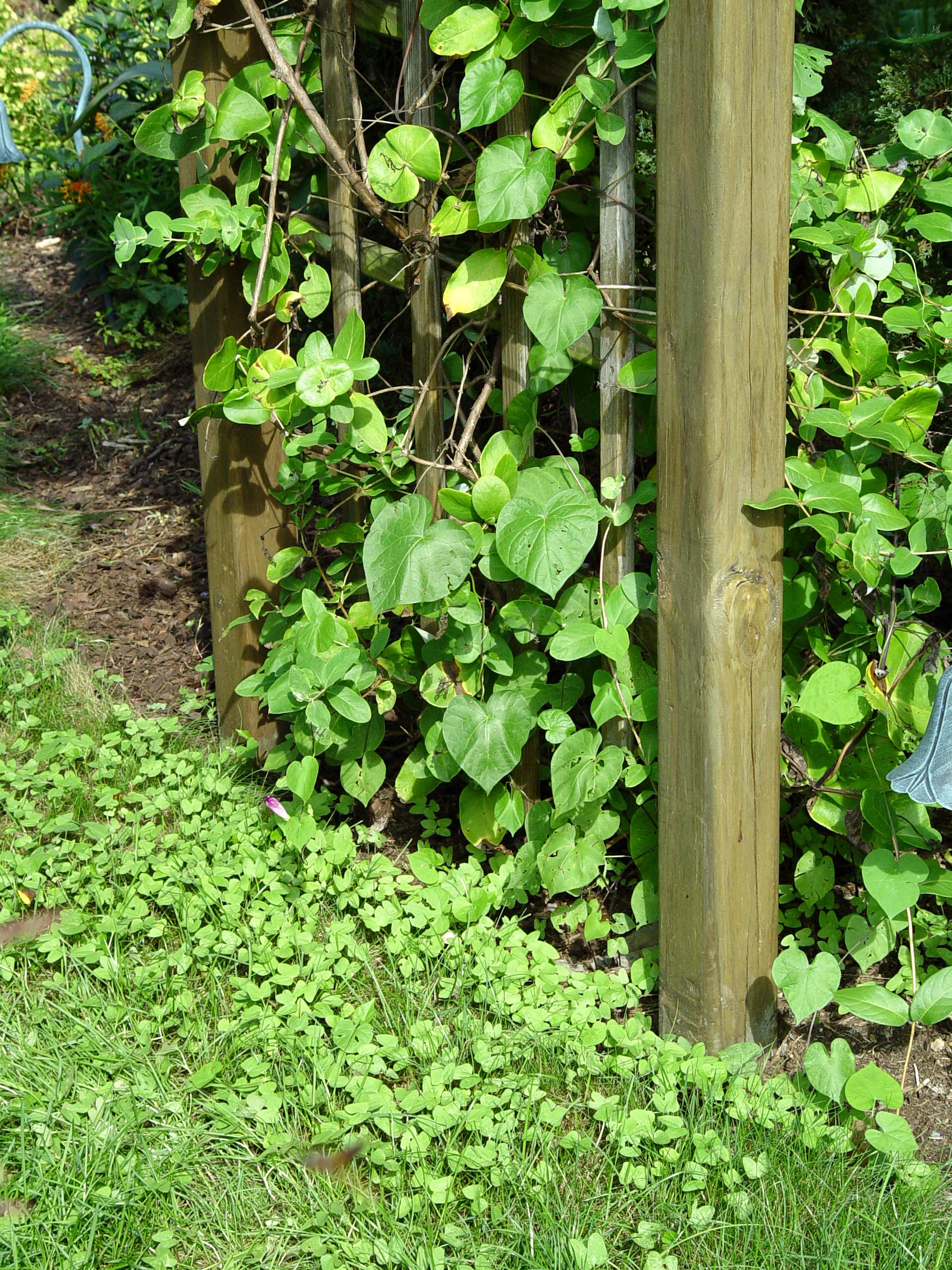
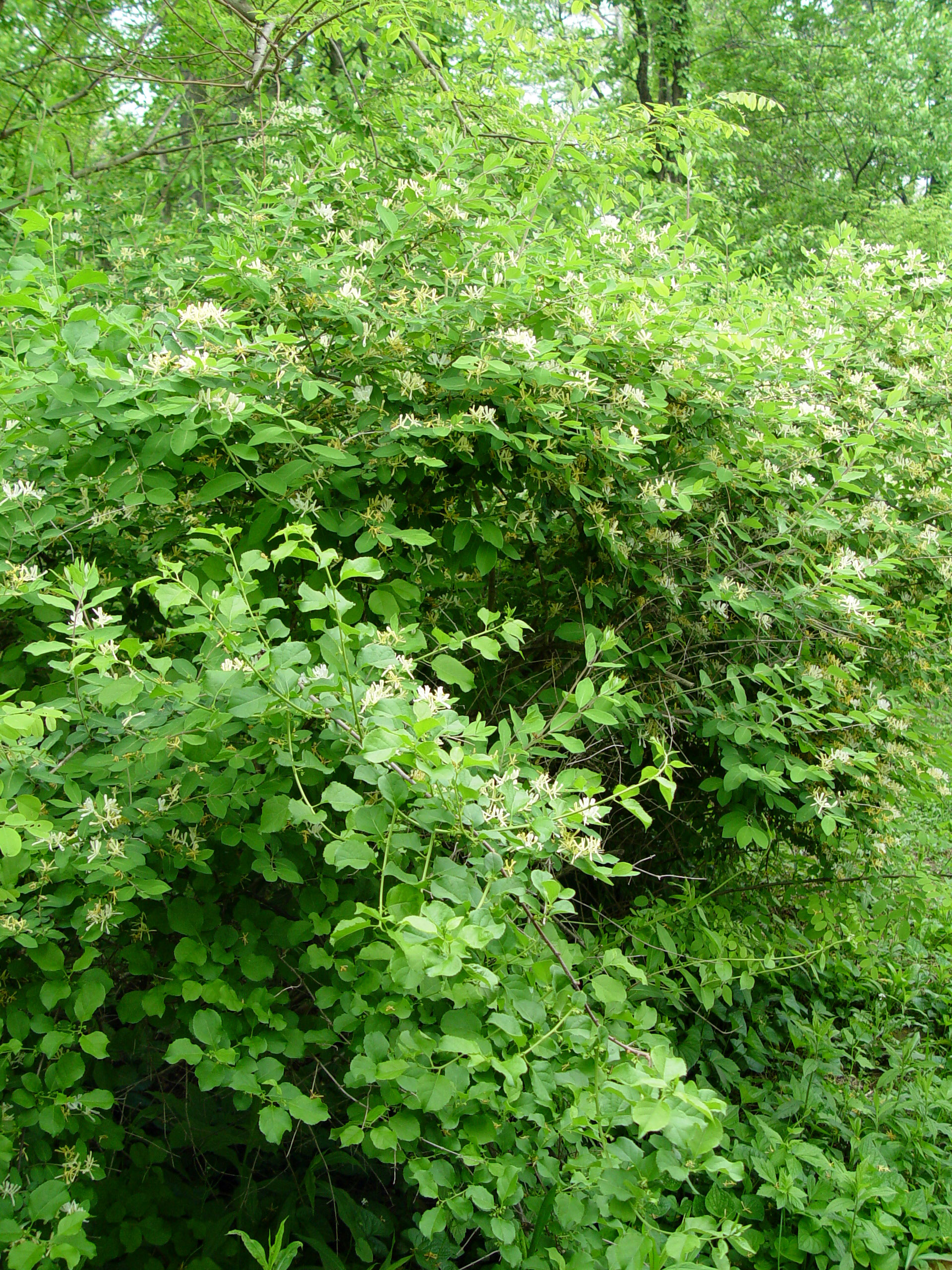
Japanese honeysuckle that's overtaken a landscape.

   PSU researchers Tomas Carlo and Jason Gleditsch thought they’d test the prevailing notion that invasives are bad for ecosystems because they choke out native species and deprive native wildlife of the food and shelter they depend on.

   The pair studied sections of Happy Valley that have been overrun with Japanese honeysuckle – one of our most invasive invaders – and compared bird activity with surrounding urban, agriculture and forested areas.

   What they found is that robins, catbirds and other fruit-eating birds actually like honeysuckle fruits and have come to depend on it.

   “The abundance of fruit-eating birds in the Happy Valley region is linked to the abundance of honeysuckle,” says Carlo. “Honeysuckle comprises more than half of all the fruits available in the landscape, and it benefits birds by providing them with a source of food in the fall.”

   Carlo and Gleditsch then introduced native American nightshade into honeysuckle-infested areas and found that birds took 30 percent more of that than in non-honeysuckle areas.

   “The newly introduced plants piggybacked on the success of the honeysuckle,” says Carlo, “which is a common phenomenon because fruit-eating birds usually feed on a variety of fruit – whatever happens to be available to them.”

   Now that doesn’t mean the researchers are saying it’s OK to ignore potentially invasive species or that none of them pose any problems.

   What their research does suggest is that this issue is a lot more complicated than concluding that native plants are always good and non-natives are always bad.

   Once an alien species is introduced, the study suggests, it may be a mistake to try and eradicate it and return areas to their native, pristine state. That’s been the prevailing goal of conservationists, eco-minded land managers and native-leaning gardeners.

   Says Carlo: “We wondered, ‘Are we sometimes doing more harm than good when we eradicate plants that, despite being introduced recently, have formed positive relationships with native animals?’… Nature is in a constant state of flux, always shifting and readjusting as new relationships form between species, and not all of these relationships are bad just because they are novel or created by humans. We need to be more careful about shooting first and asking questions later, assuming that introduced species are inherently harmful.”

   So what are we to make of all of this when it comes to our home landscapes?

   What I try to do is plant as much diversity as possible – natives as well as non-natives – and then stay out of the way as much as possible to let nature sort it out.

   I seldom spray anything so as not to interrupt nature’s system of using bugs, weather and disease to determine what plants should grow here and which shouldn’t.

Morning glory that's seeded into the lawn.

   I stay away from plants that get out of control, and that includes species on native-plant “hit lists” (burning bush, non-sterile butterfly bush, barberry, etc.) as well as rampant seeders such as morning glory (a non-native) and hardy ageratum (a native).

   And I try to point my disturbed subdivision “soil” back in the right direction by adding compost and using fallen leaves as mulch instead of blowing them out to the curb.

   I like most native plants, but I also like plenty of introduced plants. So I guess that puts me somewhere in the case-by-case, moderate middle.

   By the way, another “finding-middle-ground” issue is in the trend toward what’s being called “meadowscaping” – a form of gardening I plan to write about in a couple of Patriot-News garden columns next month.

   This is a way to replace lawns with native plants but in ways that are acceptable to populated sensitivities.

   Catherine Zimmerman wrote a new book on the topic (“Urban and Suburban Meadows: Bringing Meadowscaping to Big and Small Spaces,” Matrix Media Press, $29.95), and I’m going to sit in on a talk she’s doing at this year’s Native Plants in the Landscape conference.

   If you’re interested in native plants, that conference is loaded with great info, resources, speakers and plants.

   It happens every June at Millersville University, and is open to the public.

   This year’s conference takes place June 1-4 and includes programs by fruit expert Lee Reich, former Longwood Gardens plant curator and grass-book author Rick Darke and Cornell urban-tree professor Nina Bassuk.

   Check out the full program and more details at www.millersvillenativeplants.org.


Inspired Pot Plants

May 3rd, 2011

   It’s easy to get in a pot rut, picking the same worn choices every spring for your containers.

   How many pots of red geraniums, spikes and vinca vines do we really need?

   One of the best resources for cutting-edge pot-plant ideas is Ray Rogers, a perennial multiple ribbon-winner at the Philadelphia Flower Show and author of “The Encyclopedia of Container Plants” (with Rob Cardillo, Timber Press, 2010, $34.95).

   I sat in on a talk Ray did at this year’s Philly Flower Show on some of his favorite pot choices.

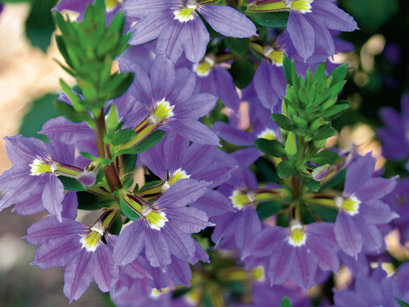
Proven Winners' Scaevola aemula 'New Wonder.'

   Here are a few pot plants he’s particularly high on…

   * Scaevola aemula. Fan flower is a common name for this Australian native that blooms blue or bluish-purple and has a trailing habit.

   “If there’s one plant you grow in a container, it’s this one,” says Rogers. “It will bloom from the day you put it in in May until frost. It’s never out of bloom.” (Sun or light shade.)

   * Angel’s trumpet (Brugmansia). Rogers like these and the closely related datura for their huge, showy, drooping trumpet-shaped flowers, most typically in white, pale pink and soft yellow.

   “If I grew only one tropical in a pot, this would be it,” he says.

   Both are poisonous, though, so be mindful if you’ve got pets, little kids or hallucinogen-aware teens lurking. (Sun or light shade.)

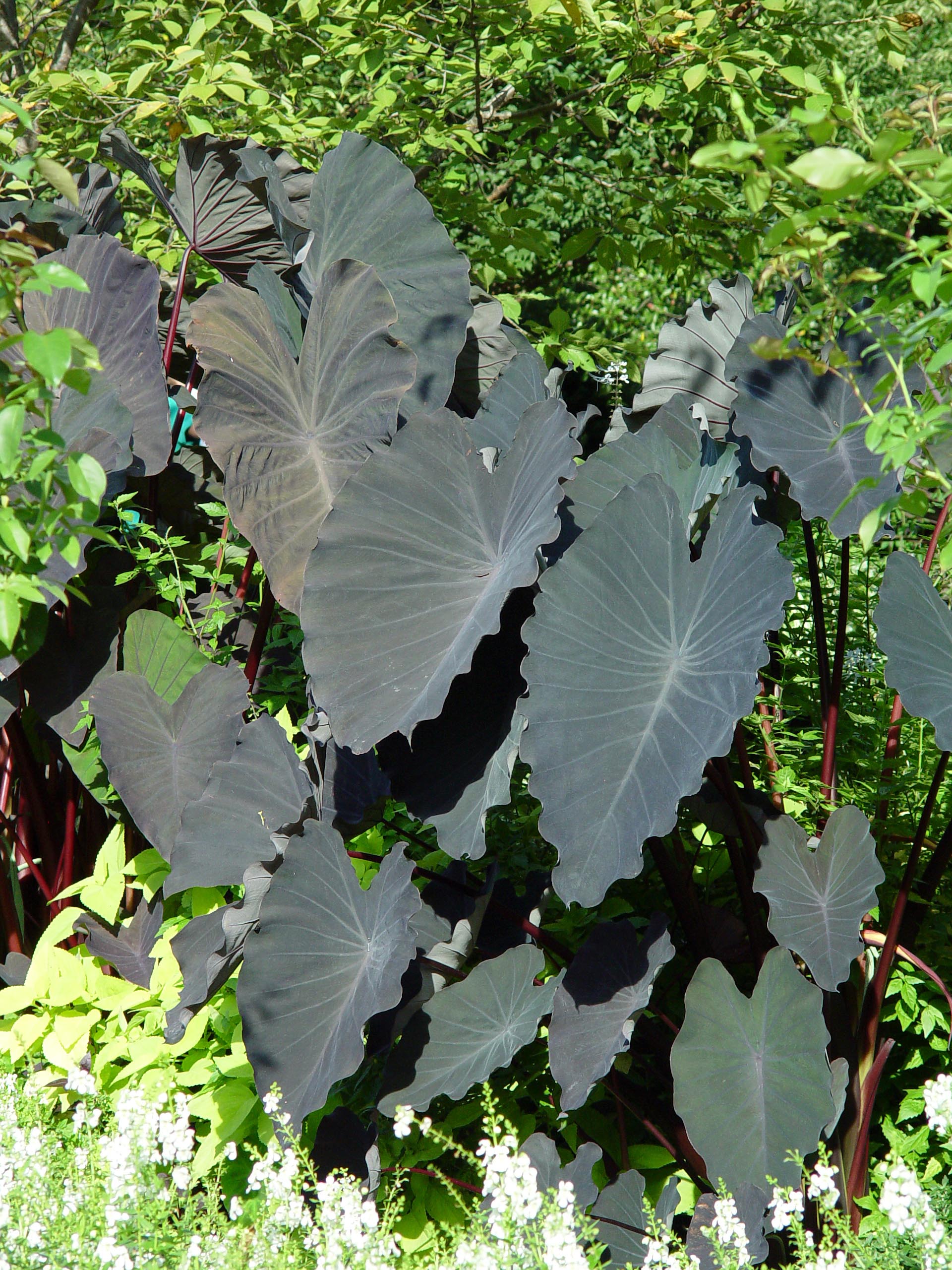
A black-leafed colocasia.

   * Colocasia. Commonly called “elephant’s ears,” this softball-sized summer bulb is grown for the huge leaves – some of which come in black or burgundy/green variegation.

   “The leaves are so big you could hide an 8-year-old child in them,” says Rogers.

   Bulbs can dug and saved inside over winter for use another year.

   * Cannas and callas. People get these two confused, but both are summer bulbs that produce trumpet-shaped flowers.

   Cannas are bigger with large leaves (sometimes in black, burgundy or tiger-like variegation), and they bloom at the top of 3- to 4-foot spikes mostly in orange, red or yellow. (Full sun.)

   Callas are smaller (1 to 2 feet), have upward-facing flowers (most often white), and many have white-spotted leaves. (Shade or part shade.)

   Both also can be saved like colocasia.

   * Cactus. “I love cactus in pots,” says Rogers. “They’re not all blobs, heads or pillars.”

   These and other worthy succulents (aloes, creeping sedums and echeveria) need much less water than annuals, which is a plus in pots and hanging baskets. (Sun or light shade.)

A snake plant with tubular stems.

   * Houseplants. Do some pot-plant hunting in the houseplant section, not just around the annuals benches. Most of these do just fine outside in pots. Rogers especially likes snake plants and especially the ones that look tubular (Sansevieria cylindrica).

   “Why not use houseplants in your pots?” he asks. “They deserve to be liberated.”

   * Hakone grass. This is actually a hardy perennial grass with a beautiful arching habit. It grows only a foot or so tall and comes in golden and gold-variegated versions.

   Grow it in the ground and just dig up sections to pot each spring for a money-saving option. (Shade or part shade.)

   * Variegated iris. Also a perennial, this 2-foot upright has bladed leaves that are striped white and green. The spring blooms are a bonus – usually in blue or purple.

   It’s another that can go in the ground at season’s end.

   * Edibles. Just because you can eat a plant doesn’t mean it’s off limits in an ornamental container.

   Rogers says purple cabbage looks great in a pot with parsley and sage.

   Red mustard, purple basil and all sorts of sages are colorful as well as useful for snipping for the kitchen.

   And mints are actually best grown in pots or hanging baskets where their roots won’t run.

   “How many of you have grown mint in the open garden and regretted it?” Rogers says.

   * Petunias and calibrachoa. So far as conventional annuals go, Rogers puts these two high on his list.

   All of the ‘Wave’ petunias and their many new hybrid, cutting-grown brethren are non-stop balls of color (save for occasional mid-summer attacks by budworms).

   Calibrachoa or “million bells” have similar trumpet-shaped flowers of most any color, except their leaves and flowers are slightly smaller than petunias (not counting the petite versions of petunias, such as ‘Petitunias,’ ‘Littletunias’ and ‘Mini Me’). (Sun or light shade.)

   OK. You’re armed now. Try something new… whether it’s one of these or something that grabs your eye at the garden center.

   Life is too short for red geraniums.


Surviving the Sog

April 26th, 2011

   Rain is good, but enough is enough already.

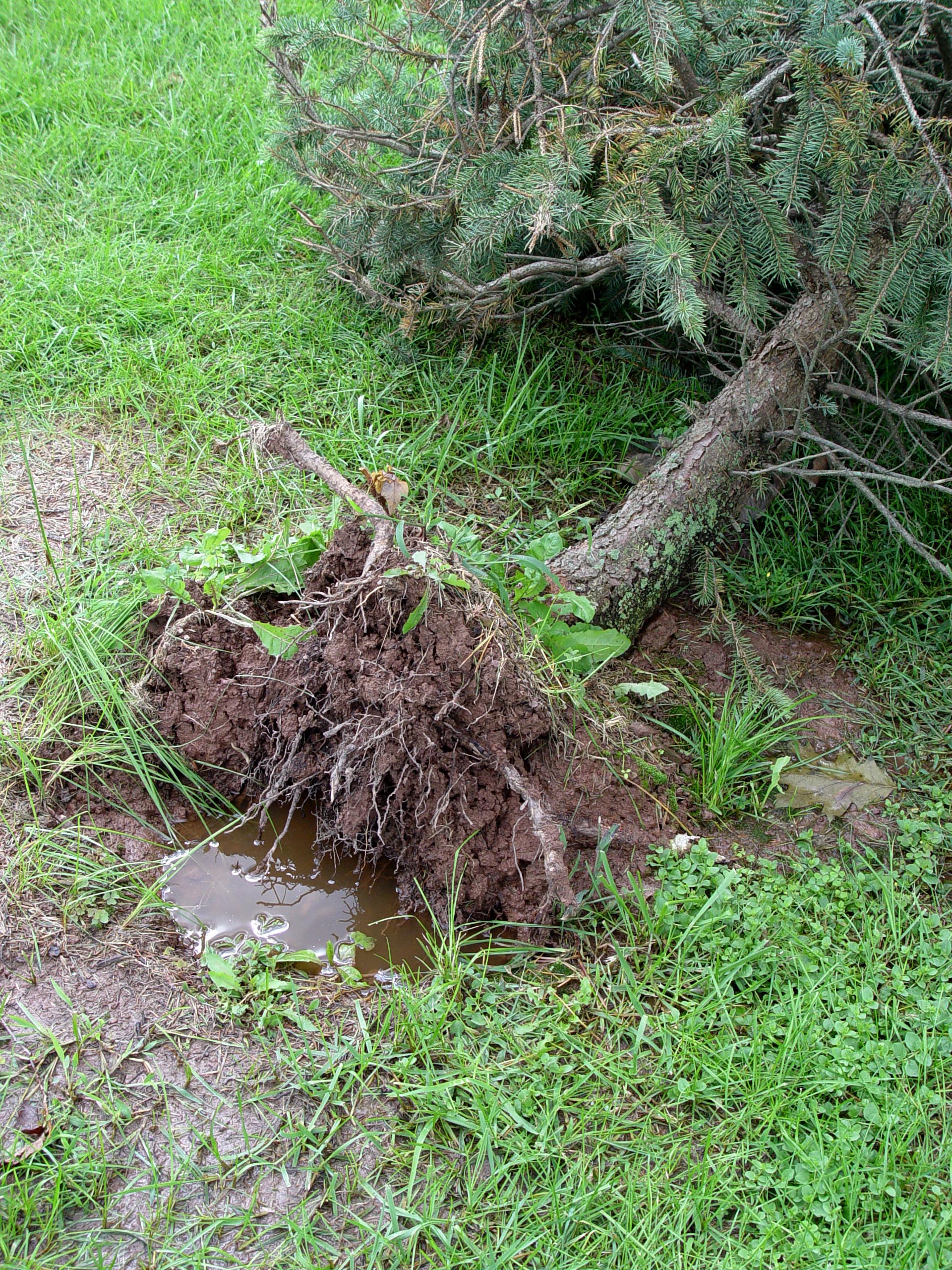
Soggy soil is the culprit behind this spruce blow-over.

   We could really use some warmth and sunshine to activate our plants, which have been lagging around waiting for the growing season to show up.

   All of the new rain on top of saturated soil has created a lot of soggy spots that aren’t normally soggy.

   One fellow told me last week he had water literally pouring out from around his 4-year-old weeping Alaska cedar for two days – the result of a water table that topped out way above normal.

   Soggy soil can be a big problem but often an insidious one that doesn’t show its true damage until months later.

    Most plants can survive two or three days in wet soil, but few can go a week or more. Some of the most at risk are needled evergreens (such as weeping Alaska cedar). Most evergreens don’t tolerate soggy soil as well as most leaf-dropping trees.

   The main problem is that excess water fills the air pores in the soil and deprives roots of oxygen. Damage is typically gradual and varies based on just how wet the soil is for how long, how well the soil drains, and the age, health and root spread of the plant.

   In other words, there’s no clear, defined line where you can say two days in wet soil is no problem but three days is death.

   Even different parts of the same yard pose different threats. A south-facing slope might dry out just fine in a matter of hours, while a low-lying patch near a shady, north foundation might stay wet for days.

   Soggy soil damages root systems gradually — starting with the small feeder roots. You might not notice any problem soon after the water table goes back down (assuming it someday does).

   A bigger test will come in summer.

   Assuming we end up with the usual wild July/August swing the opposite way into ridiculous heat and drought, that’s when sog-damaged roots will be put to the test. If enough of the roots died off that they can’t supply the peak water demand to the foliage, that’s when the tree could “suddenly” brown out.

   Most people will blame the heat and drought at that point, but it’s really the insidious root loss from the earlier bogginess that was the main cause.

   Soggy soil also can lead to a buildup of toxic compounds in the soil as well as encourage root-rotting fungi — two other side effects that aren’t helpful.

   High water tables are trickier to solve than water from surface runoff, which I wrote about in last week’s post below. Sogginess caused by slope runoff or drainage from a down spout can be corrected by redirecting the flow.

   When rain of Noah’s Ark proportion happens and water rises from below, there’s not a whole lot you can do.

   Digging a trench to help drain the area faster might help a little. So might removing mulch and poking a few holes in the soil surface.

   Beyond that, be ready to bail out hurting plants if/when we get into hot, dry weather this summer. If you had plants swimming in soggy soil for several days, assume root damage has occurred. Help plants at that point by giving them a good weekly soaking. Just stick your finger or a probe into the ground before watering and do the deed if it’s dry down in the root zone. That’ll help the remaining roots that are trying to get the job done by themselves.

   Solving sogginess is better done at planting time than afterward. If you realize a site is wet often, the two best solutions are: 1.) moving soggy-sensitive plants to a drier location or 2.) building a berm so the roots will sit above the water table.

   Most tree roots grow in the top 1 to 2 feet of soil. They don’t go way down like many people believe. Berms 2 feet high solve most wet-soil issues.

   The sooner you have to move a threatened plant, the better. Young or newly planted plants transplant much better than ones that have put down extensive roots.

   I wouldn’t move an established plant if this soggy situation was a first-time and hopefully very rare event.

   However, if you realize a site is wetter more often than you thought, better to get your threatened green friends to higher ground than to let them constantly gasp for air.

   One of these days they’re going to give up.


Weather Driving You Boggy?

April 19th, 2011

   Here’s hoping your garden – and house, for that matter – didn’t float away in Saturday’s deluge.

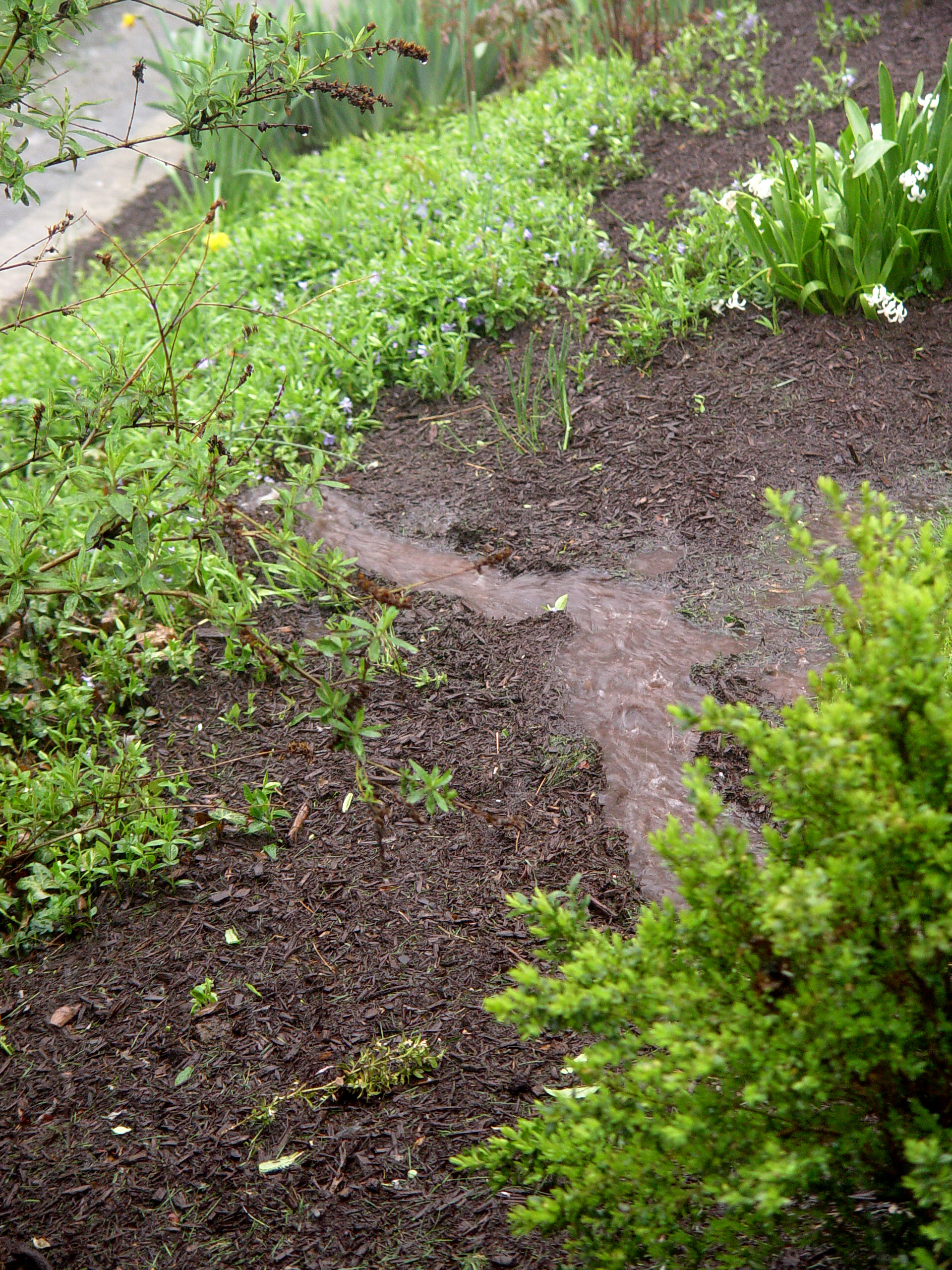
Saturday's deluge created all sorts of new little backyard "creeks."

   Outside, the biggest threat was washouts. If you planted something recently in the path that run-off water decided to take, look for your plant in the gutter down the street. You may be able to salvage it by replanting ASAP.

   A slightly lesser problem was soil that got washed away from the root zones of plants. If you can rake or add soil back around the roots, the plants should be fine. The longer you let bare roots exposed to the air, the more likely you’ll get dieback. So check around plants and “retrofit” them now.

   Soggy soil is a third and more insidious threat. Some plants tolerate “wet feet” pretty well. Others can take a day or two of standing water before trouble starts. Others (mostly Mediterranean plants and those native to dry meadows) start to root-rot if they’re in soggy soil for more than a few hours.

   There’s not a whole lot you can do to get rid of standing water once it happens. A better approach is to correct the cause so you don’t run into trouble the next time we get dumped on (and you KNOW there will be a next time).

   This storm was actually a good test to get a read on how your property drains. Where did the water run? Did you get washouts? Where did it puddle? How did your spouts and storm-water grading perform?

   If you noticed trouble spots, you’ve got two options. One is to address how and where the water reaches the ground. The other is improving the ground’s ability to soak up that water.

   Although our house sits up on a ridge, we still got some water in the basement. That happened because the spout was clogged with birch-tree debris, causing 3+ inches of rain to spill out the front of the spouting and into a flower bed along the basement wall.

   So Lesson 1 is to keep those spouts clean. Or install one of the various gutter protectors to keep leaves and assorted other debris out of them.

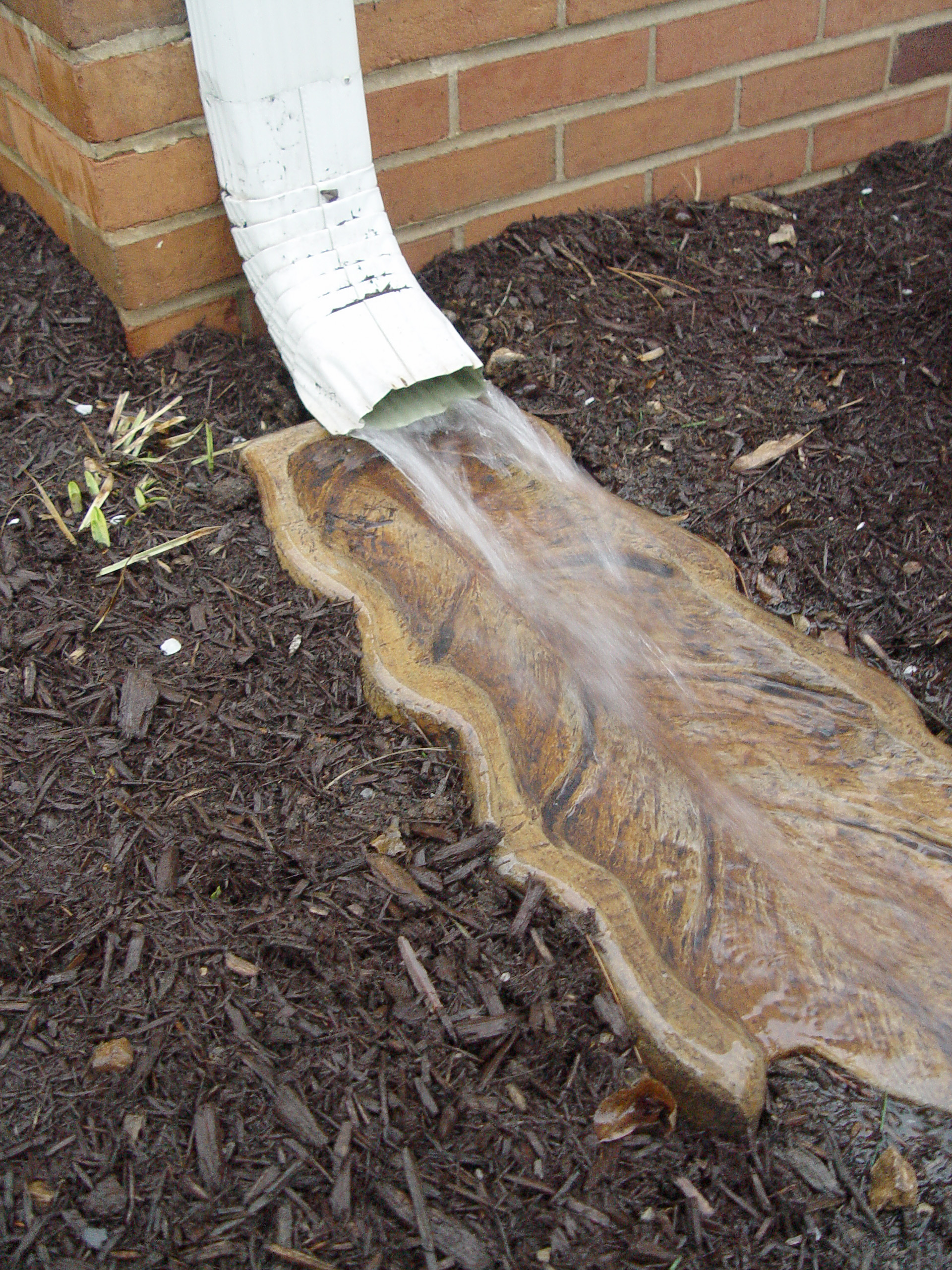
Splash guards, spout extenders or stone circles are all ways to slow run-off and preven washouts.

   Lesson 2 is to make sure you’ve got extenders at the base of your down-spouts so water is carried away from the house. I see a lot of homes that drop the water right underneath a down-spout. Unless those homes have superb water-proofing, that’s a recipe for water seepage in heavy rain.

   Lesson 3 is to break gushers that happen at the end of those extenders. If your spouts are dumping into a mulched bed, heavy storms will blow the mulch out of the way and probably some of the soil underneath.

   I head that off by installing circles of mid-sized stones at the end of my spouting. Gushing water hits the stones and slows enough that it then washes more gently out into the lawn. You need big enough stones to withstand that force. River pebbles or gravel won’t cut it.

   Lesson 4 is redirecting where the water flows. If water is dumping into a low-lying area, you might want to redirect spouting so it sends water down a different route. (Make sure it’s downhill!)

   Some people bury extended drain piping to carry run-off to a more strategic location. That might solve that part of the yard that’s always muddy for days after a storm.

   A whole second strategy is “going with the flow.” Instead of the traditional goal of trying to move as much run-off as possible off your property as fast as possible, an increasingly popular option is building “rain gardens” designed to capture rain water.

   These gardens are created in slight depressions and improved with generous amounts of sand and compost so water soaks into the ground within two days. The rain garden is then planted with species that tolerate occasional soggy soil (winterberry holly, red osier dogwood, Virginia sweetspire, summersweet, turtlehead, etc.) but that also do fine when the weather is dry.

   If you’re interested, here’s a link to a garden column I wrote on building a rain garden:

   I’ve also got a new article written on rain gardens scheduled to run in this Thursday’s Patriot-News (and which should end up on the paper’s Pennlive web site .

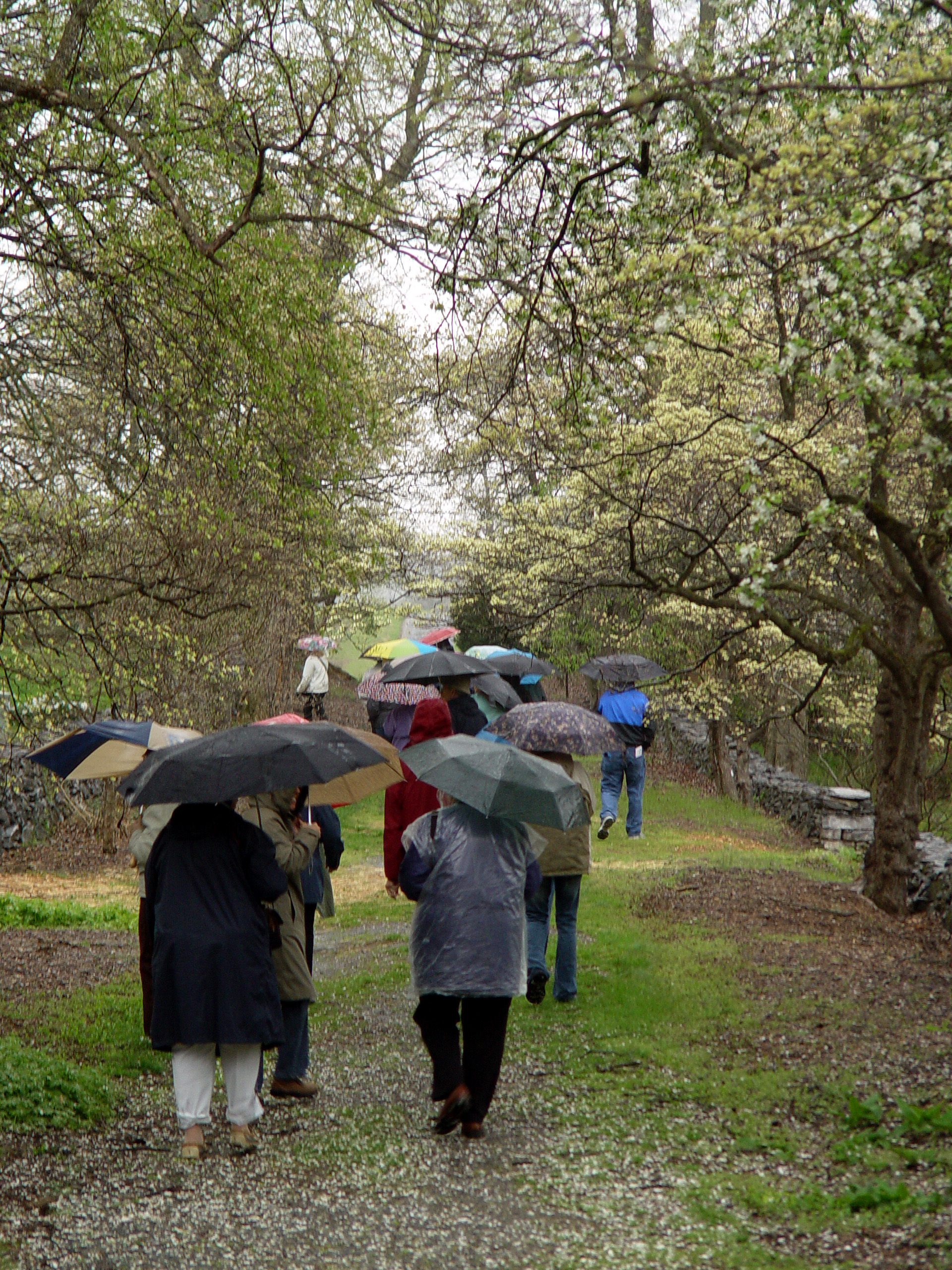
Garden-touring at the Virginia State Arboretum in the rain.

   My wife and I spent the soaking day Saturday leading a garden tour to Winchester, Va. As you might’ve noticed, my weather track record isn’t always very good any time I plan to be in a garden.

   Nevertheless, our bus group was filled with gardeners who also are used to getting rained on, and they enjoyed the nice gardens anyway at the Virginia State Arboretum, Historic Long Branch and three of the homes on this year’s Winchester Home and Garden Tour.

   Winchester is two hours south of Harrisburg, so their blooms and plant development were at least a week ahead of us.

   We’re all running late this year, though, because of the cool and rainy start to the growing season.

   We could use a little warmth and sunshine. Otherwise, I’m starting work on an ark.


« Older Ramblings and Readlings Newer Ramblings and Readlings »

  • Home
  • Garden House-Calls
  • George's Talks & Trips
  • Disclosure

© 2026 George Weigel | Site designed and programmed by Pittsburgh Web Developer Andy Weigel using WordPress