




Poison Ivy: The Plant that Bites Back
September 8th, 2015
Plants are generally pretty docile and defenseless creations.
If your dog wants to dig up a daylily or you feel like decapitating a cabbage for dinner, there’s really not much the plants can do about it.
Then there’s Toxicodendron radicans, better known as poison ivy.
Now THAT’S a plant that can bite back!
Poison ivy’s key weapon is a potent oil called “urushiol,’ which causes an annoying to dreadfully painful skin rash in an estimated 85 percent of people who come into contact with it.
The plant itself is a tough, adaptable vine that lurks most everywhere, from shady wooded areas to roadside banks to that forgotten corner of the backyard.
Some evidence suggests it’s been getting worse lately due to the warming climate, so you might not be imagining it if it seems that way in your yard.
The dreaded itching usually begins within 24 to 36 hours of getting the oil on your skin. Exposed areas turn red and may blister, then typically crust over and heal within two weeks.
That’s bad enough. But for about one in 10 people, the rashes are severe, painful and in extreme cases, even life-threatening.
Randy Connolly found that out when he was 7 years old.
Connolly was playing baseball one day in a park in his native Massachusetts when a neighbor decided to burn some brush and leaves. In the pile was poison ivy.
Urushiol oil in the smoke caused a severe allergic reaction in Connolly’s lung lining. He spent two weeks in the hospital and nearly died.
Ever since, he’s had immediate and severe reactions to any contact with urushiol. Needless to say, Connolly and his wife, Heidi Ratner-Connolly, who also reacts to urushiol, are more vigilant about poison ivy than your average people.
Ratner-Connolly says the secret is 1.) knowing what this “ghoulish greenery” looks like, 2.) taking a few basic precautions to avoid it, and 3.) knowing what to do in case you come into contact with it.
Sounds simple. But when the Connollys were first developing their anti-poison-ivy game plan, they found a lot of myths, half-truths and anecdotal advice.
“Since Randy almost died from inhaling the smoke, we were always worried about contact with it,” says Ratner-Connolly. “But we just couldn’t find one resource with all the information we needed.”
So they researched and wrote their own. Their book is “10 Things to Know About Poison Ivy, Pets and People” by Heidi Ratner-Connolly and Randy Connolly (2Lakes Publishing, 2004, $9.95 paperback).
Native Americans warned the early European settlers about this wretched vine as early as 1609, when Capt. John Smith coined the term “poison ivy” and logged it in his records.
That it’s still around today – healthier than ever – is a testament to its tenacity.
Ben Franklin’s saying, “Leaves of three, let them be,” is still great advice, says Ratner-Connolly.
“Identification and avoidance are the ONLY real means of prevention,” she says.
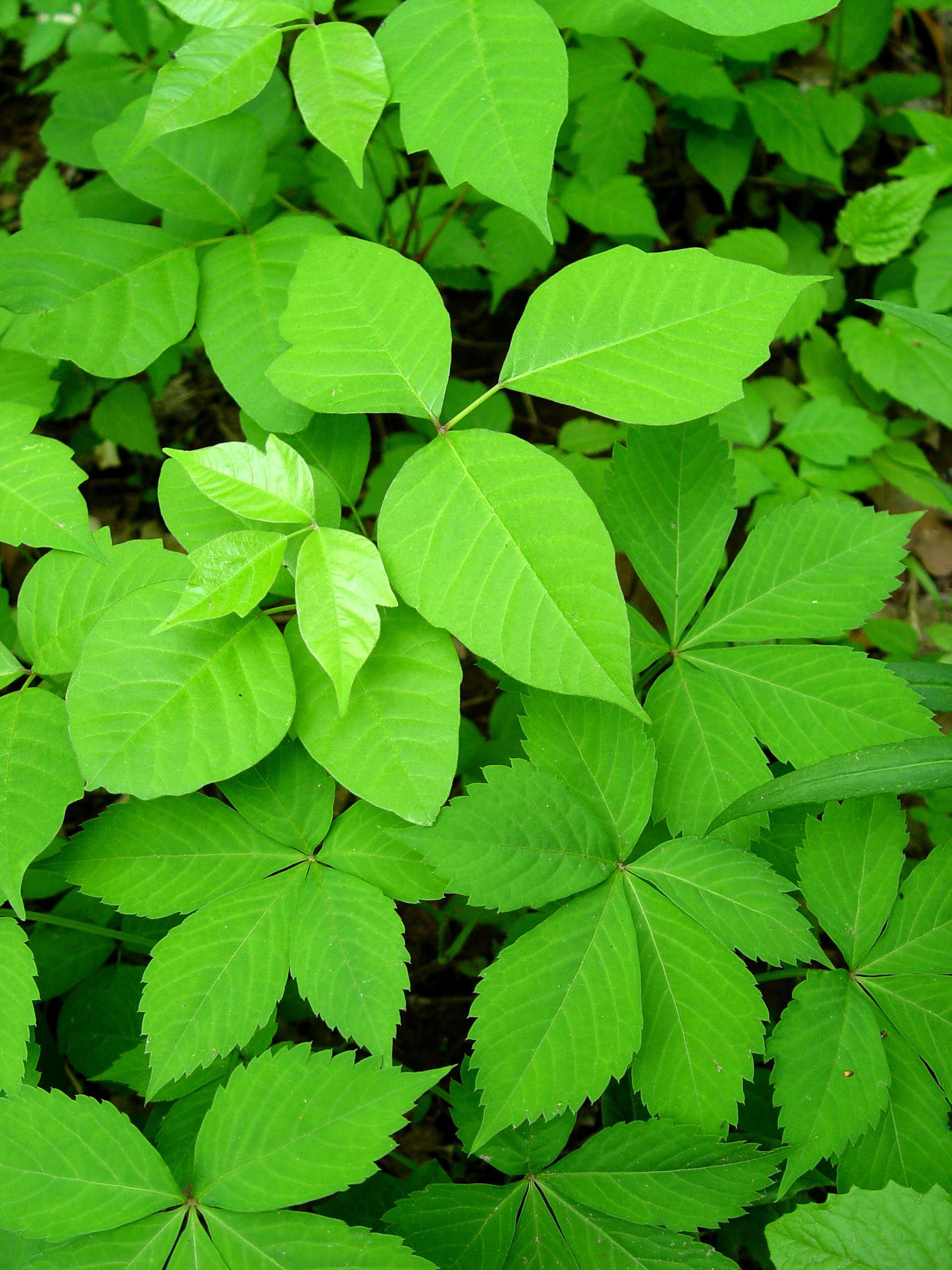
Poison ivy leaves grow in clusters of three with the middle leaf being slightly bigger than the two on either side.
Here’s poison ivy (left) mixing with Virginia creeper (right). Notice that poison ivy has three leaves per cluster while Virginia creeper has five leaves per cluster.
The leaves start out reddish in spring, then become a shiny green in summer before turning various attractive shades of red, orange and yellow in fall. Small, waxy white berries also form in late summer and turn red in fall.
The vines suck onto trees or other nearby climbing surfaces, but if there’s nothing to grab onto, they’ll grow into a floppy shrub. As the vines age, the stems become woody and put out distinctive “hairy” root growths.
Much of the time, people develop rashes without ever realizing they came into contact with poison ivy.
It doesn’t take much. Urushiol is so potent that even a quarter of an ounce of the stuff is enough to give a rash to every person on the planet.
“It’s a really powerful irritant,” Ratner-Connolly says. “Not only does a little bit do a lot of damage, but it’s an invisible oil. It’s hard to avoid something you can’t see.”
The oil is in every part of the plant, not just the leaves, and it can remain viable for as long as five years after the plant has died. So don’t assume you’re safe yanking dead vines off a tree or pulling them when leafless over winter.
Direct contact with a vine isn’t the only way you can get a rash, says Ratner-Connolly.
She says the oil is easily transferred from plants to objects to people – including tools, clothing, shoe bottoms, even stray baseballs and soccer balls retrieved from a weedy area.
Obviously, one of the best ways to lessen the threat is by eliminating nearby poison ivy plants. That’s not easy, but it’s possible.
“Diligence is the key,” says Ratner-Connolly. “You have to get every bit of the plants, leaves, vines and roots, or they will simply sprout again.”
The earlier the better.
“Repeated cutting to the ground will eventually starve out the plant’s root system,” Ratner-Connolly says. “Of course, the hardest part is trying to avoid poisoning while you’re trying to remove it. Always wear protective clothing and try to cover as much of your skin as possible.”
If you’re a spray-oriented person, the Connollys suggest glyphosate-containing weed-killers such as Round-Up, Kleen-Up and Brush-B-Gon to kill the foliage. They also like ordinary white vinegar.
Just be careful using any of those around “good” plants because they’ll kill most anything green. Placing a stone-topped plastic barrier over the cleared surface will help prevent new poison-ivy seed from germinating.
Whatever you do, Ratner-Connolly says, don’t mow, weed-whack or burn poison-ivy plants – dead or alive. That will only spew the oil around more.
Protective creams such as Ivy Block, Tecnu, Multi-Shield and the new “buji Block” help some people, the Connollys say, and so does simply covering up all exposed skin with gloves and clothing.
Tips on prevention:
If you come into contact with poison ivy and its oil, author Heidi Ratner-Connolly advises washing it off ASAP with lots of plain, cold water.
You’ll probably head off a rash if you can wash within 15 minutes. After then, the oil binds irreversibly to skin proteins.
Also wash clothing and other objects so you don’t pick up an indirect, secondary allergic reaction later, she adds.
Randy Connolly also likes to wash with soap (the laundry soap Fels Naptha is his favorite) after washing first with cold water. Another new post-exposure product is “buji Wash,” an exfoliating cleanser that helps remove urushiol.
If a reaction occurs, the Connollys recommend any of a variety of creams and treatments that lessen the itch, including calamine lotion, Epsom salts, bicarbonate of soda, Aveeno oatmeal bath, aloe gel and/or goldenseal root powder.
Over-the-counter cortisone cream or Zanfel Poison Ivy cream also may help mitigate a reaction.
For severe reactions, the Connollys advise seeing a doctor for a possible round of oral steroids. Antibiotics also may be needed in cases where the rash has become infected.
Some other interesting factoids about poison ivy:
* People aged 5 to 20 tend to be most sensitive to poison ivy. Sensitivity tends to lessen from the 30s on, although it’s also possible for previously non-sensitive people to suddenly develop an allergic reaction at any age.
* Reactions usually vary depending on how much urushiol oil you’ve contacted. Higher doses and prolonged contact typically produce worse symptoms.
* Eating poison ivy doesn’t build up a resistance to it. There is, however, a vaccine that can help reduce skin reactions to urushiol.
* Poison ivy is not contagious. You won’t get it from touching someone’s rash or blisters. However, you can react if unwashed urushiol oil on someone else’s skin or clothing rubs onto your skin.
* Most animals do not react to poison ivy. Many birds eat poison-ivy berries, and deer and small mammals even eat poison-ivy leaves with no ill effects.
* Although dogs and cats don’t get skin rashes, they can have life-threatening reactions after eating poison ivy or its berries. Call a vet or one of the two National Animal Poison Control Centers at 1-800-548-2423 or 1-888-426-4435 if your pet has eaten poison ivy. (Note: The poison control centers charge fees for consultations.)
— Source: “10 Things to Know About Poison Ivy, Pets and People”
Other skin-rash plants:
Poison ivy is one of three woody perennial weeds that commonly cause skin rashes.
Also a threat is poison oak and poison sumac, which contain the same urushiol oil as poison ivy.
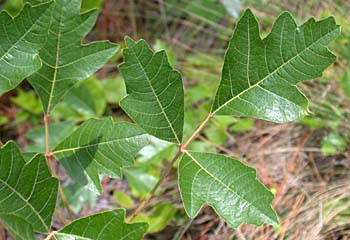
Like poison ivy, poison oak grows in clusters of three leaves that start out reddish in spring, turn glossy green in summer and then take on fall colors of red, orange and yellow.
The leaf tips of poison oak are more rounded than poison ivy’s pointed tips, and poison oak is more commonly found growing as a bushy shrub or groundcover than climbing as a woody vine. Poison oak also puts out waxy, white berry clusters that turn red in fall.
Poison sumac has pointy leaves like poison ivy and the same changing leaf colors. However, its leaves grow in pairs opposite one another on the stems. It also gets white berries that turn red in fall.
The native but non-poisonous staghorn sumac looks very much like poison sumac except it has small hairy projections on the stems. Poison sumac has smooth, hairless stems.

Hello,
Today my girls and I went wild blackberry picking. I of course wandered in far and was picking berries that were near poison ivy some of the berries were very near the ivy leaves. So after picking I got to wondering if any of the oil got on to the berries and if eating them would be ok. Of course they are all mixed together and I can not identify those that were very close to the ivy. Do I toss the entire batch, do I turn it into a pie? or is I am just being overly cautions and it is ok to eat?
Thanks for your thoughts
Jennifer
Hi Jennifer,
Give the berries a good washing with cold water and they’ll be fine. It’s possible that small amounts of the urishiol oil in poison ivy brushed onto some of the berries, but the washing should get rid of most of even that amount. It’s unlikely they’ll lead to any reaction except in the most poison-sensitive people.
Urishiol is pretty potent stuff, though. Some people have had allergic reactions by handling a soccer ball kicked into the woods or by petting a dog that came into contact with poison ivy.
George
I came across poison ivy, was on my hand which wiped my brow, scratched my scalp, and then after it coming out on my face, I washed but it was too late.
Now I’m on prednisone, tecnu wash & calamine solutions. But after 8 days, I seem to wake up with more rashes that have gone over my whole body.
If the oil is in my home I don’t know where? my laptop keys, furniture? I’ve washed all my clothes and bedsheets in hot water and change regularly to still be breaking out ea day.
Help!!!!!!
Pat,
You must be really sensitive to the oil in poison ivy. It sounds like you’re still coming into contact with it somehow. Do you have any pets that might’ve run through it? Any tools? Try to think about anything that might’ve come into contact with the poison ivy before you found it. The oil transfers easily and can stay active for at least weeks. Soap and water should remove it, so it doesn’t sound like you’re getting it from clothing. I hope it settles down soon. That’s a really nasty plant.
George
Hi my name is Kelly. I live in Canada (New Brunswick). I could write a small book about this poision ivy. Mine started 4 years ago in my small back yard.
The first time I caught it, I didn’t have a clue what was going on. It went on for 4 to 5 weeks. I was so sick. Finally, a doctor gave me steriods. That did help. Every May until July I have a rash and feel terrible. I still don’t know where it’s at in my yard. I hope i can get this figured out so i can help others to know what to do.
There are several good books that are excellent for identifying and eliminating poison ivy as well as preventing and treating outbreaks. Besides the Connolly’s book, I can also recommend “Outwitting Poison Ivy” by Susan Carol Hauser (Lyons Press, 2001) and “The Poison Oak and Poison Ivy Survival Guide” by Sandra J. Baker (Coleman Creek Press, 2011).
George
How does poison ivy germinate? I haven’t see any obvious seeds.
Thanks
Glenn
Glenn,
Poison ivy fruits and gets little red berries in fall that birds actually like. They apparently don’t react to the oil that’s so allergenic to people. The usual way this plant spreads is that birds eat the fruits and poop out the seeds, which germinate in the new area.
George
A few years ago my small dog was eating grass and by accident (or so I thought at the time) ate some poison ivy leaves. I immediately called our vet. She told me to feed my dog some crumbled up bread and milk. She said if she’d only ingested a small amount, I had nothing to worry about. However, to be on the safe side, I should give her the bread and milk and keep an eye on her for anything unusual. I followed the vet’s instructions, and my little dog was just fine.
Since that time, my dog seeks out poison ivy and tries to nibble the leaves! She may have discovered she likes the taste the first time I caught her eating it! Or, maybe she had eaten it before, and I hadn’t noticed she wasn’t just eating grass! None the less, it’s difficult to keep an eye on her every move when she’s outside! She’s had no ill effects from her nibbles. But, I still stop her every time I see her near poison ivy!
I was wondering if you’ve ever heard of dogs that crave the taste of poison ivy? Also, what might be the reason they seek it out to eat? My dog is on a good diet of a well known brand of dog food. But, if something is missing in her diet that could be leading her to poison ivy, I wish I knew! I’d certainly try a supplement to hopefully get rid of her craving!
Caroline,
Interesting. It’s hard to imagine what goes on in a dog’s mind when he/she decides whether to eat something or not. From the dogs I’ve seen in action, at least some will eat most anything in front of them that looks curious. I don’t think it’s always a matter that they’re trying to compensate for something missing in their diet.
It sounds like your dog for some reason likes the taste of poison ivy or at least finds it attractive-looking enough to eat. You’ll probably have an easier time just eliminating any poison ivy within reach than teaching your dog which plants is OK to eat and which isn’t.
George
It was growing up a tree so I pulled it out and of course I got it for a few weeks during the summer but now I’m afraid to pull at it again I’ll wear gloves and clothes etc. but is it better to do it in the winter ? I was advised to get it off The tree because it could choke the tree is that true?
Hal,
Poison ivy is a little easier to manage in winter when leafless, but you can still get a skin reaction from the oil in the stems and branches. At least the exposure is a little less without dense leaves all over. Definitely wear gloves, long sleeves, etc. even when pulling it in winter.
Poison ivy doesn’t suck the life out of trunks or “choke” trees, but the vines can grow up and over the tree branches. Then the poison ivy leaves can block sunlight to the tree, and at that point, it can stunt and even kill a tree. So, yes, it’s a good idea to keep poison ivy from climbing trees. The sooner you recognize it and stop it, the better.
We have poison ivy creeping by way of roots into the yard from the fenced off pond bank where control seems to be a lost cause. However, I would like to at least keep it on the opposite side of the fence. Can I create a below ground barrier that will help me accomplish this? I am working to gradually eliminate each tiny out cropping manually and follow the roots also using vinegar-dish soap+salt.
Belle,
A barrier might help a little, but poison ivy also can spread by seed, so a barrier alone won’t guarantee a solution. I’d go down at least a foot if you try one and then monitor the area to cut and/or spray any shoots or branches that appear. If you’re persistent enough going on the offense, you’ll eventually win. A 3-inch layer of mulch will help discourage seeding once you clear the area.