



Artillery fungus
May 28th, 2000
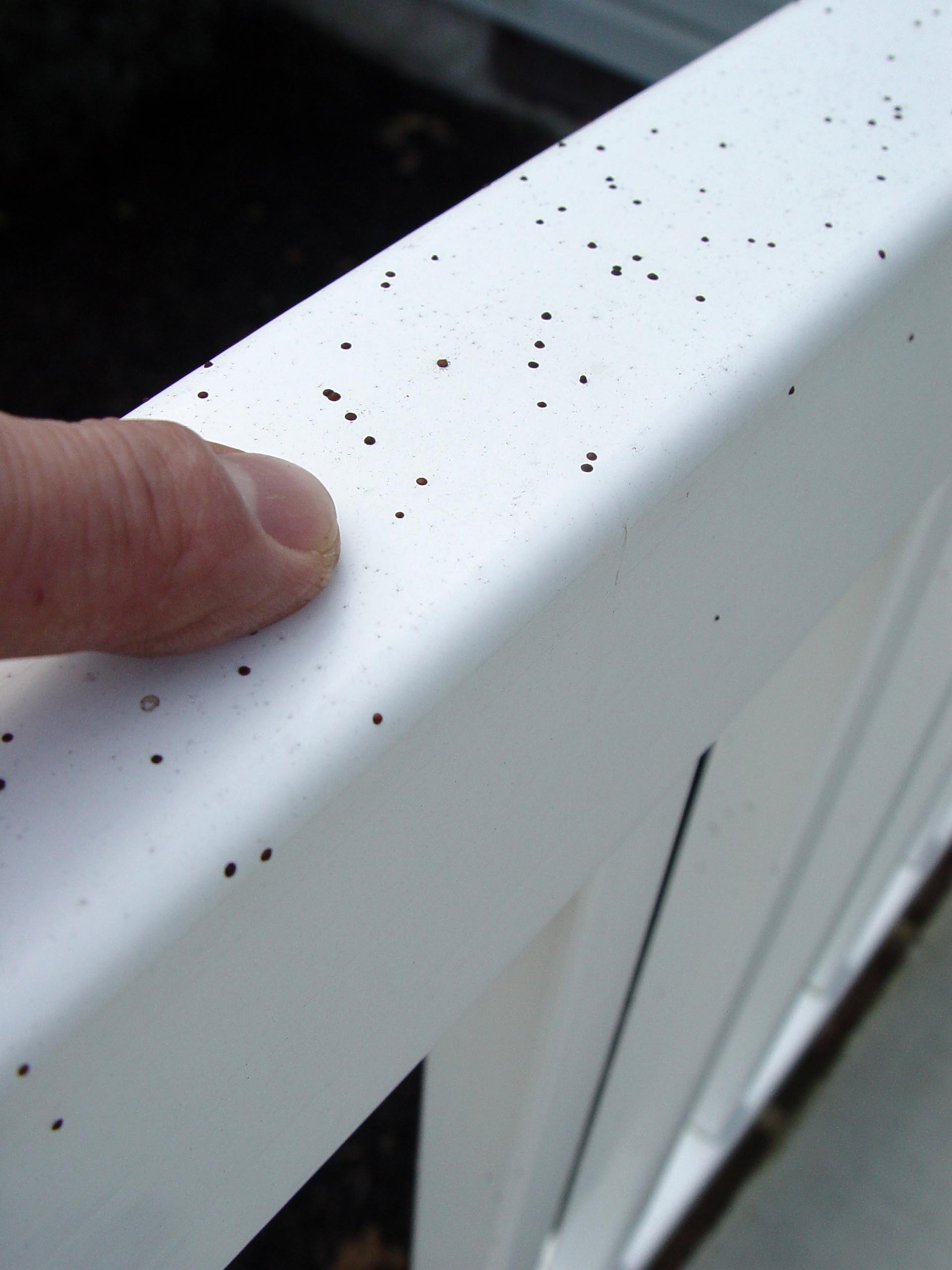
These little tarry black dots on siding and fencing are the spores of mulch-borne artillery fungus.
Lois Stewart was aghast when little, black tar-like spots started mysteriously appearing all over the new white vinyl deck railing and white aluminum siding at her Upper Allen Twp. home.
“I thought it was some kind of bug coming off the hollies at first,” she says. “But this stuff just would not come off.”
The mystery was quickly getting out of hand until Stewart went to a garden center and learned that the spots were not bug-related but were actually the work of a notorious wood-dwelling fungus known as the “artillery” or “shotgun” fungus.
This organism - scientifically known as “Sphaerobolus stellatus” — helps decompose wood, plant debris and animal dung. It’s totally harmless to people, animals and living plants, but it has the nasty habit of shooting sticky, black spores up to 8 or 10 feet high and wide.
That wouldn’t be a problem if we didn’t put siding, fences, railing and even cars in its way.
But when these shooting spores hit such surfaces, they “stick like Super Glue,” says Dr. Larry Kuhns, a Pennsylvania State University horticulture professor who’s researching what to do about artillery fungus. “As it accumulates, it takes on the appearance that the house has been spray-painted with a clogged sprayer.”
This little fungus has been causing big problems in recent years, not only in Pennsylvania but around the world. It’s become especially bad lately throughout the East Coast, where our cool, damp spring and fall weather is perfect for spore growth.
The presence of the artillery fungus is difficult to detect because it is only one-tenth of an inch in diameter and orangish-brown in color. Usually the first time people notice they’ve got it is when those black dots - about the size of a round-headed pin - show up on the siding.
Most often, the fungus is found growing in the wood mulch that’s become increasingly popular for weed prevention, moisture retention and neatness around homes. If enough of the fungus is present, the mulch can take on an orangish, bleached look.
The problem is bad news not only for homeowners. It’s become an increasing headache for mulch producers, mulch suppliers and insurance companies, who are getting more and more claims from people who want reimbursed for having their houses and cars cleaned or repainted.
Penn State researchers estimate the fungus is causing at least $1 million in damage per year throughout the state.
“I run across it a lot, mostly on light surfaces,” says Anthony Baer, who owns A.R. Baer Painting in Mechanicsburg. “It’s hard to get off. It seems to eat its way into paint and even works into bare metal.”
The artillery fungus shows up at people’s homes like the Stewarts’ in a variety of ways.
It could show up in mulch that’s already infested or on plant material that has spores on the leaf undersides. It could come in on the droppings of animals that have eaten infested plants or wood. Or it could even show up on the fur and feathers of animals and birds that previously have visited infested areas.
Given wood as a plentiful food source along with moisture and temperatures in the 68- to 77-degree range, the fungus reproduces readily.
But it’s when the temperatures are a bit cooler - in the 50- to 68-degree range - that the real trouble occurs.
That’s when the little cup-shaped fungus produces the black spores or “gleba” that are ejected over a two- to three-week period with amazing force up and out of the cup. Researchers say the thing even makes a sound as it ejects, although it’s not loud enough that you’d hear it walking by.
What’s even worse is that the artillery fungus is “phototropic,” meaning it actually aims itself toward light or light objects.
“That’s why you see it splattering house siding, cars, even white sheets that might be hanging on the clothes line,” says Kristen Akina, a graduate student who has been working on the fungal research with Kuhns and Dr. Donald Davis, a professor of plant pathology.
Penn State researchers have been testing 22 different types of mulches and mulch blends in both lab dishes and in the field in bins next to white siding. They’ve also been looking at variables such as temperature, light and moisture and at ways to clean the spores off surfaces and prevent them from sticking in the first place.
So far the research shows that the fungus colonizes much better in wood than in bark.
Akina says wood contains mostly cellulose while bark contains mostly lignin. The fungus seems to prefer cellulose as a food source.
Of the mulches tested, high-quality bark mulch with little or no hard wood in it was one of the best mulches for staying out of artillery-fungus trouble. Cocoa bean hulls, licorice mulch and cypress mulch also were effective fungus-fighters, says Akina.
Artillery fungus grew best in mulches that were a blend of bark and hardwood, which unfortunately happens to be the type of mulch most often used by homeowners. Although the percentages of bark and wood may vary, this type of mulch typically is called “shredded hardwood mulch” or “tanbark.”
When the Penn State researchers added treated sewage sludge and mushroom compost to the bark-wood blends, the fungus grew even faster. “That was like basically throwing a banquet for the organisms that already were in the material,” says Akina. “It added more food.”
Curiously, though, when 100 percent compost was used as a mulch with no wood, spores did not grow.
Akina says cedar mulch supported some fungal growth (although not as much as bark-wood mixes) but dyed or colored mulches did not inhibit growth.
Because there is no organic food source in stone products such as crushed stone, pea gravel or marble chips, those are other fungus-resistant mulch options.
“We found it doesn’t take a whole lot of light for the fungus to thrive,” says Akina. “Low light levels were not a problem, but it grew best in full sun. Temperature also makes a difference. This is a cool-season fungus, so it produces its spores in the spring and fall.”
That’s exactly when Stewart’s problem began.
Figuring she’d get a jump on the season this year, she had a new load of mulch put down at the end of March. When that string of cool, damp days hit in April, that’s when the black dots began appearing - some as high as 8 feet up on the siding.
“SOS pads were the only thing that got it off, but I was afraid that would scratch the surface,” she says.
Stewart’s husband, Jerry, had pretty good success getting the spots off the heat pump. He used a mobile-home cleaner called Protect All and let it soak in awhile before rubbing.
Baer, the painter, says he’s been able to get the spots off unpainted aluminum or vinyl by using a cleaner called Night Spray 9.
“You have to be careful if you put any cleaner on paint,” he warns. “If it’s petroleum-based, it will stain.”
Or worse.
That’s why it’s a good idea to test any cleaner on a small, out-of-the-way area before using it wholesale over a spotted wall.
Penn State researchers say the spots are fairly easy to get off if you get to them early while they’re still damp. Once the spores harden, though, they’re tough.
In Penn State’s test of artillery-fungus-cleaners, some of the best performers were Foaming Wheel Cleaner and Purple Muscle from Turtle Wax; Bleach Wite from Blue Coral, and a cleaning solution from Planet Solutions (sold through distributors or by contacting the company at toll-free 1-888-313-6183 or online at www.planetsolutions.org).
“It takes some work to get the spots off no matter what you use,” says Baer.
Penn State research also is taking a look at pre-treatments that homeowners can apply to surfaces ahead of time so the spores won’t stick very well.
Kuhns says chemical controls to kill the fungus itself haven’t proved very effective, so it’s unlikely a spray for existing mulch will be the answer.
However, simple raking can help somewhat by exposing the fungus to dry air and by dislodging the spores before they eject.
Covering infested or potentially infested mulch with a layer of one of the fungus-resistant mulches also may solve the problem.
But the Stewarts - now suspicious of wood mulch - decided to remove their new mulch down to the ground and go with stone or possibly all-bark mulch.

Yes we have the same problem at our home on a portion of our azek deck and white vinyl railings. It is a mulched area where this is occuring
I’ve been battling artillery mold that stubbornly clings to the vinyl siding on the shady side of my house. Recently, I discovered a lot of it on two sides of my house that receive considerable direct sunlight. This surprised me, because I didn’t think there was any artillery mold on the ground in these areas and I didn’t think the mold grew in sunlight. My next surprise came when I brushed the mold with my hand, and it immediately fell off. This leads me to the question, how much light does it take to kill the mold, and is it feasible to use a man-made light source to accomplish this?
Steve,
You’re right in that artillery fungus tends to grow better in shade than in light, but that’s because of generally more moist conditions in shade and not because light kills the fungus.
I’ve seen this fungus actively reproducing – snapping and popping like Rice Krispies – in an open field in full sunlight. So I know it’ll grow in light, so long as it’s moist. (The field I was in was damp.)
I’ve never seen any research on using light to limit artillery fungus, and I suspect that’s because there’s no reason to believe light would be effective.
I wonder if the new mold you’re seeing on the sunny side is really artillery fungus. That particular organism shoots sticky, black spores that look like dots of tar. Those spores don’t brush off like dry powder. It’s possible you’re seeing some other type of nuisance fungi.
The best info source I’ve seen yet on artillery fungus is a Q&A page put together by Dr. Don Davis at Penn State. Here’s a link to it if you’ve never seen it: http://www.personal.psu.edu/faculty/d/d/ddd2/
George
George,
This year has been very wet in Colorado and I am finding that this artillery fungus is extremely invasive. All around the house we have concrete or rock so I am not even sure where I should be cleaning to stop the fungus since its not in any mulch. I am cleaning outside and now it has even come into my house! What do I need to do to keep it out of my house and what can I do outside to try to prevent this?
Caity,
I never heard of this type of fungus moving inside. I wonder if you’re dealing with a different kind of mold or fungus. Inside you can control moisture to slow or stop most moisture-preferring molds. Outside, not so much. Maybe someone else reading this can be more helpful…
Dear George PLease Please Help I have a three old 16 x 24 ‘ wood deck (treated yellow pine from home depot) It is attached to a slat house also same wood. About 2 years ago i notice a mushroom growing on my window sill (By the way the window sill is now rotting away)I cut it off and threw it on the deck Now about 3 months ago I notice a hugh area in the slat house covered with yellowish white mushroom looking fungus growing in about a 3’ area. I poured bleach on it and thought it was dead. Well low and behold I notice that my fairly new deck was rotting . This fungus ( I now know it is called artillery fungus) has eaten my deck and part of my slat house My question is HOW do I get rid of the fungus.??? I am a single women and not very handy. I hired a young man to take the floor of the deck apart and cut out the rotted wood. althought I still have rotting post etc. Can I reuse the wood that appears to not been affected???? What should I do thank you
I have this fungus all over my white PVC railing which I am scraping off with a straight edge razor, then using a dry Brillo pad & mr clean sponge. After all that, I hose it clean. Helps somewhat but my main question is what can I use on the plants that have spores on the underside if their leaves. Yes, I have black wood mulch in these gardens.
Linda,
That fungus can be a real nuisance, eh? At least it comes off easier before it dries.
But at least those sticky black spores aren’t harmful to plants. Those dots on the undersides of your leaves won’t kill or damage the plants; it’s just another surface where they stick.
That said, when the leaves die and drop, they can return spores to the mulch to help keep this wood-decaying fungus going until the food supply runs out. Rather than focusing on applying something to your leaves ahead of time, you’d do more good by removing any fallen, spore-splattered leaves from the mulched bed when they drop.
There’s not anything you can do anyway to keep the spores off your plants – not anymore than can be done to keep them from shooting onto your railing.
The solution to that is the same for artillery-fungus-fighting in general – switch to non-wood mulch (leaves, stone, etc.), mix wood mulch with 40 percent mushroom compost, lean toward less artillery-fungus-friendly wood products such as bark nuggets or cypress, or keep a fresh topping of wood mulch on the surface every year. Or skip mulch altogether and be ready to dig or hoe those weeds.
An excellent web site for more on this fungus is Dr. Don Davis’s page at Penn State University .
I have used a spray mixture of bleach and water to kill them off. It seems to work, I have applied it once a year for 2 years now. I have a white car that the little buggers love.
I had this show up on an indoor philadendren. It was all over my furniture.walls and ceiling. It came off with Mr Clean in hot water. I did have to scrape of where it had been stepped on the floor.
I tried Scrubbing Bubbles on my vinyl siding and railings just for the heck of it and it worked really well. Spray it on and let it sit for 3-5 minutes lightly scrub then hose off. The worst spots may need to hit again but they all came off. I also tried this cleaning technique on the porch furniture cushions with success. jb
Yeah, finally have a name for the little black dots. Thought our shingles were shedding! We live in the south and most of the mulch here is pine needles due to most of the trees are pine. However, where there is wood mulch is where most of the fungus seems to grow. Have you tested pine needles as a food source for the fungus? We are going to remove the wood mulch and replace it with pine needles and see what happens. Thanks so much for this interesting study. (Give all your students an A).
Bobby,
I don’t believe pine needles are susceptible to artillery fungus, which mainly colonizes various woods and bark. I haven’t seen any studies that verifies that, though.
We have a large property small gardens, fruit trees, weeds. With the rain we are covered with weeds and weedy flowers. We have 2 wood piles. My pets are NOT scratching at all, but the white dog and light colored cat both had tiny sticky black dots on legs - mostly the dog/wht maltipoo. The spots DO NOT move. Could it be this fungus?
Barb,
That sure sounds like the spores (technically “gleba”) of artillery fungus. They do a lot of their “dot-shooting” in May, especially when warmth follows rain like we’ve just had. The timing is right, the description is right, and it makes sense that the light-colored fur was an attractive target for the spores.
The spores are very sticky and hard to get off, especially when they dry. So the sooner you can try to rub them off, the better. Otherwise, it might take a haircut to get rid of them.
I have been trying so hard to figure out what was inside of my house and it seems to be this! I have found splatters in and around all of the recessed lights as well as around my windows and on my pretty new white fabric blinds (not coming off of that). Various lights are splattered and on the windows and frames as well. Thank you! The first time I found it I thought my kid had exploded something, but it gets in areas the kid could not!
How can I get rid of this?
Wendy,
I’ve never heard of artillery fungus inside the house. The spores also make little black dots and not splatters, so I don’t think this is what you have.
Artillery fungus reproduces on decaying wood and especially wood mulch. The spores then shoot onto outdoor surfaces, like siding, fences, cars parked near mulched beds, and even wash hung out to dry.
Hi George!!
I had a bunch of spores get inside my wood shop after leaving a window open. Should I be concerned about the spores maturing inside? I’ve read that they feed off wood and there is quite a bit of lumber in here and the floors are wood as well.
Thank you!
Shelby,
I’m not aware of any reports of artillery fungus growing and reproducing inside. I’m pretty sure this fungus needs moisture to reproduce and shoot new spores.
However, I haven’t seen any reports saying indoor growth is impossible either. There have been cases of potted plants harboring the fungus and then having spores shoot from the potting mix.
Artillery fungus is mainly considered an outdoor cosmetic problem stemming from reproduction in mulch. Even outside, the fungus prefers to grow in wood that’s already rotting. So that would be another strike against the likelihood of the fungus growing on dry wood inside, especially any that’s been stained or painted or varnished.
This is exactly what I have all over my cars… a result of fresh mulch this year.
It sounds like the only solution is to get rid of the mulch around your house? Would overlaying the hardwood mulch with cedar or pine needles prevent the spore reproduction?? If I have to remove it then so be it, just looking for an easier path.
Robert,
Removing all wood mulch is the only 100 percent, sure-fire guarantee of no future spores.
However, there’s some evidence from Penn State that the fungus doesn’t survive in mulch that’s blended with 40 percent mushroom compost. I don’t know why mulch vendors aren’t widely selling that mix. If you can top your mulch in the spring with a blend of 40 percent mushroom compost and 60 percent wood mulch, that should at least slow the spore-shooting.
Penn State also found that artillery fungus doesn’t do as well in cedar mulch (although that’s expensive and isn’t always cedar wood in the bag anyway) or in large nuggets of bark mulch.
There’s no spray or other treatment that I know of that you can apply to stop the spores. Eventually, your mulch will break down enough to the point where it’s no longer a good food source for artillery fungus, and then the spores will lessen.