

Composting, George Style
February 20th, 2012
Today I’d like to talk to you about sex, American Idol, bizarre crime, free vacations and Paris Hilton.

- Black gold to a gardener.
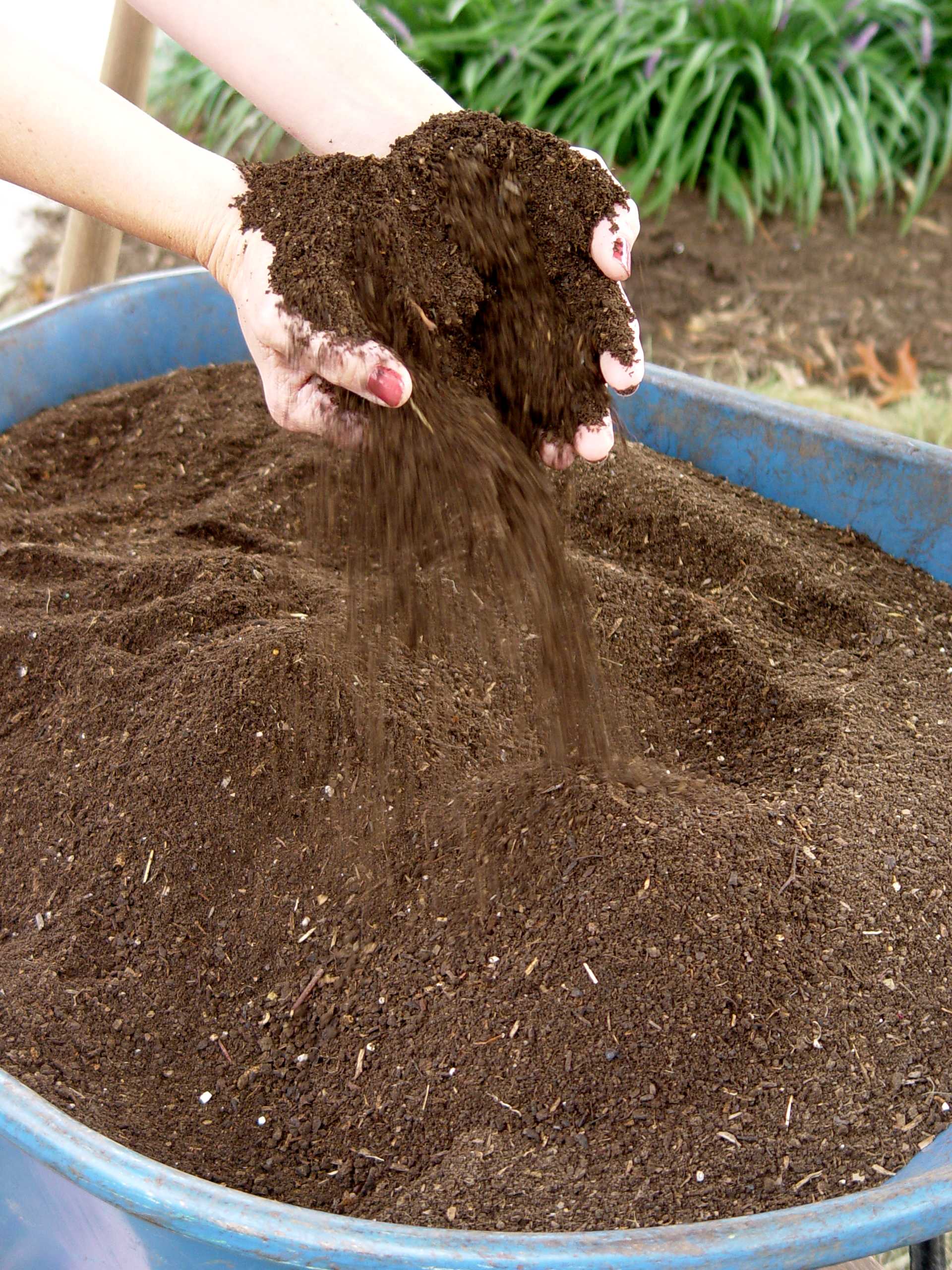
OK, actually it’s about compost. But I had to get your attention so you didn’t stop reading and miss out on THE SINGLE MOST IMPORTANT THING you can do to become a better gardener.
Fact: Our biggest non-four-legged gardening problem around here is plant-murdering clay, shale and/or compacted subsoil.
Fact: If you don’t improve that lousy, rotten stuff with two or three inches of good rotten stuff (namely, compost), you’re set up for trouble.
There’s no better compost than that you make yourself, using a nutritious blend of fallen leaves, grass clippings, kitchen scraps, coffee grounds and whatever other future soil fuel you can get your dirty little organic hands on.
Once cooked into crumbly black particles and lovingly mixed into the top 6 to 12 inches of your alleged soil, this “gardener’s gold” will turn your yard into a growing machine.
I’ll tell you about my practical, handy-dandy compost system in a minute, but first, reasons why you really ought to consider compost…
1.) Compost breaks up compacted soil, adds air space so roots can grow better and improves drainage so plants won’t rot in clay.
2.) It adds a great mix of nutrients and organic matter to the soil - key building blocks to plant growth.
3.) In dry weather, it helps absorb and retain soil moisture, making plants more drought resistant.
4.) Numerous studies have found compost has disease-fighting properties and adds beneficial fungi that aid root growth.
5.) It’s a great way to recycle organic waste that otherwise ends up in a landfill or shoved down water-wasting garbage disposers. Patti Olenick, the state Department of Environmental Protection’s organic recycling coordinator, points out that a typical American generates 4.5 pounds of waste per day, and 20 percent of that is compostable food and yard waste.
6.) It’s cheaper and better than any commercial fertilizer.
7.) It’s great exercise hauling, turning and sifting compost in the fresh air (or semi-fresh air if you live close to the Route 11 truck stops).
Composting is much easier than most people think. Garden writer and former Mississippi Extension agent Felder Rushing says it boils down to two simple rules: 1.) Pile it up, and 2.) Let it rot.
That’s basically the game plan I use in my suburban back yard. And my pile doesn’t stink, doesn’t attract varmints and isn’t an obtrusive eyesore.
Composting gets a lot of undeserved bad raps that just a little know-how solves.
For instance, a pile can smell if you load it up with nothing but grass clippings or if you toss rotting meat and bones on it.
It can attract skunks and other unwanted wildlife if you pile those same meat and bones or other food waste on top.
And it can look ugly if you locate it in a prime view from the patio and use scrap wood for a bin.

- George’s two-bin home composting station.
Let’s start with looks.
I made my two side-by-side bins out of 1-by-6 lumber slats and 4-by-4 posts. The front slats are loose and can be slid in one by one as the pile fills. Or they can be removed altogether when I empty the bin.
I tucked the bins in the back corner of the yard - nestled between my neighbor’s back row of Douglas firs and a blue holly I planted to help screen it from our patio.
For good measure, I surrounded the partly visible back and one side with wooden lattice, which I grow vines up to disguise the whole thing.
In small yards, you could simply buy one of those molded-plastic compost bins or compost tumblers… or even drill half-inch holes in any 30-gallon lidded, trash can. Tuck it in any nook you’ve already got or erect a small piece of lattice to make an outdoor closet.
You don’t even need a bin at all. Things like cinder blocks, tied-together pallets, staked-up wire bins, snow-fencing, etc. merely keep the pile confined.
Before you go too far, check with your municipal office to see if there are ordinances on bins and their allowed locations.
You might hear about correct “carbon-to-nitrogen ratios,” compost “activators” and all sorts of other technical guidance. But the truth is, any reasonably varied mix of organic materials will break down in time without any help from you.
In other words, you don’t need to add compost activators, you don’t need to add fertilizer and you actually should not add lime.
You can speed up the process by doing things like chopping your raw ingredients into smaller pieces before adding them, turning the pile every few days and wetting the pile enough to keep it consistently and moderately damp (but not soggy).
Those are all good ideas, but I don’t have time for all of that. I still get great compost, but it just takes a year for it to happen instead of a few months.
What’s more important is making sure you’re using a blend of “browns” and “greens.”

- An ideal compost mix has greens and browns, such as leaves and grass clippings.
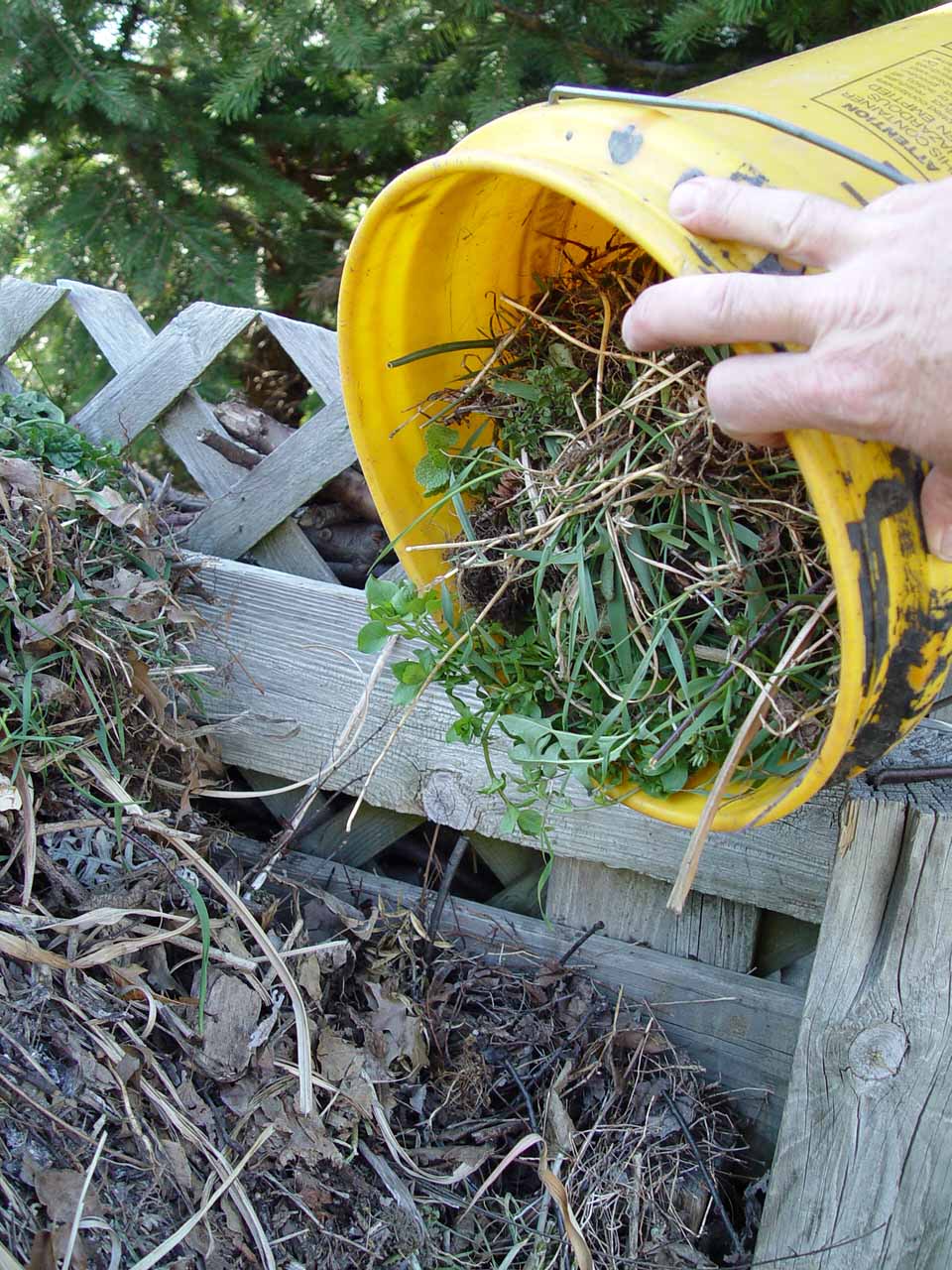
Browns are high-carbon materials such as dried leaves, straw, paper, sawdust and twigs. Greens are high-nitrogen materials such as grass clippings, kitchen peelings, spent plants, weeds that haven’t gone to seed and coffee grounds.
Don’t worry so much about exact ratios. Just be sure you mix both.
If you pile up all green materials like grass clippings, it’ll turn to slime and start to smell like ammonia.
If you pile up all brown materials like fallen leaves, they’ll just sit there, mat down and look pretty much the same a year later.
Some people segregate the browns and greens and then mix them together when they’re ready to build a pile, which is ideally sized at about 4 feet tall, wide and long, by the way.
I use the pile-as-you-go method and have found that I usually end up with enough of each that the pile slow-cooks without even turning it.
Fall is the ideal time to empty existing piles and start new ones.
I like to clear out my bins in October for two reasons: 1.) It’s an ideal time to work finished compost into my garden beds, and 2.) I need to make room for the glut of falling leaves and year-end grass clippings that will peak soon.
The first thing I do is use a pitchfork to flip the uncomposted stuff off the top of one bin onto the other. A foot or two down is when I usually get into the semi-composted stuff.
This stuff I flip onto a 2-by-2-foot square sifter I built out of metal hardware cloth and a few 2-by-4’s. I sift several forkfuls at a time into the sifter over top of a garbage can, and the fine compost falls through while the coarser pieces remain on the screen.
The coarse stuff goes on top of my beds as mulch. The light, fluffy, finely sifted compost is pure gardening magic dust.
I dig the fine stuff into my recently cleared vegetable garden and annual beds. I use it to top-dress the lousy shale soil in my lawn. And I bag some to use next spring in my flower pots, which adds nutrition and cuts down on how much potting mix I have to buy. (One-third compost to two-thirds potting mix works great.)
Once the pile is empty, I flip the uncomposted material from the second bin into the empty first bin until I reach the semi-composted layer in the second bin. I always empty that one, too, long before I run out of good places to use it all.
The uncomposted material is the beginning of next year’s compost, and I pile new stuff on top of it.
In a few weeks, both bins are full again with fallen leaves, grass clippings, pulled plants from the yard, etc. But as the pile cooks, it continually reduces in size so I’m able to keep adding more and more material the following year without it overflowing.
If it ever does, I’m adding a third bin.
Call me a gardening wacko, but it just doesn’t make sense to me to pay to throw away all of those leaves and clippings and trimmings, then turn around and pay to bring peat moss, fertilizer and mulch back to the same yard.
* Good nitrogen-rich materials to add to your compost pile:
Blood meal

- Weeds, kitchen peelings and spent plants are good nitrogen sources.
Bone meal
Cow, horse, pig or poultry manure
Clover
Coffee grounds
Feathers
Fruits and fruit peelings
Grains
Grass clippings
Hair
Sea weed
Sod
Tea leaves
Vegetables and vegetable peelings
* Good carbon-rich materials to add to your compost pile:
Bark
Branch or twig prunings

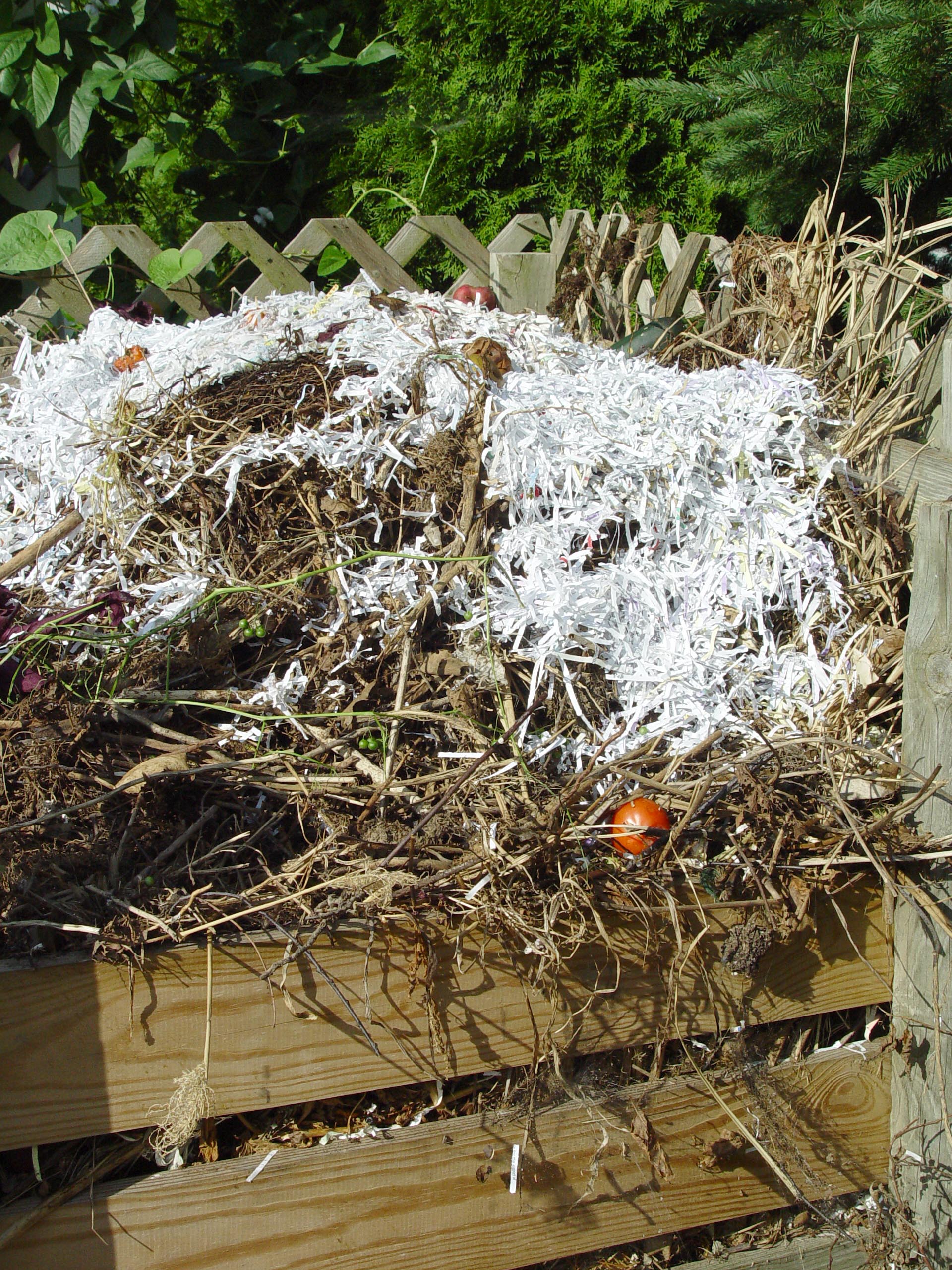
- Shredded office paper is a good carbon source.
Cardboard
Corn cobs
Dried flowers
Dryer lint
Egg shells
Leaves
Paper
Pine chips or needles
Sawdust
Straw
Wool or cotton scraps
* Items NOT to add to your compost pile:
Bones
Charcoal or coal dust
Diseased leaves and plants
Eggs
Oil, lard
Herbicide-treated weeds and grass
Human or pet manure
Magazines and glossy printed paper
Meat
Milk, cheese and dairy products
Plastic, metal and other inorganic materials
Pressure-treated lumber
Weeds that have gone to seed
Source: Pa. Department of Environmental Protection






Hi George,
Does the compost pit/bin/can need to be in the sun or can it be in a shady area?
Thanks. Love your columns!
It can go in the shade. So long as the pile is getting moisture and oxygen and has that nice mix of materials, it’ll break down. Full sun isn’t necessary.
The timing of this was just perfect! I am new to composting & began my “collection” about a month ago. Your advice in this column is very helpful. My husband is in the process of building me a raised bed for my first veg garden.
I always look forward to your columns & enjoy them very much.
Thank you!
Crystal,
Thanks. And glad to hear the world has one more new composter.
I agree. I couldn’t have a garden without my compost bin. It’s actually 3 little laundry soap tubs (the large kind from Costco’s). My husband drilled holes in them and I add every thing from watermelon rind to egg shells and dried leaves and torn up newspapers. At the end of the summer I dig a hole in my little (4 ft. x 10 ft.) garden and dump in what is left in the tubs. This year my husband is drilling holes in a regular sized trash can and I’ll be able to fit more in it. We never use weeds though because they may end up growing in my garden. I have been surprised with cantaloupes and tomatoes plants that I didn’t plant this year (could that have been seeds that weren’t composted yet when I dumped the containers?
Thank you for the great article. One question… during the fronzen/snowy winter months, do you continue to add kitchen scraps?
Cass,
If you’re doing “cool composting” (i.e. pile it up and let it rot), temperatures don’t get hot enough to kill most seeds. Options are: 1.) just pull unwanted plants when they come up; 2.) avoid putting mature seeds in the compost, and 3.) hot-compost by chopping materials into smaller bits, turning them regularly, keeping the pile moist and using a good mix of carbons and nitrogens (browns and greens). I go with Option 1 and some Option 2.
Mark,
Yes, I save kitchen scraps in my under-the-sink stainless-steel composter and dump them all during winter every few days. I open up a hole in the pile and dump them down in. I also occasionally dump them on top of snow… as the snow melts, it carries the scraps down into the pile.
you mentioned coal dust in your very informative article.
i “inherited” a detached pick up truck box full of the stuff. i was wondering if i could use it as a “border” around my large veggie gardens to assiste in deterring if not wholly eliminate weed growth and maybe slow down insect invasion. i think likely have enough coal dust to do a 4 to 6 inch border around my 3 main gardens.
1. is 25 x 30 feet assorted root veggie, plus cabbage and cousins.
2. is 10 x 60 feet potatoes and peas/beans
3. is 12 x 100 feet corn and squash
should i worry about the coal dust leeching into the garden and polluting the veggies? i read in other online sources that coal dust was formerly used to help control insects.
and again, thank you for the article. i do sort of compost already. my horses provides tons of manure that gets stock piled up/rotted and spread in fall and spring. i have a 45 gallon barrel that the weeds go into. it gets dumped on the garden in the fall too. i also have bog moss that gets rotatilled into the soil too.
yes, i live on a larger acreage and use a farm tractor for all the manure, composting and moss spreading/rotatilling.
thank you for your assistance with regards to what i could or should do with this coal dust.
Roz,
I wouldn’t use coal dust anywhere near my vegetable garden. I can believe it would stop weeds and deter insects, but from what I’ve read, it’s likely to contain heavy metals that could leach into your garden. It’s also an acidifying material, which could effect the pH of your garden soil over time.
I suspect what you have is similar to what’s called “fly ash” that’s produced as a waste product of coal-fired power plants. And I know there are regulations dealing with how that can be safely disposed of. I don’t know what’s recommended as safe disposal for home owners, but I don’t think spreading it over the ground near edibles is a good idea.
Here’s one rundown on coal dust and health issues that I found from a physician’s group: http://www.psr.org/assets/pdfs/coal-ash-hazardous-to-human-health.pdf.
George
many thanks for the information and the prompt response. i think what i may do with it, is use it for the base of post holes, to slow down bugs from gnawing on the wooden posts. none of the fencing and cross fencing we are doing is near the gardens or the well on the property. and it will be 3 to 4 feet down in smaller doses, per se.
if i take it to our local landfill (unregulated)it will just be a huge mass of dangerous “garbage” in a lump sum; that someone else may feel they have use for.
the article certainly explained why my father had it. “sprinkled as cinders on snowy roads” per the first url you provided. we often get 3-4 feet of snow in the winter here.
he didn’t garden,although our soil is akaline, so it would assist in altering the ph. but i really don’t want to feed my family or livestock heavy metals.
again thank you for your very informative response.