
• Home
  • Contact
  • Site Map
George Weigel - Central PA Gardening
  • Landscape 1
  • Landscape 2
  • Landscape 3
  • Landscape 4
  • Garden Drawings
  • Talks & Trips
  • Patriot-News/Pennlive Posts
  • Buy Helpful Info

Navigation

  • Storage Shed (Useful Past Columns)
  • About George
  • Sign Up for George's Free E-Column
  • Plant Profiles
  • Timely Tips
  • George’s Handy Lists
  • George's Friends
  • Photo Galleries
  • Links and Resources
  • Support George’s Efforts


George’s new “50 American Public Gardens You Really Ought to See” e-book steers you to the top gardens to add to your bucket list.

Read More | Order Now


George’s “Survivor Plant List” is a 19-page booklet detailing hundreds of the toughest and highest-performing plants.

Click Here


Has the info here been useful? Support George’s efforts by clicking below.


Looking for other ways to support George?

Click Here

George's Current Ramblings and Readlings

Virused-Out Trips

April 14th, 2020

   The two garden trips that Lowee’s Group Tours and I had planned for April and May are officially casualties of the coronavirus pandemic… for now.

We’ll have to wait until next year to sniff the lilacs at Rochester’s annual Lilac Festival.

   The April 30 day trip we were going to do to two Lancaster County home gardens and to two stellar Lancaster County plant places is off but now rescheduled for Fri., June 19. We’re hoping the coast will be clear by then and things back to at least semi-normal.

   The Lancaster trip starts with a visit to the 1-acre, no-lawn “Gardens of Oz” of Dr. Dennis Denenberg near Manheim. The property has a variety of theme gardens, including a Wizard of Oz garden with a yellow brick road and Toto doghouse.

   Dennis’s house is a veritable Wizard of Oz museum, too. We’ll tour both the gardens and house.

   Stop 2 is the colorful beds on the grounds of Vivian and Bob Abel’s Pheasant Run Farm Bed and Breakfast in the serene Lancaster County countryside.

   Vivian is an active garden clubber and has flowers and gardens both around the B&B and sprinkled throughout the 48-acre property – 26 acres of which is farmed.
Read More »


Why “Clank” Is a Bad Sound in the Landscape

April 7th, 2020

   I thought it was the heavy black clay that’s on the way to becoming coal that was responsible for the awful drainage in my new Pittsburgh yard.

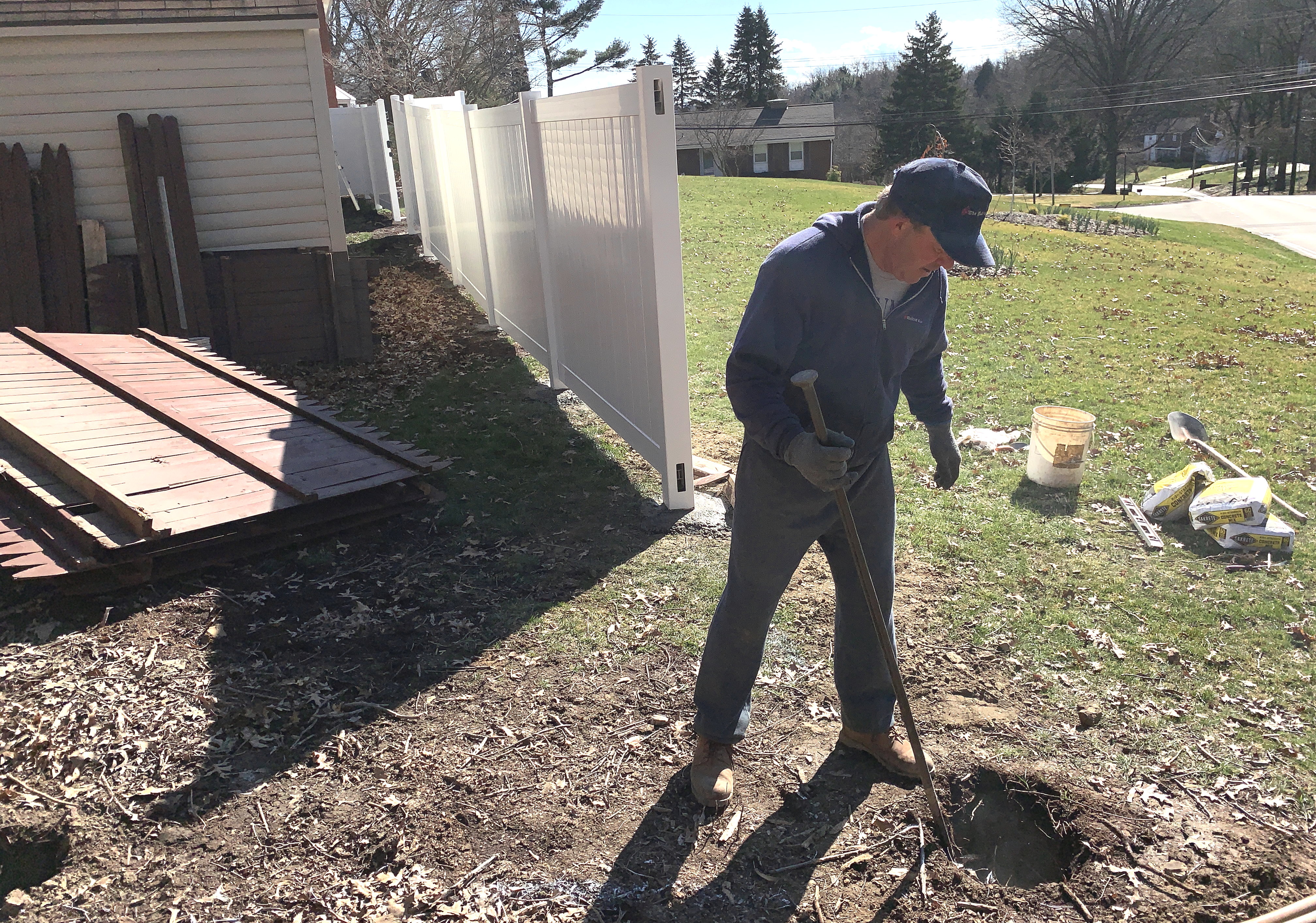
Me encountering solid rock with a digging bar. “Clank!”

   As it turns out, it’s the future coal and a solid layer of rock lurking a foot underground that’s behind all of the sogginess and surface runoff.

   I discovered that while trying to dig post holes (in isolation) for a fence to address that other gardening nightmare I have – fearless deer.

   The wooden fence that came with the house was rotting and breaking.

   I was going to hire a fence company to replace it with a six-foot-tall vinyl privacy fence… until I got the $7,000 estimate.

   “I’m getting old, but I’m not that decrepit yet that I can’t dig holes and lug plastic panels,” I figured.

   So to whittle the cost down to more like $2,500 in materials, I got out the post-hole digger and digging bar and got started.

   The first two holes weren’t bad. It was hard work, but I was 32 inches deep in about 20 minutes each.

   Then I hit a root the size of Arnold Schwarzenegger’s thigh in the middle of hole three.

   Two hours of hacking with a hand ax later, I decided to rent an auger to drill the remaining dozen holes – and hoped that no more roots were lurking.

   I’d never used a gas-powered auger before, but in the YouTube videos I watched, these drills on steroids bored three feet down in less than a minute with almost no operator effort.

   Apparently, those videos were shot by people who have actual soil in their yards.

   Here in the real world, hand-operated augers are useless when roots or rocks are in the way.

Read More »


Planting in a Pandemic

March 31st, 2020

   On the one hand, it’s a plus that this coronavirus pandemic comes at a time when the weather is warming because it allows us to get out in the yard instead of being cooped up in the house for weeks on end.

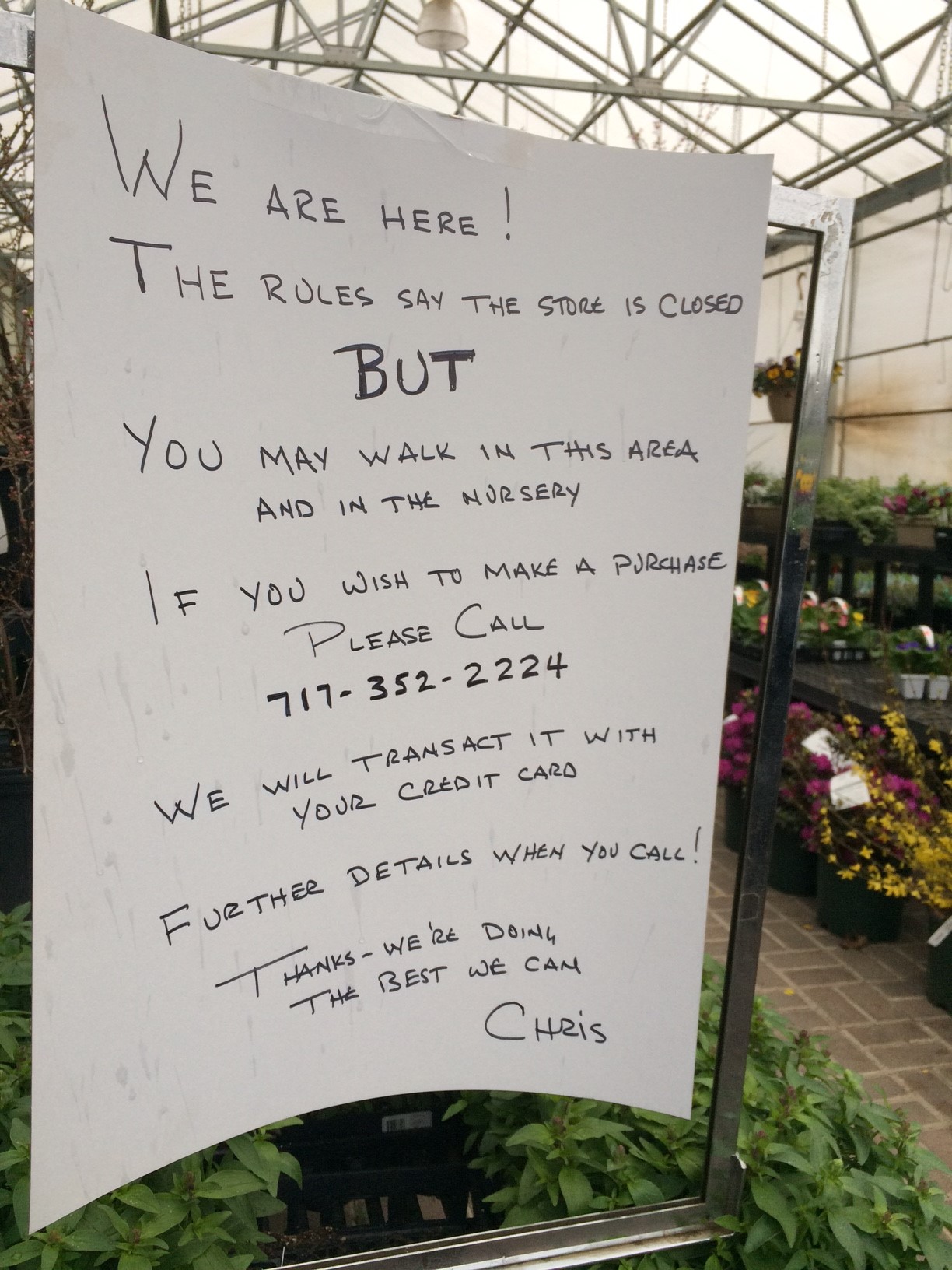
This is how Snavely’s Garden Corner in Chambersburg pivoted after the governor’s shutdown rules went into effect.

   On the other hand, it’s a minus that this coronavirus pandemic comes at a time when the weather is warming because it’s when we’d normally be out there buying and planting most of the year’s new plants.

   What a mess this isolating has been on so many fronts. But at least it’s better than the alternative of letting everybody mix uninhibited to wantonly spread a germ that could kill tens of thousands – or more.

   Plant nut that I am, I’m willing to delay or even scrap new plants if it helps flatten any curves or makes this surreal nightmare go away.

   Things certainly have been crazy and bizarre – for plant-sellers as well as would-be plant buyers.

   In an attempt to keep people at home, Gov. Wolf drew up a list of essential vs. non-essential businesses and ordered the non-essentials to shut down. That included garden centers and florists.

   I researched an article for PennLive.com and the Patriot-News – aiming to sort out the upshot for gardeners – and quickly realized that the shutdown rules allowed just about everybody to sell plants, except for the businesses that sell plants for a living.

   Lowe’s and Home Depot were allowed to keep their garden centers open because they were exempted as being an essential seller of potentially emergency home-repair items.

   Hardware stores that often sell young plant starts, onion sets, potting mix, seeds, and the like also got the green light for the same reason.

   Grocery stores that sell young plants, hanging baskets, potted flowers, and such were exempted because they needed to stay open to sell essential food.

   Walmart was allowed to keep its garden centers open because it was both a food store and a seller of necessary “general merchandise.”

   Even farm markets could stay open and keep selling plants because they got an exemption for selling produce.

   That left full-service garden centers like Ashcombe’s, Black Landscape Center, Highland Gardens, and Stauffers of Kissel Hill out of business.

Read More »


Want a Garden Design?

March 21st, 2020

   My wife and I were going to visit our daughter in Amsterdam the next two weeks, but now that that’s off – along with my entire spring schedule of talks – I suddenly have time to do a few garden designs again.

Here’s a scale drawing with the colored option.

   After I retired from 18 years of Garden House-Calls home visits, I offered designs only for a couple of years in which people sent me dimensions and photos, and I sent them back a scale design and detailed plant list.

   If you’re thinking about redoing an area or digging a new bed or three, I’ll be happy to develop a planting plan.

   Your job is to get the measurements, snap a few photos, and fill out my three-page questionnaire on preferences and goals, and I’ll take it from there.

   You pay just for the drawing time, which is $50 an hour.

   I’ll give you an estimate up front based on the size and scope of the area to be drawn. To give you an idea, I can usually design a house-front in two-and-a-half to three hours, and the entire way around a house in five to six hours.

   In the end, you get a letter-coded design on graph paper along with a list of specific plants for each of the marked spots. I use graph paper with each box representing one foot. That makes it easy for you to just count the boxes and plant on the dots.

   The plant list includes sizes, specific cultivars (along with alternate options in most cases), and how many of each plant you’ll need.

   Additional options are available if you want them, such as:

   * Color-coding for your drawing: $25

   * Custom plant-care instructions for all plants on your drawing: $25

   * Copy of my “Yard-Care Survivor Manual” (24-page instruction manual for the yard): $8

   * Current copy of my detailed, 19-page “George’s Survivor Plants for Central Pa.” list, updated for 2020: $8

   * Signed copy of my “Pennsylvania Getting Started Garden Guide,” a 240-page Cool Springs Press book featuring the 170 best landscape plants for Pa. yards: $20

   * Signed copy of my “Pennsylvania Month-by-Month Gardening” book, a 240-page Cool Springs Press book that details how and when to care for your landscape, laid out in a month-by-month format: $20

   I’ll probably be doing these only for this spring and maybe into summer… until talks and trips are back to normal from the COVID-19 pandemic.

   If you’re interested in a drawing or have questions, give me a call at 717-737-8530 or email me at george@georgeweigel.net.


Joe’s Seed-Starting Tips

March 17th, 2020

   Joe Lamp’l, a.k.a. “Joe Gardener” and the host of PBS’s “Growing a Greener World,” is one America’s most trusted garden communicators because he’s such a practical guy who draws on what he’s learned from his own lifetime of hands-on gardening.

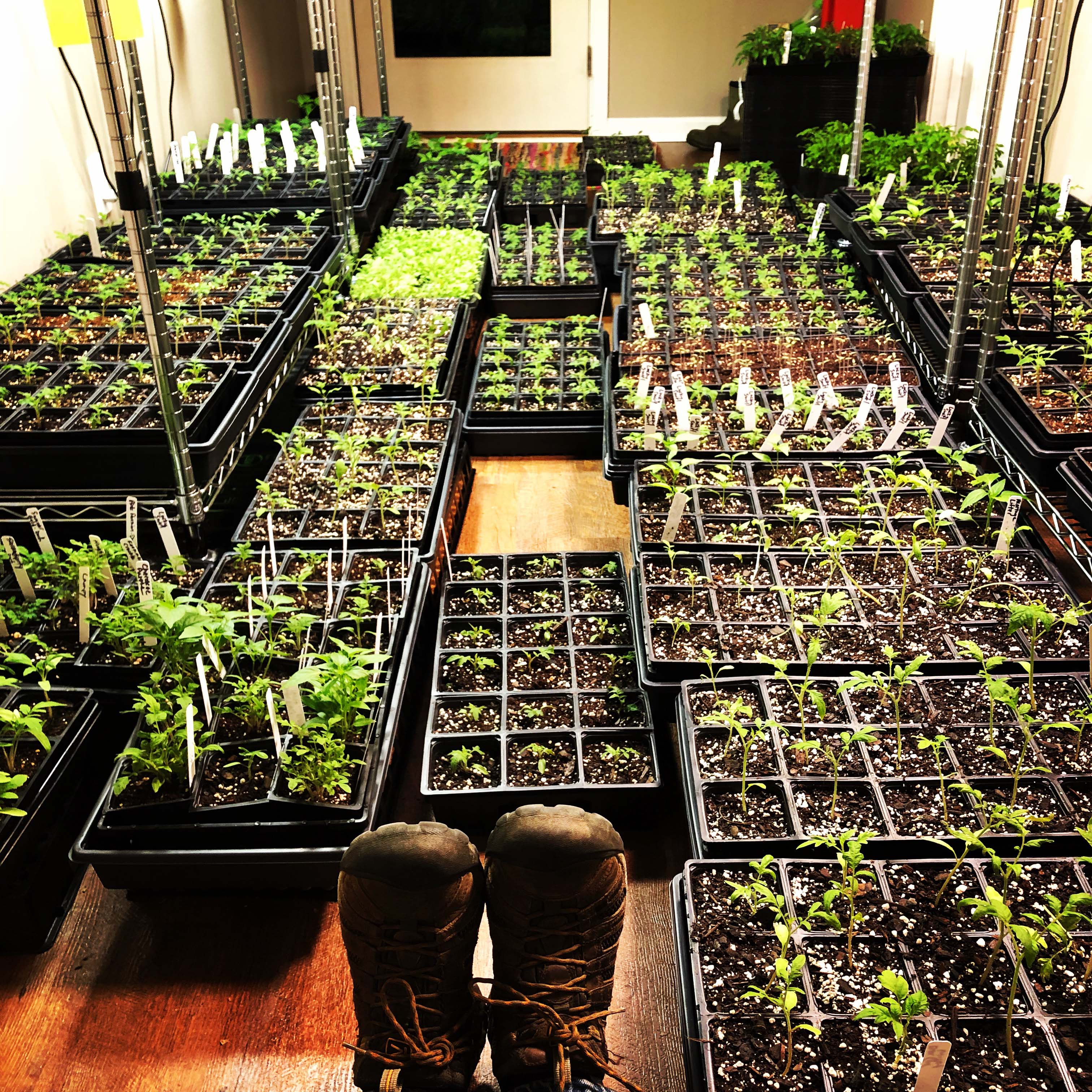
This is what Joe’s seed-starting experiment looked like.
(Credit: JoeGardener.com)

   Joe’s latest and maybe most prodigious effort yet is his attempt to figure out the best way that home gardeners can start their own plants from seeds.

   Seed-starting can be tricky if you don’t know some of the key “secrets.” It doesn’t help that much of the advice is a bit murky and sometimes conflicting.

   So Joe set out to see what really works by turning a 10-by-25-foot basement room at his Atlanta-area home into a seed-starting lab, crammed with 60 seed trays that had anywhere from 18 to 72 cells each.

   He bought all sorts of lights and grew the seedlings under 14 different lighting scenarios to see what difference that important factor makes.

   His findings are the genesis of a new $197 Master Seed-Starting course he’s offering through his Organic Gardening Academy.

   But Joe shared some of his seedy findings in an interview with Margaret Roach, the former editorial director for Martha Stewart’s magazines. The whole interview is on Roach’s “A Way to Garden” website, if you want to read or hear it.

   When it comes to lighting, Joe says ordinary workshop fluorescent light tubes (known as T12s) work reasonably well if you’re just growing seedlings for six weeks. One cool-light tube and one warm one in each unit improve the light spectrum.

   Joe says the higher-efficiency T5 fluorescent tubes and newer LED grow lights are markedly brighter. However, he found that biggest and brightest doesn’t always equate to best plant performance.

   “Just because a light is brighter doesn’t necessarily make it better,” he concluded.

Read More »


« Older Ramblings and Readlings Newer Ramblings and Readlings »

  • Home
  • Garden House-Calls
  • George's Talks & Trips
  • Disclosure

© 2026 George Weigel | Site designed and programmed by Pittsburgh Web Developer Andy Weigel using WordPress