• Home
  • Contact
  • Site Map
George Weigel - Central PA Gardening
  • Landscape 1
  • Landscape 2
  • Landscape 3
  • Landscape 4
  • Garden Drawings
  • Talks & Trips
  • Patriot-News/Pennlive Posts
  • Buy Helpful Info

Navigation

  • Storage Shed (Useful Past Columns)
  • About George
  • Sign Up for George's Free E-Column
  • Plant Profiles
  • Timely Tips
  • George’s Handy Lists
  • George's Friends
  • Photo Galleries
  • Links and Resources
  • Support George’s Efforts


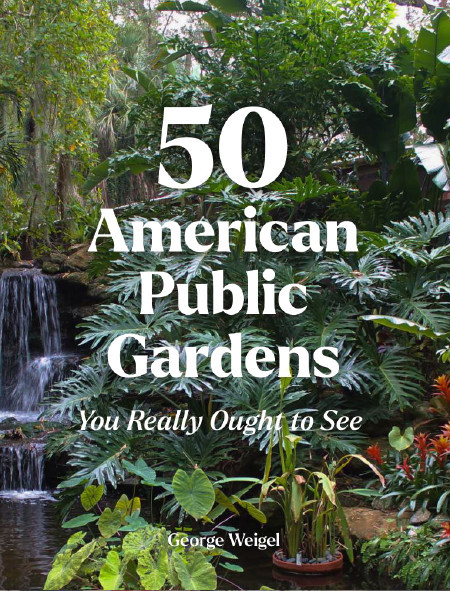
George’s new “50 American Public Gardens You Really Ought to See” e-book steers you to the top gardens to add to your bucket list.

Read More | Order Now


George’s “Survivor Plant List” is a 19-page booklet detailing hundreds of the toughest and highest-performing plants.

Click Here


Has the info here been useful? Support George’s efforts by clicking below.


Looking for other ways to support George?

Click Here

George's Current Ramblings and Readlings

Four of Our Best Home Gardens

June 14th, 2022

   A fair number of south-central Pennsylvania homes have little to no landscaping.
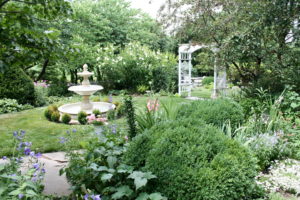
A fountain and arbor in Jill and John Hudocks’ back yard.

   A majority have passable to middling plantings – enough to “fit in” or at least avoid being neighborhood embarrassments.

   Then there are the glorious few where the ambitious owners were bit by the plant bug and ended up building truly outstanding home gardens.

   Two busloads of garden appreciators got to see four of our region’s best home gardens last week in a local “Home-Grown Gardens” tour that Lowee’s Group Tours of Harrisburg and I put together. It was our fourth installment of these home-garden tours over the years.

   I thought I’d share these superb planting efforts with those of you who didn’t get to experience the wow-ness of seeing them first-hand.

   Read on for a brief rundown of the four gardens… or better yet, go to my Photo Gallery web page to see 10 pictures from each place.
Read More »


The Mini-Meadow Project

June 7th, 2022

   I’ve always had doubts about meadows.

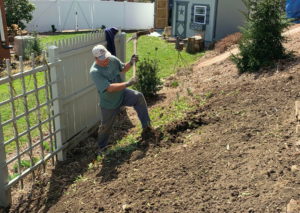
George grubbing deep-rooted weeds out of the future mini-meadow with a mattock.

   Proponents of this buckshot-planted, multi-species idea tout meadows as an exceptionally low-care way to cover a lot of ground colorfully while being friendly to pollinators and the ecosystem.

   The cynical side of me pushes the too-good-to-be-true button and wonders whether weeds will be the ultimate winner.

   After all, I’ve heard a fair number of meadow-failure stories over the years, including poor seed germination, a shrinkage down to just one or two dominant species after a few years, and “misbehaved seeding,” which can include meadow seeds blowing into unwanted areas as well as weed seeds blowing into the meadow.

   Not everyone is happy with the somewhat-wild look either – not the least of which is neatnik neighbors who see the effort as reason to call the code-enforcement officer.

   For all of those reasons, a meadow is one of the few kinds of gardens I’ve never planted.

   Until now.

   I’ve been battling a rather large bank in back of my house for nearly four years now. More accurately, it was a hillside jungle when we moved in.

   A previous owner sometime in the distant past made an attempt to tame it with landscape timbers, stone walls, and plantings of wintercreeper euonymus, tawny daylilies, miscanthus grass, evergreens, and apparently some roses and spireas.

   But for at least 10 years before we moved in, the bank went untouched. Neighbors told us the most recent owners rarely went outside while they lived there and were cited at least twice by the borough for not even cutting the grass.

Read More »


Full and Fuller

May 31st, 2022

   I’ve seen a big shift these last few years in what gardeners view as the “best,” or at least the “desired,” way to garden.

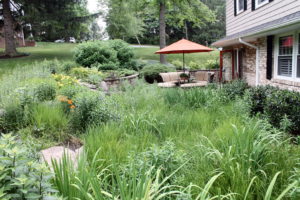
Naturalistic gardens like this back-yard one in York County are trendy lately.

   The trend is strongly toward a natural look in which lots of different plants intermingle and grow in laissez-faire masses – similar to how plants grow in the wild.

   That’s in contrast to the more formal, tended look that’s been the landscape norm for decades. In that style, order reigns supreme, and every plant has its space… with a neat carpet of mulch underneath and between.

   Whether you call it a meadow or a cottage garden or a naturalistic landscape, the loosely regulated, action-packed look has the common thread of a tremendously full planting.

   Bare soil doesn’t show its face in these gardens – at least not during the growing season.

   Traditional spacing guidelines are out the window, replaced by packing as much in as possible and letting self-seeding fill in the rest.

   So much is going on in these gardens that they’re season-long riots of color and texture.

   Several factors are converging to fuel this “new naturalism,” as author Kelly Norris calls it.

   One is the message about helping pollinators. Concerned about the plight of bees and butterflies, many gardeners are acting on the petition of popular authors like Dr. Doug Tallamy, Rick Darke, Thomas Rainer, Claudia West, Piet Oudolf, Larry Weaner and others to plant not just for cosmetics but with an eye on benefiting ecosystems and the wildlife in it.

   Related to that is the boom in native plants, which is being fed by concerns of invasive plants bumping out native species that local wildlife needs to survive.

   And a third factor is that people are tired of spraying, trimming, mulching, and mowing big lawns. They see the loose approach as less work and welcome the idea of yards that are better able to care for themselves.

   These tightly-packed, naturalistic gardens deliver on a variety of fronts.

   For sure, they’re much more diverse than the traditional landscape of yew bushes, azaleas, a few daylilies, and a pear tree or two.

Read More »


Five Lessons from the Flower Garden Master

May 24th, 2022

   Flower color is one of nature’s most joyous gifts to people.

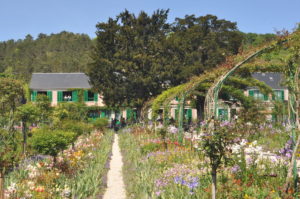
Monet’s 2-acre front-yard garden looks like “an explosion at a paint factory,” as one writer described it.

   Even non-gardeners appreciate it, while many a gardener strives to load the yard with a nonstop parade of flower power from the season’s first hellebores to the last Montauk daisy petal of fall.

   That’s not easy.

   More color means more plants, more effort, and especially a lot of skill to orchestrate it all.

   No one was better at that than the French master painter Claude Monet, who was arguably one of the world’s best flower gardeners in addition to being one of its best-ever artists.

   Monet created a magnificent 2-acre flower garden across the front of his modest home in Giverny, a countryside village about an hour drive west of Paris. He built it mainly as a model for his paintings.

   Some 130 years after Monet begin painting, his Giverny garden is still turning out massive color. It’s the most exuberant flower garden I’ve ever seen, and it fires on all cylinders all season long.

   One writer observed that the garden reads like an “explosion at a paint factory.”

   I first saw Monet’s garden six years ago in September, when dahlias, sunflowers, nasturtiums, mums, cosmos, zinnias, and numerous other summer annuals dominated the landscape.

   I saw it again a few weeks ago on a group tour I hosted with Lowee’s Group Tours. Despite being filled with all different plants, it was still full and colorful even though it was so early in the gardening season.

   This time, the wall-to-wall color was coming from the end of the tulip bloom, from cool-season annuals such as pansies and wallflowers, from May-blooming perennials such as salvia, irises, and woodland phlox, and from the beginning of rose bloom.

   Following Monet’s long ago lead, today’s staff masterfully color-coordinates each vignette and constantly plants, deadheads, and replants to achieve that difficult goal of color everywhere all season long.

   It’s a living textbook in how to mix and match plants.

   Maybe we can’t recreate Monet’s 2 acres of blooming glory, but we can glean a few lessons on how to improve our yards’ color show.

   Five of them that struck me…

Read More »


Plants and Our Future

May 17th, 2022

   If the Dutch Floriade 2022 is correct, plants in the future will do way more than make our yards pretty or supply us with fresh salads.

The 2022 Floriade shows many ways our cities can be greener. The striped Viewing Tower in the background is made out of recycled concrete sewer pipes, while the elm trees are floating in the lake in repurposed buoys.

   Tomorrow’s plants could fuel our cars, insulate our roofs and walls, and serve as building blocks for everything from cheese to bridges.

   The theme of this year’s once-every-10-year Floriade expo is “Growing Green Cities.” Exhibitors are using that theme to show how plants can solve most of the dilemmas that populating the earth has caused.

   Specifically, the message is that plants make excellent sustainable, renewable, clean, and healthy alternatives to our tradition of burning fossil fuels to manufacture our voluminous daily stuff out of plastic, foam, and other synthetics.

   Besides the expo’s international and display gardens, many of the exhibits show ways plants already are paving our future with creative new uses.

See a photo gallery of 2022 Floriade pictures

   One bridge shows how walkway cables can be made out of flax fibers and plant-based resins instead of metal or polymers.

   The show’s nature pavilion has floors and walls made out of corn fibers, rice straw, seaweed, oyster shells, and even coffee grounds instead of conventional wallboard and synthetic tile.

   A mushroom-shaped pavilion that feels like it’s made out of foam or fiberglass is actually made out of rice straw, potato starch, and cattails, held together by a sort of fungal glue.

   And what seems to be leather furniture is actually covered with a fabric made out of tomato stems.

   It seems that with a little re-engineering and thinking outside the box, just about everything at the Home Depot of the future could come from materials that now go in our compost bins or landfills.

Read More »


« Older Ramblings and Readlings Newer Ramblings and Readlings »

  • Home
  • Garden House-Calls
  • George's Talks & Trips
  • Disclosure

© 2026 George Weigel | Site designed and programmed by Pittsburgh Web Developer Andy Weigel using WordPress