
• Home
  • Contact
  • Site Map
George Weigel - Central PA Gardening
  • Landscape 1
  • Landscape 2
  • Landscape 3
  • Landscape 4
  • Garden Drawings
  • Talks & Trips
  • Patriot-News/Pennlive Posts
  • Buy Helpful Info

Navigation

  • Storage Shed (Useful Past Columns)
  • About George
  • Sign Up for George's Free E-Column
  • Plant Profiles
  • Timely Tips
  • George’s Handy Lists
  • George's Friends
  • Photo Galleries
  • Links and Resources
  • Support George’s Efforts


George’s new “50 American Public Gardens You Really Ought to See” e-book steers you to the top gardens to add to your bucket list.

Read More | Order Now


George’s “Survivor Plant List” is a 19-page booklet detailing hundreds of the toughest and highest-performing plants.

Click Here


Has the info here been useful? Support George’s efforts by clicking below.


Looking for other ways to support George?

Click Here

George's Current Ramblings and Readlings

Spring at Phipps

April 18th, 2023

   Since few of you likely made it to Pittsburgh to see Phipps Conservatory’s 2023 spring flower show, I thought I’d share a few photos of it this week.

   Phipps Conservatory, if you’ve never seen it, is a 14-room Lord and Burnham Victorian glasshouse that dates to 1893. It’s filled with changing exhibits of tender specimens from around the world (including desert plants, ferns, tropicals, orchids, and a butterfly house) and is surrounded by 15 acres of outdoor gardens.

   Each spring, the conservatory stages a spring flower show. This year’s four-week show, which just ended, centered around a theme of Five Senses of Splendor.
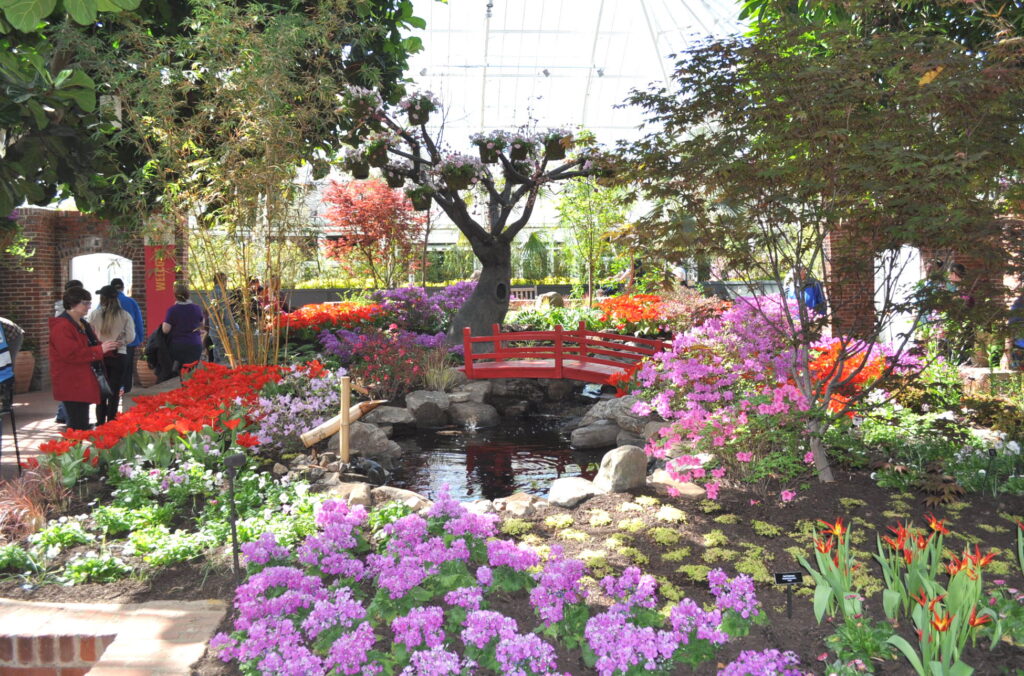
A spring-time scene featuring a pond, Japanese fountain, and tulips was the centerpiece display in the central glasshouse.

   As visitors enter the main glasshouse through a second-floor entry, they were greeted by an oversized perfume bottle, adorned with succulents like strings of jewels. The bottle was surrounded by colorful gardens of fragrant plants.
Read More »


Just Say No to These Pass-along Plants

April 4th, 2023

   This is the time of year when gardeners get outside to grapple with plants that are growing beyond their intended space – or growing where they aren’t wanted at all.

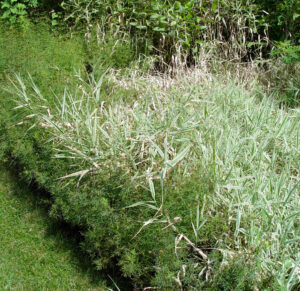
Here’s a patch of ribbon grass — a common pass-along plants — invading its way through a garden bed.

   But since gardeners tend to be kind, benevolent, and nurturing souls, they often have a hard time digging and tossing these “surplus” plants.

   It seems so hard-hearted!

   And so lots of gardeners – dug-up rootballs in hand – go looking for foster parents for their newly homeless plants.

   Sometimes these plants end up at plant sales, plant exchanges, and yard sales.

   Unfortunately, many of these botanical castoffs are, to put it nicely, “overly frisky.” OK… they’re often weedy or invasive. In other words, people tend to dig and get rid of what’s turned out to be maintenance headaches.

   Now that doesn’t mean you should run the other way when you see a neighbor heading your way with a mystery clump.

   Sometimes pass-along plants turn out to be welcome gifts. If the culled-out plants aren’t invasive and match a site in your yard, this is a great way to fill or expand garden space at no cost. And the digger-outer feels like he/she has saved a plant’s life while doing a good deed for a friend.

   My own gardens have been enriched over the years by gardening friends who gave me divisions of really nice plants.

   I got a gorgeous velvet-purple bearded iris that way as well as a clump of betony ‘Hummelo,’ a long-blooming perennial that’s way under-used and at that time, hard to find in garden centers.

   My first Polianthes tuberose – a tremendously fragrant white-blooming tender rhizome – also came via the freebie route.

   On the other hand, before I knew any better, I once graciously accepted a division of variegated ribbon grass. Within three years, the clump was running around my perennial garden to the point where I had to dig everything up, unravel, and start over.

   The trick, then, is sorting out the good stuff from the Trojan horses.

Read More »


What Would Happen If…

March 21st, 2023

   One of the best ways to learn gardening is to try a few educated experiments and see what happens.

My gardens have served as test labs often over the years.

   You can’t beat it for first-hand feedback and for determining whether generally accepted advice is going to work in your yard or not.

   I’ve been doing that for more than 40 years now in three different yards. The results contribute a lot to how I garden, which, by the way, is still constantly changing as I find out new things and adjust to the ever-changing climate, environment, and animal situation around me.

   I thought I’d go over some of my past first-hand experiments in hopes that some of them might help you in your own garden… or inspire you to try your own experiments.

Do you have to start over with fresh potting mix every year in your containers?

   The word on potting mix is that you should empty and clean your pots each year before refilling them with fresh potting mix. The argument is that it prevents disease and heads off compaction as the medium breaks down.

   Potting mix got expensive enough that I experimented with salvaging about half of my existing mix each year and blending it with 25 percent fresh mix and 25 percent homemade compost from my bins.

   I haven’t run into disease or compaction issues, and my potted plants seem to do just as well in my “hybrid” blend as 100-percent fresh mix.

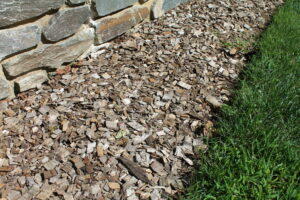
This is what wood-chip mulch looks like on a bed.

Can wood chips from ground-up trees be used as mulch?

   I gave this one a first-hand try when I moved and had several dead trees cut down. I wanted to recycle as much as possible, so I had the tree company leave the chipped branches on site.

   I saved a bundle of money on purchased mulch by moving scores of wheelbarrow chip loads to beds that hadn’t been mulched in 10 years.

   The chips looked a little “rougher” than the smooth brown carpet left behind by shredded hardwood mulch, but they did a good job holding down weeds, and they haven’t decayed as fast as shredded mulch (three years of coverage vs. one or two).

   I haven’t seen any detrimental plant effect, including the so-called “robbing of nitrogen” that fresh chips supposedly cause to the soil surface. Verdict: I’ll use whatever wood chips I can get my hands on.

Read More »


Award-Winning Plants of 2023

March 7th, 2023

   Why wing it with your plant selection when you can weigh the word of experts who know the difference among the good, the bad, and the so-so’s?

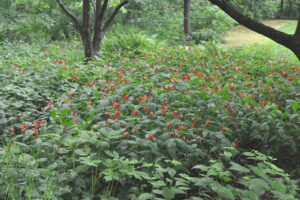
Indian pinks are a Gold Medal award-winning plant for 2023.

   Each year, organizations of growers, horticulturists, researchers, and other plant experts bestow awards on what they consider to be the top plant performers – some new, some old, and some just under-used because few gardeners know them. (Disclosure: George is a member of that Gold Medal panel.)

   Here’s a look at plants that have won honors for 2023:

Pennsylvania Gold Medal

   A panel of experts assembled by the Pennsylvania Horticultural Society (best known for running the Philadelphia Flower Show) each year picks a half-dozen trees, shrubs, and perennials worthy of greater use in Pennsylvania landscapes.

   For 2023, two trees, two perennials, one flowering shrub, and one evergreen shrub made the Gold Medal grade. All happen to be U.S. native species.

Swamp white oak

   This long-lived, native shade tree grows fairly fast to 50 feet and is a good food source for multiple species of pollinators, birds, squirrels, and other native wildlife. It’s tolerant of urban conditions and less-than-ideal soil. Fall foliage is yellow.

Black gum Green Gable

   Black gum Green Gable is a variety that stands out for its pyramidal habit and brilliant blood-red fall foliage. The tree grows about 50 feet tall but about half as wide. It tolerates wet soil, produces few (if any) fruits, and makes a good substitute for the flowering pears that Pennsylvania is banning due to invasiveness.

Indian pinks

   Indian pinks are native perennials that produce red, early-summer tubular flowers that are especially attractive to hummingbirds. Plants grow about two feet tall in full sun to part shade. They’re seldom bothered by deer. 

Ironweed ‘Iron Butterfly’

   ‘Iron Butterfly’ was singled out as a particularly good variety of native ironweed for its compact habit and long-blooming purple flowers that butterflies and hummingbirds like. The fern-like foliage is also attractive. Plants grow two to three feet tall in sun to light shade.

Viburnum Chicago Lustre

   Chicago Lustre is a reliable variety of native arrowwood viburnum, especially known for its glossy green foliage, late-spring white flowers, and bird-attracting blue/black fruits in the fall. Plants grow about 12 feet tall and 10 feet wide in sun or part shade.

Juniper ‘Grey Owl’

   An oldie-but-goodie, ‘Grey Owl’ is a spreading, spray-formed needled evergreen with a proven track record of tolerating heat, drought, and poor soil. The foliage is blue-tinted. Deer don’t bother junipers, and this one also produces small silvery-gray “berries” in fall and winter. It grows about three to four feet tall and six to eight feet wide in full sun to light shade.

Green Ribbon Native Plants

Read More »


Better Naked

February 21st, 2023

   Traipsing through the winter landscape one day, it occurred to me that some plants are actually better looking with their leaves off.

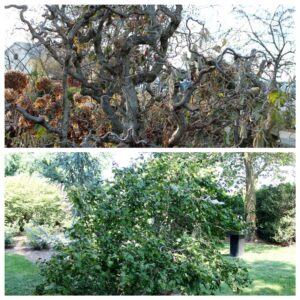
I like the twisty bare branches of Harry Lauder’s walking stick in winter, top. The plant looks ordinary and even gangly to me in summer, below.

   Whether it’s bright color on the stems or just interesting branching habits that are much more visible in winter, some plants are at their best naked.

   The poster child of that is the shrub known as Harry Lauder’s walking stick (Corylus avellana ‘Contorta’). This is a shrubby version of filbert grown mainly for its twisty, contorted branch structure.

   However, summer leaves hide or at least downplay that interest. When Japanese beetles show up to eat Harry’s leaves in July and when heat or all-too-common fungal disease attack, the plants look horrid.

   But when the plant finally has the good sense to shed its ratty leaves in fall, its nakedness unveils the plant’s hidden curiosity. You almost wish Harry would croak to keep it leafless for good.

   Another beauty unveiled in winter is the red-twig dogwood (Cornus sericea) and its sister, the yellow-twig dogwood.

Read More »


« Older Ramblings and Readlings Newer Ramblings and Readlings »

  • Home
  • Garden House-Calls
  • George's Talks & Trips
  • Disclosure

© 2026 George Weigel | Site designed and programmed by Pittsburgh Web Developer Andy Weigel using WordPress