
• Home
  • Contact
  • Site Map
George Weigel - Central PA Gardening
  • Landscape 1
  • Landscape 2
  • Landscape 3
  • Landscape 4
  • Garden Drawings
  • Talks & Trips
  • Patriot-News/Pennlive Posts
  • Buy Helpful Info

Navigation

  • Storage Shed (Useful Past Columns)
  • About George
  • Sign Up for George's Free E-Column
  • Plant Profiles
  • Timely Tips
  • George’s Handy Lists
  • George's Friends
  • Photo Galleries
  • Links and Resources
  • Support George’s Efforts


George’s new “50 American Public Gardens You Really Ought to See” e-book steers you to the top gardens to add to your bucket list.

Read More | Order Now


George’s “Survivor Plant List” is a 19-page booklet detailing hundreds of the toughest and highest-performing plants.

Click Here


Has the info here been useful? Support George’s efforts by clicking below.


Looking for other ways to support George?

Click Here

George's Current Ramblings and Readlings

A “Hobby Gone Awry”

June 20th, 2023

   Dr. Ronald Stanley was a fledgling dermatologist when he and his new wife, Cheryl, built a house in 1979 on five acres in the Blue Ridge Mountains of western North Carolina.
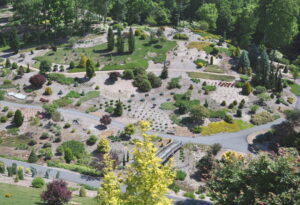
The first view of Arborcrest Gardens from above.

   At first, Stanley focused on a rather large and innovative vegetable garden that was good enough to be featured on PBS’ Victory Garden show.

   Then he graduated into landscaping with trees, shrubs, conifers, and flowers while adding another 45 steeply sloping adjoining acres in 1985.

   Things started to get out of control in 2009 when Stanley cut his first trail through the new land.

   Fourteen years later, the Stanleys’ property has grown into a 26-acre botanical garden with two-and-a-half miles of trails. It’s planted with a staggering five million plants of 15,000 different varieties – essentially a home garden with more plants than most public gardens.

   The place is called Arborcrest Gardens, and it’s open on a limited basis to the public – only on Fridays during the growing season and only by reservation.

   I got to see this “High Country hidden gem” on a Lowee’s Group Tour earlier this month of North Carolina gardens.

See a photo gallery of Arborcrest, Duke University’s Sarah Duke Gardens, North Carolina State’s Raulston Arboretum, and more.

   This is a garden worth putting on your radar if you’re ever near Boone, N.C., which is a small mountain city that’s home to Appalachian State University.

   What’s especially mind-blowing is that this vast creation is primarily the work of one man.

   Stanley will tell you that Arborcrest is a “hobby gone awry” and that it’s what happens when a plant-obsessed gardener isn’t limited by space.
Read More »


Composting in Place

June 6th, 2023

   Weeds rank high on most gardeners’ list of landscape vexations, but that’s one problem that’s never bothered me too much.

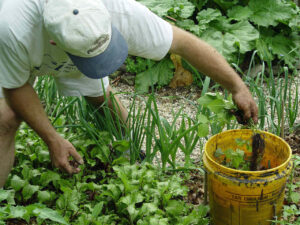
George on weed patrol with five-gallon bucket at his side.

   For one thing, my strategy of planting real plants wall-to-wall and mulching the limited or temporary openings doesn’t leave much room for weeds to get started.

   Plus, I’ve never minded going on regular weed patrols with my trowel and five-gallon bucket. I look at it as “harvesting compost.” Adding those young yanked weeds to the compost bin turns the enemy into an asset – plus it gives me an excuse to enjoy up-close-and-personal looks at the developing shrubs, flowers, and vegetables.

   The key is getting on top of the weed issue and staying on top. It’s so much easier to do regular but light cleanups than to try and corral an outbreak after it’s gone out of control.

   I know about that first-hand, too, after taking over a landscape that was completely ignored for 10 years.

See before and after photos of George’s landscape makeover

   Now is an important waypoint in the weed journey since June is a peak month both for the germination of summer weeds and the maturation of weeds that sprouted in spring. Allowing any of those weeds to go to seed will magnify your future troubles.

   It may seem overwhelming now as those weeds keep coming and coming. But the good news is that if you do a thorough cleanup now, the germination rate goes down from here on out.

   Some people turn to weed-killers for help. That’s a viable option if you’re careful how and where you spray and follow the label instructions.

   Not everyone has the back acumen and energy to get down there and pull, so herbicides become the only viable alternative to hiring out the weed-control work. (Landscapers usually lean to herbicides anyway and generally charge top dollar even if they’re willing to go the pull/dig route.)

   Kill-everything herbicides also can make sense as a one-time solution to bring a total mess back under control, essentially leveling the playing field for a fresh start.

   I’ve occasionally used spot-sprays but mostly avoid herbicides for a few reasons.

   One is that I’d rather garden with as limited risk to beneficial organisms, myself, and the environment in general as possible.

   Another is that I don’t like the look of the browned-out weeds left behind, which can take weeks to break down… unless I remove them after they’re dead (which is counter-productive if the point is to save work).

   And a third reason is that I like the idea of using the nutrients and organic matter in weeds as a compost ingredient. (I avoid composting toxic weeds like poison ivy or the few weeds that have gone to seed before I could yank them.)

   As I’m aging, I’m always on the lookout for ways to minimize work, especially the bend-over kind.

   One technique I’ve been using more and more is the idea of “composting in place,” or in other words, hiding pulled weeds under nearby plants instead of lugging them by the bucket full to the compost bin.

   I’m apparently not the only aging gardener embracing the idea.

Read More »


Gardener’s Heaven

May 23rd, 2023

   There’s a place on this planet where the soil is rich and well-drained, where temperatures sit in the pleasant 70s all year, where the sun shines day after day, and best of all, where deer don’t tread.

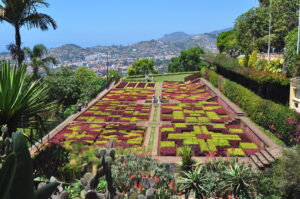
My favorite garden view on Madeira… the quilt garden in Funchal’s Madeira Botanical Garden.

   This gardener’s heaven is the Portuguese island of Madeira, a volcanic blip in the Atlantic Ocean located 320 miles off of the west coast of Morocco.

   Its southerly location (about the same latitude as Charleston, S.C.) ensures year-round warmth, while its surrounding water keeps it in that stable and plant-perfect 70s range. It’s like eternal spring.

   Unlike in our deer-infested yards of root-blocking clay and extreme, erratic weather, plants in Madeira show their gratitude with incredibly lush, diverse, and healthy growth.

   I got to see what a difference prime conditions breed on a visit earlier this month to Portugal and its Azore and Madeira islands. (See pictures in a new collection I’ve posted on my Photo Gallery pages.)

   Given the trifecta of great soil, ideal weather, and few bug, disease, and animal attackers (a side benefit of ocean isolation), it’s easy to see why Madeira is sometimes called a “floating garden” and the “pearl of the Atlantic.”

Read More »


How One of the Warmest Winters Ever Caused Some of My Worst Plant Damage Ever

May 16th, 2023

   How could this be?

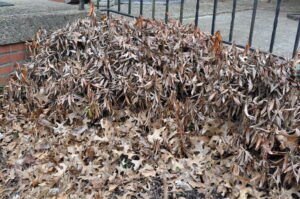
This is what winter did to my planting of sweetboxes.

   After one of our warmest winters ever – including a January that was nearly 9 degrees warmer than average and a February that averaged 7.3 degrees above normal – my landscape looked like it had been to Alaska and back.

   Most of my variegated boxwoods were the color of toast by the end of March.

   A dwarf nandina, a leucothoe, an aucuba, a band of sweetbox, a trio of gold-variegated box honeysuckles, and a pair of Red Beauty hollies were in various states of brown with rings of fallen leaves at their feet.

   A dwarf ‘Hedgehog’ cedar – an elegant new specimen going into winter – came out the back end completely brown and brittle. Ditto for that little osmanthus I got as a freebie at last year’s Philadelphia Flower Show.

   The ‘Tonto’ crape myrtle I planted two seasons ago had nothing but brown, brittle branches and has died back to the roots.

   Even my plenty-hardy roses suffered noticeably more branch dieback than usual.

   You’d expect this kind of damage in a cold winter, like the kind of sub-zero ones we used to get… or that year the low went down to minus-22 degrees.

   But when winter days are primarily in the 40s and 50s, plants should be safe and happy, right?

   Not necessarily.

   The explanation here is twofold.

Read More »


My Bulb Experiment: Three Years Later

May 2nd, 2023

   I wish I could say that my experiment growing 955 spring bulbs of 16 kinds has been a rousing success, carpeting my yard with vibrant color at a time when most everything else is just waking up.

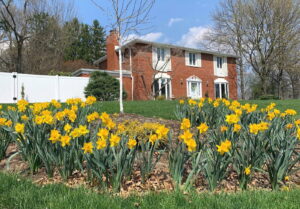
These ‘Mando’ daffodils have been my strongest bulb-trial performer.

   But three years after planting, only four of my bulb groupings put on a good show this spring. The rest have dwindled into meagerness or disappeared altogether.

Read more on the bulb game plan and what got planted

   To get right to the point, the four winners have been:

   1.) Yellow-blooming ‘Mando’ daffodils, which have bloomed long and strong all three years from mid to late March in several front-yard beds. These are actually growing in number.

   2.) Siberian squill ‘Spring Beauty’ (Scilla siberica), a low-growing blue-bloomer that’s spread and seeded its way into a colony on a morning-sun driveway terrace bed that later fills with astilbes, brunnera, sweet woodruff, and hydrangeas. These also bloom in mid to late March.

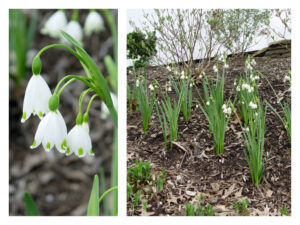
A 25-bulb planting of summer snowflakes ‘Gravetye Giant’ is thriving after three years.

   3.) Summer snowflakes ‘Gravetye Giant’ (Leucojum aestivum), foot-tall plants that produce hanging, bell-shaped white flowers for about two weeks from mid to late April. All 25 bulbs I planted in another driveway-terrace bed are still growing, blooming, and steadily expanding.

   4.) Camassia leichtlinii ‘Caerulea,’ a little-known, seldom-used bulb that grows about a foot tall and produces bluish-purple flower spikes in late April. The 25 bulbs of these also have come back reliably for three years now, despite deer gnawing off the foliage of this supposed deer-resistant species.

   I should add here that I’ve had excellent results, too, with allium ‘Globemaster,’ a softball-sized purple bloomer that I planted four years ago (technically not part of this experiment).

   And now, the losers.

Read More »


« Older Ramblings and Readlings Newer Ramblings and Readlings »

  • Home
  • Garden House-Calls
  • George's Talks & Trips
  • Disclosure

© 2026 George Weigel | Site designed and programmed by Pittsburgh Web Developer Andy Weigel using WordPress