


10 Out-of-the-Ordinary Ways to Use Spring-Flowering Bulbs
October 21st, 2025
We’re in the heart of bulb-planting season right now in Pennsylvania, and if you’re part of the majority, you’re either lining up a few packs of tulips across the front foundation or planting none at all.
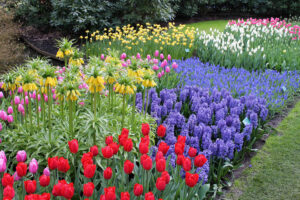
Bulbs can be way more showy than lined up single file along the house front.
Few gardeners take advantage of the full potential of spring bulbs – those little onion-looking things that get planted in fall and blossom into beautiful flowers early the following spring.
Maybe it’s because of that delayed gratification that our yards are seriously under-bulbed. Or maybe we’re just not sure how and where to use them.
Either way, if you’re up for trying to step up your bulb game, October is the month to do something about it.
Last week we took a look at how some of the smaller, earlier bulbs can be planted into the lawn to spruce up our oceans of green.
Here are 10 other less-ordinary ways to light up next spring with bulbs:
Masses, not lines
Bulbs give way more impact when planted in clusters or masses than lined up single-file.
Pick an empty area (or dig a new bed), and plant bulbs four to six inches apart in all directions. Think circles or blocks at least three bulbs deep instead of lines.
This is the technique that gives public tulip displays such as a Hershey Gardens and Longwood Gardens their “wow” factor each April.
Fill shrub gaps
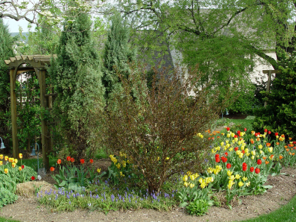
The space between landscape shrubs is prime territory to fill with a few smaller clusters of bulbs.
Especially with shrubs that are late to leaf out in spring, bulbs will poke up and flower by the time the shrubs are just starting to wake up.
Cut the bulb foliage when it yellows heading into late-spring dormancy, and the shrubs will take over the space from there.
Interplant with perennial flowers

Bulbs can be interplanted with perennials.
Bulbs and perennials also share space well.
When early bloomers such as snowdrops, daffodils, crocuses, Siberian squill, glory of the snow, and hyacinths use the space, most perennial flowers are just starting to push up new shoots.
As the perennial foliage begins to take over, the bulbs have bloomed and are ready to be cut back for the season.
Sedum, hosta, daylilies, goldenrod, lilies, phlox, black-eyed susans, and coneflowers are some of the best bulb partners.
Under trees and shrubs
Most bulbs need full-sun locations, but when they’re planted under trees and tall shrubs that lose their leaves in winter, they can usually take in enough early-spring sunlight to recharge themselves for years before the woody plants leaf out.
When the bulb foliage dies back as the tree/shrub canopy fills in, simply tramp down and mulch over the browning bulb foliage.
Daffodils, snowdrops, winter aconite, Siberian squill, and glory of the snow make some of the best under-tree groundcovers.
Share space with annual flowers
Annual flowers and spring bulbs make some of the best tag-team partners.
About the time bulbs are going dormant in late spring, it’s time to plant new annuals for the season (typically around Mother’s Day). They can go between or even right over top of the buried bulbs. Just be careful not to slice into the bulbs when planting.
Then when frost kills the annuals in fall, you can yank them and either plant new bulbs or dig and divide existing ones that are getting too crowded.
Tulips are ideal for space-sharing with annuals since most of them don’t return well and can just be pulled when you replant the space in annuals.
A bulb meadow

Mixed bulbs can be planted to create a meadow effect.
You don’t have to pick just one type of bulb and mass it out.
If you lean toward an action-packed, less-formal look, buy a bunch of different bulbs and plant them randomly. In spring, you’ll get a riot of consecutive color that looks a lot like a wildflower meadow.
This is a great way to take advantage of year-end bargains of two packs of this, three packs of that, etc.
Insert bulbs into groundcovers
The shoots of many bulb varieties are adept at finding their way up through short groundcover plantings, such as vinca, pachysandra, creeping sedum, sweet woodruff, lamium, and leadwort.
Poke bulbs through the groundcover, and they’ll find their way up. Then cut off the foliage after it browns.
Taller bulbs work best for this, such as daffodils, hyacinths, tulips, alliums, crown imperial, and Spanish bluebells.
Bulbs in pots
Bulbs can be planted in pots and left outside over winter, just as with in-the-ground plantings.
One caveat is that you’ll probably have to water the pots during dry periods when the soil is thawed. You can avoid that by simply burying the bulb-planted pots, then lifting them back above ground in spring when the shoots are up.
Place chicken wire over the top of pots to prevent rodent-digging.
Be sure to use weather-resistant containers, such as foam or heavy concrete ones, so you don’t end up with cracked-apart terra-cotta pots at the end of winter.
With window boxes, plant bulbs in plastic liners that can be removed from the boxes. Bury the planted liners over winter, then re-insert them in the boxes as the bulb shoots begin poking up in spring.

These bulb combos are growing in a bulb pot garden.
Coordinated trios
Show off your design acumen by planting bulb clusters or beds with three different kinds of bulbs, coordinated by color and size.
Start by picking bulbs with the same bloom time (labels usually tell you that), then select a tall, medium and short variety from the list. Finally, pick specific ones that match colorwise.
In a circular or island bed, the tallest bulb goes in the middle, surrounded by the mid-sized ones, with the shorties around the perimeter.
In a one-view bed, put the tall bulb in the back, the shortest one in the front, and the mid-sized one in the middle.
Example of an April-blooming trio: tall white daffodils, mid-sized pink hyacinths, short blue-purple glory-of-the-snow.
Example of a May-blooming trio: tall yellow crown imperial, mid-sized red tulips, short purple grape hyacinths.
See George’s list of which bulbs bloom when in central Pennsylvania
Make a “bulbarinth”

Dr. Bill Miller’s Cornell University class planted this labyrinth-style bulb garden.
Credit: Cornell University
A labyrinth is a meditative winding path typically built using stepping stones in a lawn. How about creating a labyrinth out of bulb-lined grass paths instead?
Dr. Bill Miller has done that with his Cornell University horticulture class, using a classic circular seven-circuit labyrinth pattern.
This is different and impressive but surprisingly easy to do. Just line out the paths with string and flour or spray paint, dig, and plant bulbs along the lines.
Read George’s PennLive post on seven things that can go wrong with bulbs and how to fix them