

Success Story: Bulbs in the Lawn
October 7th, 2025
Trying to plant a half-acre, deer-infested, clay-laden yard that was neglected for a decade – at Medicare age, no less – has been a “challenging” endeavor for me the last few years.

Here’s what my bulb lawn looked like in March of the third spring.
Muscles were strained, gallons of sweat were poured, and much money was invested, not to mention that visit to the ER when I smashed my finger trying to hammer a stake into my coal-in-the-making “soil.”
But one of the small victories I can report is the section of bulb lawn out front.
A bulb lawn is a regular lawn most of the year, but it’s one planted with small flower bulbs that come up in early spring to add color to this otherwise sea of green.
Few people know it’s possible to do this.
Longwood Gardens has displayed large swaths of the idea for years, and in 2022, Flowerbulbs.com (an arm of the Dutch bulb industry) reported that there was brewing new interest in bulb lawns.
The year before, the Connecticut-based bulb company Colorblends rolled out a five-mix line called “Color Your Grass” that was geared specifically for planting in lawns.
Besides adding color at a time when little else is flowering, bulb lawns offer an early-season pollen and nectar source for pollinators – a factor that could be fueling at least a little of the supposed new bulb-lawn interest.
Since I had never tried this myself, I took the plunge and invested $300 in a 1,000-bulb crate of Colorblends’ Lawn Suite mix.
I planted the bulbs in October of 2022 in a section of my sunny front yard.
After three seasons watching the show unfold, I can say I’m very happy with the results. Most of the short, early tulips have either fizzled away or got eaten by deer, but the crocuses, grape hyacinths, and especially the dwarf daffodils have flourished.
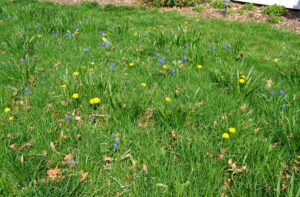
Short, early bulbs poke up through the grass blades, then die back later in spring, leaving a “normal” lawn behind.
I enjoy the changing color for weeks in March and April with virtually no care, and I’ve even got compliments from neighbors who enjoy the color.
The $300 crate contained: 300 bulbs of Yellow Mammoth crocus (a four- to six-inch-tall yellow bloomer); 200 bulbs of Tarda tulips (five- to seven-inch yellow/white bicolor bloomers); 200 bulbs of Scarlet Baby tulips (six- to eight-inch red/yellow bicolor bloomers); 200 bulbs of grape hyacinths (five- to seven-inch purplish/blue bloomers), and 100 bulbs of Tete-a-Tete dwarf daffodils (seven- to nine-inch yellow bloomers).
I planted them all during two days at the end of October, following Colorblends instructions of mowing the grass short and raking leaves before planting.
I figured the front yard was a good spot – both because it was a full-sun site and would get a lot of visibility from passing traffic.
To start, I roped out a kidney-shaped planting area, mixed all of the bulbs together in a five-gallon bucket, then set the bulbs over the top of the lawn in a random layout.
I left a three-foot grass mowing strip between the bulb-lawn area and a neighboring fence bed and conifer garden to isolate the bulb lawn into a sort of temporary spring meadow.
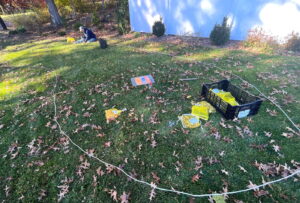
I planted the bulbs randomly, one-by-one, in a kidney-shaped bed.
Then I planted the bulbs one-by-one, using a sturdy, serrated digging tool similar to a Hori-Hori knife.
You could also use a bulb planter, a handled tool that you twist into the ground to remove cores of soil. That lets you set the bulb in the hole, then replace the core to minimize disruption to the turfgrass.
Drilling with an auger, as you might do for a mass planting in a garden bed, would grind up the turf, so I discounted that option.
Planting was labor-intensive.
Digging 1,000 holes by hand was a lot of work, especially in my compacted, heavy-clay lawn. The going was much tougher than in a garden bed with loosened soil.
The tulips and daffodils were the hardest to plant because of their larger size. The smaller crocuses and grape hyacinths went faster since I could get them underground a couple of inches with a single knife plunge and pullback.
The lawn looked a bit rough and beat up after planting, but with a good watering, it didn’t appear much different than the surrounding untouched grass.
Come late February, the yellow crocuses were poking up and starting to bloom.
It was nice to see color in the lawn that early, but the look was very spotty since these were the only flowers of the 1,000 to get going that soon.
By the second week of March, the 100 yellow Tete-a-Tete daffodils were up and almost immediately blooming. These turned out to be the most impressive of the whole lot – blooming non-stop into mid-April before finally dropping their petals.
For about a week in mid-March, the crocuses and daffs were blooming at the same time.
Between mid-March and mid-April, a few red tips of the 400 tulip bulbs started to show here and there. However, grazing deer chewed off every last one before they grew and opened. A few dozen keep trying three years later, and I’ve since seen a few red blooms.
In late March, the first dozen or so grape hyacinths emerged and soon opened their short purple spikes. These came up incrementally and offered a smattering of color through the end of April. These have actually improved each year so far.
One thing I’ve done the past two springs is add to the planting by transplanting bulbs of Siberian squill and glory-of-the-snow from existing colonies elsewhere in my garden beds.
These have done well in the lawn, too, and have added to the diversity, fullness, and bloom time.
The main issue on the con side has been how the bulb foliage traps fallen, browned leaves that often are still blowing around at the end of winter into early spring.
That doesn’t affect bulb health (not significantly anyway), but it does detract from the look.

I mow around the bulb-lawn area until the bulb foliage turns yellow.
It’s an easy-enough “problem” to address if you don’t like it by occasional raking or leaf-blowing, assuming you don’t mind the effort.
Related to that is the fact that you have to wait to mow the lawn until the bulb foliage at least yellows. So long as the foliage is green, it’s manufacturing sugars to recharge the bulbs for next year’s flowering. Cut too soon, and you short-circuit that process.
If you don’t mind the combined “messiness” of interwoven fallen brown leaves and unmowed grass, just wait until early May and mow it all in. Do a couple of passes, and you probably don’t even need to rake anything.
I addressed this dilemma by planting my bulbed area in a kidney-shaped bed that’s surrounded by mowed grass, which kind of signals that I’m growing a meadow-like area in the grass and not just neglecting things.
Once I mow the going-dormant bulb foliage, the lawn goes on to grow and look like the rest of the lawn the rest of the year.
Here are five lessons I’ve learned about bulb lawns:
1.) If you’re gardening in deer or rodent country, forget tulips. They’re a favorite food and unlikely to thrive in the long run.
2.) Maximize diversity. My short daffodils and crocuses were winners, so I’d use a few more choices of that ilk to spread out the bloom time and color range. Added diversity also would give the planting more of a meadow look.
3.) You don’t have to stick with a ready-made collection sold just for bulb lawns. It’s fine to mix and match whatever bulbs you like from assorted stores and catalogs.
Short-growers and early-bloomers that animals don’t like are the best bets. These include Siberian squill (blue), “Tommy” crocuses such as ‘Barr’s Purple’ and ‘Purple Giant’ (light purple), winter aconite (gold), snowdrops (white), glory-of-the-snow (bluish-purple or pink), and striped squill (white with blue stripes).
4.) Try to plant after a rain or even a first early freeze. That will soften the soil and make planting a little easier.
5.) Don’t use herbicides to kill weeds in that section of the lawn – at least not while the bulb foliage is up.