


Are Bugs Driving You Buggy in the Garden?
July 1st, 2025
I’ve long battled animal pests and weather assaults in my annual quest to grow intact vegetables, but one common problem that’s never vexed me much is one that plagues a lot of other veggie gardeners this time of year – bugs.
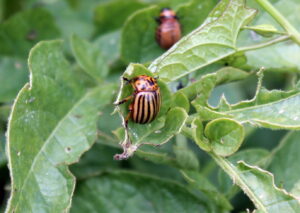
Potato beetles are a common sight on potato plants in summer.
Garden bugs can be a big problem and do a lot of damage. However, in my yard, they’re at worst an occasional annoyance – not a deal-breaker.
I chalk it up to some advice I gleaned 30 years ago while interviewing Paul Keene, then the owner of one of America’s first organic farms, Walnut Acres, a 589-acre organic farm in the rolling hills of Snyder County.
Keene’s “secret” was that if you interfere with nature as little as possible and try to mimic what nature does, everything falls into place on its own. Despite no spraying, the farm had almost no pest bugs and very little plant damage.
I remember Keene challenging me to “go ahead and look. Try to find a bean beetle.”
There were none.
The fields of corn, tomatoes, cabbage, beets, peas, beans and zucchini were some of the healthiest I had ever seen – all without a drop of any chemical bug-killer, weed-killer or disease-killer in half a century.
“We really have very little trouble with bugs,” Keene explained. “You might see one here or one there, but it’s no big problem.”
It wasn’t always that way. When Keene and his wife, Betty, first moved to Walnut Acres at the end of World War II, they were greeted by a familiar array of garden pests.
But rather than reach for the spray as was more “fashionable,” Keene stuck with the game plan that attracted him to a farm in rural Pennsylvania in the first place.
Weaned on the teachings of contemporaries J.I. Rodale, founder of Rodale Press and Organic Gardening magazine, and Sir Albert Howard, often called the “father of composting,” Keene decided that toxic chemicals would upend nature’s balance and ultimately do more harm than good. In other words, less is more.
“The remarkable thing to me was how the insects just seemed to disappear,” Keene said. “When we first came, we couldn’t even grow squash. Borers would get them every time. Then one day I remember saying, ‘You know, Betty, we don’t have squash vine borers anymore.’’’
All the bugs didn’t go away overnight, but as the years went by, pests became less and less of a problem.
Paul Shaw, Walnut Acres’ assistant general manager, told me back then that a big part of the farm’s success was its healthy population of beneficial insects. Those are the bugs that prey on the relative few pests that cause most of the damage.
“When you start using chemicals, the problem is you knock out the good guys along with the bad guys,” he said.
Left alone, the good-guy populations tend to rise and fall with the pest populations, keeping problems in check much better than we can in our never-ending spraying quest, Shaw explained.
He said that Penn State entomologists once did an “insect sweep” of a section of the farm and found that it had no more destructive insects than on conventional farms that were spraying pesticides… and a very healthy population of beneficial insects.
So is the answer to simply toss out the pesticides and watch your bug problems go away?
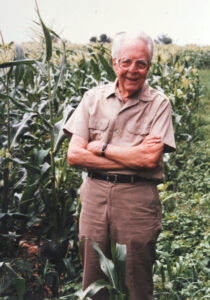
A shot of Paul Keene that I took of him at Walnut Acres in 1995.
Not quite. Keene said it’s also absolutely essential to build up healthy soil so you grow healthy plants, which he was convinced are much less likely to be attacked by pests than weak plants.
Keene arrived at that conclusion early on when he did a test planting of a dozen different varieties of squash plants.
“They all came up nicely and were growing fine, but then bugs came and completely destroyed just one variety,” he says. “They didn’t even touch the other varieties. I thought, “What other concept is possible but that nature has decided that this variety is not fit to survive?’”
Since that ah-hah moment, Keene viewed pest bugs as nature’s way of weeding out weak plants. The solution, he concluded, is to follow nature’s lead in growing the strongest plants possible.
“If you take care of the soil,” he said, “the soil will take care of everything else.”
At Walnut Acres, the growers used cover crops (“green manure”) and compost instead of 10-10-10.
The only fertilizing was a watering of fish emulsion at planting time for tomatoes and cabbage and an occasional foliar feeding of kelp (a seed-weed derivative) on tomatoes.
Another keystone to success is picking varieties that are naturally bug-resistant.
As in Keene’s squash observations, some varieties of even the same crop are much more attractive to bugs than others. They might all look and taste about the same to us, but minute variations can make the difference between a plant that’s attacked by a bug and one that bugs just don’t like.
Besides avoiding sprays and focusing on my soil, that’s been the third (and maybe most important) strategy I’ve used to stay out of bug trouble.
Sometimes seed catalogs and plant labels will tell you which varieties have been bred with bug resistance as a priority. Other times, it’s a matter of trial and error.
If it helps, I’ve developed a crop-by-crop list of my favorite all-time vegetable varieties. It’s posted and printable at no charge in my George’s Handy Lists section of this site.
Home gardeners can do a few other anti-bug things that weren’t practical on a farm the size of Walnut Acres.
One is hand-picking and smashing bigger bugs such as Japanese beetles, slugs, and stinkbugs. Another is spraying aphids, mites, and such with a stiff spray of bug-dislodging hose water. And third is employing floating row covers to physically block bugs from reaching their favorite plants.
If we’re at a disadvantage, it’s because our own little mini-environments often aren’t big enough to completely restore nature’s balance when neighbors all around are still wiping out hordes of beneficial bugs with their sprays.
Walnut Acres went out of business in 2000 when the company couldn’t keep pace with new organic-foods competition. Keene died in 2005 at the age of 94.
Much of the land is still a certified organic farm, and one chunk of it is a community garden called the Keene Center at Walnut Acres Organic Farm, run by the Walnut Acres Foundation.
It’s located just off Route 104 in the village of Penns Creek between Middleburg and Mifflinburg.
There’s also a meadow there and a Monarch Waystation.