
Eight Things I’ve Learned about Gardening
December 2nd, 2025
I’ve been gardening for 45 years now and have picked up a few practical insights that a.) aren’t always obvious, and b.) aren’t lessons you usually read about in books.
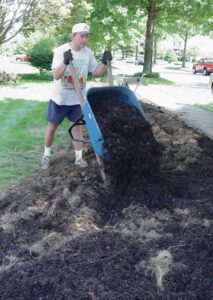
Scientific evidence to the contrary, I’m a believer in improving soil with compost before planting.
As I head into the final month of this website, I thought I’d share eight of the most important with you.
1.) You really do need to improve the soil.
This is the one really important part of gardening where I disagree with the experts and the supposed scientific evidence behind it.
The books all tell you that you shouldn’t add compost or other amendments to the soil, at least when planting trees and shrubs. The reason is the so-called “bathtub effect” – water will drain through the improved soil, then hit the more compacted native soil below and around the hole, causing a backup that leads to root-rotting.
While that can happen, I don’t think it’s anywhere near the threat that planting into unimproved soil poses. Most of our “soil” is heavily compacted clay, shale, and especially “builder’s soil” that results when home-builders grade a yard, pile up the surface clay and subsoil, then spread a six-inch layer of this plant death trap over the bulldozed site.
I’ve tried the recommended loosening and planting into existing soil, and it almost always results in severely stunted plants – and often a gradual retreat into death. I can’t tell you how many plants I’ve rescued by digging them up, working a bucket of compost into the planting bed, then replanting.
I’ve had the best results by preparing planting beds in advance – loosening a foot deep and working about two inches of compost into the soil before planting. That amounts to about a 20-percent compost improvement.
2.) If there’s a “secret” to gardening, it’s water.
I’ve seen so many fads and miracle products marketed over the years – ones that are supposed to jump-start plant growth.
Mycorrhizal fungi, vitamin B2, biochar, assorted plant stimulators, magnesium, Super Thrive, and fertilizers in general are among the many things gardeners are told they ought to apply to maximize success.
While some of them might have some benefit, I’ve found that the best overall plant-growth stimulator is simple water.
Plants go downhill quickly when they don’t have enough, and they stunt and struggle mightily in hot summers that go long spells without rain – a scenario that’s become our norm lately.
I’ve found that not enough water is the cause of way more plant woes than nutrient deficiencies, bug problems, or compost added to the soil. Being a good “waterer” leads to success more than any product.
3.) Gardening’s biggest unwinnable challenge is animal pests.

This used to be a healthy Brussels sprouts plant before a groundhog found it.
Just about everything that goes wrong in gardening can be fixed or headed off with good planning, good plant selection, and good gardening techniques.
The one exception – and by far the most frustrating part of gardening – is keeping animals from eating and/or destroying our plants.
Rabbits, rodents, groundhogs, and deer have nothing better to do all day than hunt down plants to eat. On the other hand, people have other things to do and other places to go. We can’t defend the whole yard at all times.
And so whenever our backs are turned, the aforementioned species (which thrive in peopled neighborhoods) move in for the attack. Sometimes they don’t even eat the plants… they just ruin them by pulling them out of the ground or rubbing the bark off of young trees with fuzzy antlers.
We gardeners try to do what we can with fencing and repellents and such, but I’ll be the first to admit that I can’t out-maneuver hungry animals 100 percent of the time. Just when you think you’ve won, there goes that $200 specimen redbud.
4.) You can’t plant whatever you like wherever you want. And that includes native plants.
Tops on the list of problems that we can do something about is good plant selection.
Most gardeners quickly figure out that you have to pay attention to light and soil-moisture situations and then select plant species that are naturally suited to each site. Most also realize that it’s easier to match plants to the site than to try and alter the site to match a plant you want.
What far fewer realize is that it also makes a big difference in what particular variety of a plant species you choose. Some varieties (cultivars) of plants perform far better than others. In other words, not all petunias or roses or cucumbers do as well as any other.
The best gardeners spend a lot of homework time tracking down the top varieties and then invest time finding those current top performers. It’s also why I’ve written so much about best varieties, i.e. my 19-page booklet of best plants, my archive of best-plant profiles, and my long-time annual Patriot-News/PennLive series of best new plant introductions of each year.
This applies to native plants, too, by the way. Some gardeners hear the mantra about how native plants have grown for centuries in our area and come away with the belief that natives are indestructible no matter where you plant them.
That’s not the case. You still have to get each native plant in a suitable spot, and I’ve found that most varieties of natives perform better than the straight species, although straight species generally are most useful to native pollinators.
5.) Patience is required.
Probably the biggest blunder in landscaping is planting too big of a plant in too small of a space.
I think that happens for two reasons. One is that people don’t know plant sizes terribly well and tend to under-estimate mature sizes. Even if you pay attention to sizes on the tags, those are estimates at a given point of time (usually five or 10 years out). Plants may slow in growth as they age, but they never stop growing until they die… or until something stops growth for them.
The second reason for landscaping jungledom is that people like instant results. They want things to look good and full fairly quickly, and so they purposely pack things closer than they know they should. The result is that everything is growing into one another and up and over the windows in just a few years. And that leads to unnecessary pruning and/or relocating.
I’ve learned to space accordingly and enjoy the increasing fullness as each year passes. To fill in those early empty spaces, I plug in annuals. Then I use fewer and fewer as the shrubs, evergreens, and perennials creep into the voids.
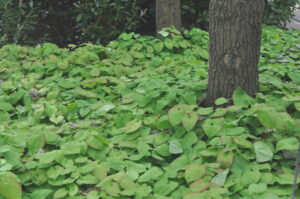
Trees underplanted with a groundcover such as this barrenwort create the lowest-care yard setting.
6.) Trees and groundcovers are the ticket to long-term lower maintenance.
Some people think that lawn is the lowest-care way to fill a yard. If you do nothing but mow and are OK with more weeds and clover than grass in the long run, then you might have an argument. However, what other plant needs “pruned” 20 to 25 times a year? That’s not exactly low care.
I’ve come to believe that the lowest-care long-time strategy is to plant trees and then cover all of the ground underneath with a mix of low-care shrubs and evergreens, durable perennials, and low groundcovers. Ultimately, you’ll need underplantings that are good at tolerating dry shade and root competition.
Some of my favorite shrubs for this purpose are summersweet, viburnums, fothergilla, boxwoods, and smooth hydrangeas. Some of my favorite perennials are hellebores, white wood asters, coralbells, variegated Solomon’s seal, assorted sedges, and Japanese forest grass. And some of my favorite shady groundcovers are barrenwort, liriope, foamflowers, leadwort, and Allegheny spurge.
7.) Just because perennials come back every year doesn’t mean they’re no work.
Beginners sometimes think their garden work is once and done if they plant all perennials. It’s a reason why a lot of people have steered away from annuals… so they don’t have to replant each year.
However, like any plant, perennials require ongoing work and maintenance. You might not need to plant them each spring, but you probably need to remove their foliage annually, do some in-season deadheading and/or trimming, do some watering in dry heat waves, and probably dig and divide most of them every few years.
I like perennials and use lots of them. But I’d rate them somewhere around mid-range on the gardening workometer.
8.) Don’t take it all too seriously. Have fun.
Gardeners sometimes get on a mission or set goals to come up with gardens that look like the ones in the magazines. I’ve been guilty of that.
But things are going to happen, and those gardens in your dreams seldom pan out. It’s just how garden reality goes.
I’ve decided that gardening works best when you live in the moment, enjoy the little successes, and don’t get too frustrated when things don’t turn out (see No. 3 above).
In other words, enjoy the process. It’s not all about the results. This should be fun. And if you like doing it, it won’t seem like work.