




Behind and Behinder
April 1st, 2014
Those warm spells we’ve had in recent winters have been great for getting some spring yard jobs out of the way early.
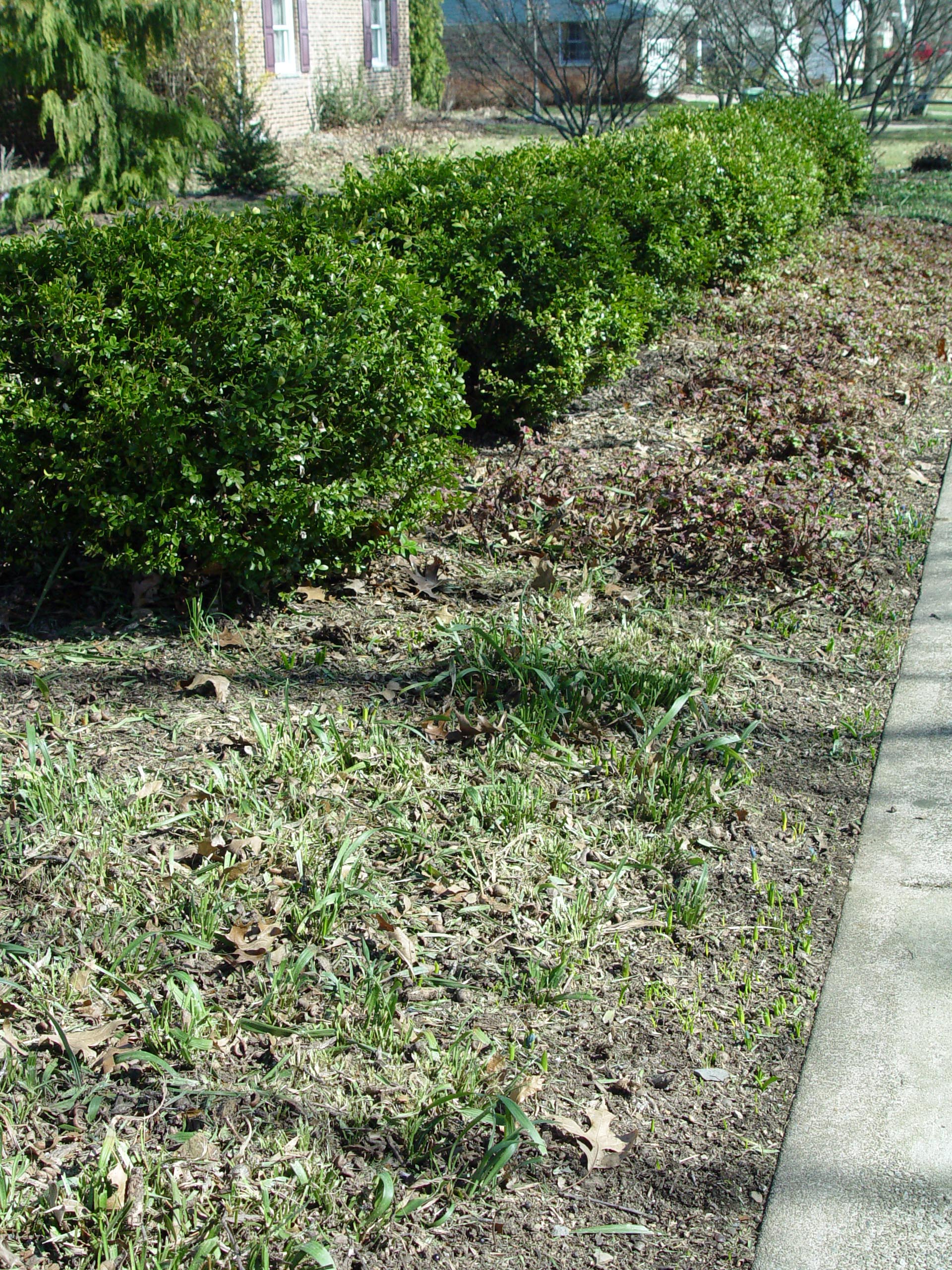
The boxwoods are trimmed, and the liriope and hardy geraniums are clipped… a few jobs done.
No such luck this year.
I probably speak for all but the most crazed gardeners in admitting that I didn’t get a thing done this year until late March. No April fooling.
Since then, it’s been a flurry of trimming, raking, pruning, perennial-cutting, vole-cursing and such. It reminds me of the folksy saying, “The faster I go, the behinder I get.”
Judging from how plants have progressed in this cold late winter and early spring, we’re all at least a week – and maybe two – behind our usual happenings.
I’d been getting used to seeing forsythia and Mellow Yellow® spireas blooming in late March, with daffodils and crocuses and helleborus adding to the chorus (a helleborus-chorus?)
We’ll catch up. All it took was a couple of 50-degree days on March 21-22 to encourage even the tulips to poke up their leafy heads.
Everything will get around to emerging and blooming, even though the timing might be on the back end of normal for a change. That’s assuming the cold winter just browned our landscape plants and didn’t actually kill off much.
To help you whip things into shape in your yard, here’s what I’ve been up to:
* Trimmed the boxwoods, hollies and falsecypresses. The boxwoods in particular had some tip-burning from the winter wind. They’ll be fine once new leaf buds push out.
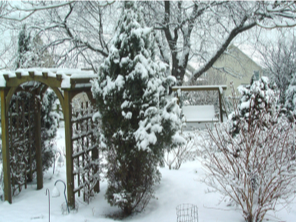
* Shored up a few sagging arborvitae. This happened to a lot of arbs under the heavy snow and ice loads we had back in January. Mine had fairly minor splaying that I fixed by bundling back together with wide bands. People with severe sags on big arborvitae aren’t going to be so lucky.
* Pruned the dwarf butterfly bushes, tree-type hydrangeas (Hydrangea paniculata Pinky Winky® and Vanilla Strawberry™), ‘Knock Out’ roses, St. Johnswort and beautyberry. These are all plants that will flower on new wood, meaning heading into the season is the time to cut them.
* Clipped the browned-out foliage from perennials that I let alone heading into winter. These include salvia, coreopsis, hardy geraniums, catmint, iris, ornamental grasses, liriope, mums, sedum and barrenwort. The clippings go onto my compost pile.
* Raked off the browned-out foliage of hostas, daylilies, sweet woodruff and leadwort.
* Raked the leaves off of semi-evergreen perennials and groundcovers, including helleborus, coralbells, foamflowers, foamybells, lamium, creeping sedum and ajuga.
* “Hardened off” the cabbage, broccoli, onion, leek, lettuce and cauliflower seedlings that I started inside in February. Hardening involves setting the plants outside gradually in increasing light and wind exposure over about 10 days before planting.

Filling a Wall ‘o Water with water to insulate the early tomatoes.
* Got out a couple of Wall ‘o Water plant protectors, filled the cylinders with water and set them in the garden to warm the soil inside. In a few days, I’ll plant two tomato plants – a cherry type and an early variety – that I also started inside in February. These usually give me my first ripe tomatoes by the end of June.
* Muttered about all of the grass-patching I’ll be doing in another week or so from vole and grub damage. Muttering followed raking all of the dead grass off and dumping it into the compost pile, which is now overflowing.
* Gathered up multiple plant tags that blew around the yard over winter. Tried to poke them back into the soil somewhere near the matching plants might be.
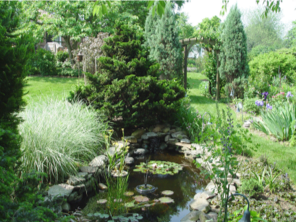
* Smiled that the goldfish seemed to have survived a winter in which the pond froze over almost the entire time.
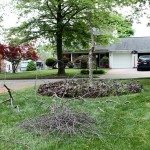
* Chipped up two large piles of tree, rose and shrub prunings with one of the few gas-powered tools I own – a 6-horsepower chipper/shredder. The homemade mulch went directly on one my perennial gardens. It makes no sense to me to pay to have prunings hauled away, then turn around and pay to have someone else bring me a pile of wood mulch later.
I haven’t even thought about edging or fertilizing yet. Come to think of it, while I’ve been writing this, I just got even more behinder…

Hi George
I’ve been thinking about getting a chipper\shredder. I mainly want to chip up small tree branches and prunings from some of my shrubs. Do you have any advice for what features to look for when buying a chipper\shredder?
Thanks!
Hi Gayle,
That’s one of the few pieces of power equipment I’ve invested in (I usually lean toward people-powered stuff). Chipper/shredders make it possible to recycle prunings into mulch, pretty much eliminating any woody waste from leaving the yard. I’ve also used mine to grind up ornamental grasses, pulled end-of-season vines and roots of dead plants.
I’d just make sure you get one that’s big enough to handle the quantity and size of your yard waste. Mine is a 6.5 horsepower model that’s a good average size for an average yard. It’s a portable model on wheels that I got at one of the home centers.
There are lots of brands, and I’m not sure one is that much better than the others. I usually defer to Consumer Reports on that when I go to buy something pricey. Mine was a low-end one, and it’s worked fine for lots of years. Hope that helps at least a little…
Hi George,
I’m not sure if this is the appropriate place to ask a question, but here goes. My garden has been without mulch now for 3 years because I have so many other garden expenses that forking over $2,000 for mulch is hard to swallow. (We need about 48 yards to do the job.). Other than keeping the weeds down, which believe me I do appreciate, and it looking good for 3 weeks before it fades, what level of priority do you give it? Is there a less expensive alternative that you can suggest? Thank you so much for your time.
Sincerely,
Sue Madlinger, Northport, Long Island
Sue,
Organic mulch such as bark or leaves is a big help to a garden… it chokes out weeds, slows moisture loss by evaporation from the soil, moderates swings in soil temperature and adds nutrition and organic matter to the soil as it breaks down. The two main drawbacks are that it’s expensive to buy and significant work to put down — especially when you’ve got a lot of beds.
You don’t have to mulch every year so long as it’s not breaking down so fast that you’re down to bare soil. You might be able to add 2 or 3 inches one year, then skip a year while it breaks down to compost. You’ll get less weed control and soil protection in the second year, but some is better than none.
Another option is breaking the job into sections — maybe even quadrants. Do one section in the spring of Year 1, then another section in the fall of Year 1. Then do the third section the following spring, and the last section the following fall.
For me, mulching is going to be the first job I hire out when I’m no longer able to keep up with it.
Another strategy that I’m already using is covering the ground with plant groundcovers instead. Creepers such as creeping sedum, creeping thyme and vinca in the sun or sweet woodruff, leadwort, barrenwort and pachysandra are good replacements for mulch. Liriope is another excellent spreading/clumping, foot-tall tough plant that I’m using under and around trees and shrubs in sun or shade.
Planting enough shrubs, evergreens and perennials so that they touch as they mature is another good way to avoid bare soil where weeds take hold.
And finally, weed preventers such as Preen and corn gluten meal can be put down in early spring and early summer to prevent many/most new weeds from germinating from seed. These don’t kill existing or perennial weeds, but they can reduce the number of new weeds popping up.
George