

Brown Trees and Red Tomatoes
August 5th, 2014
Lots of short stuff to share this week…
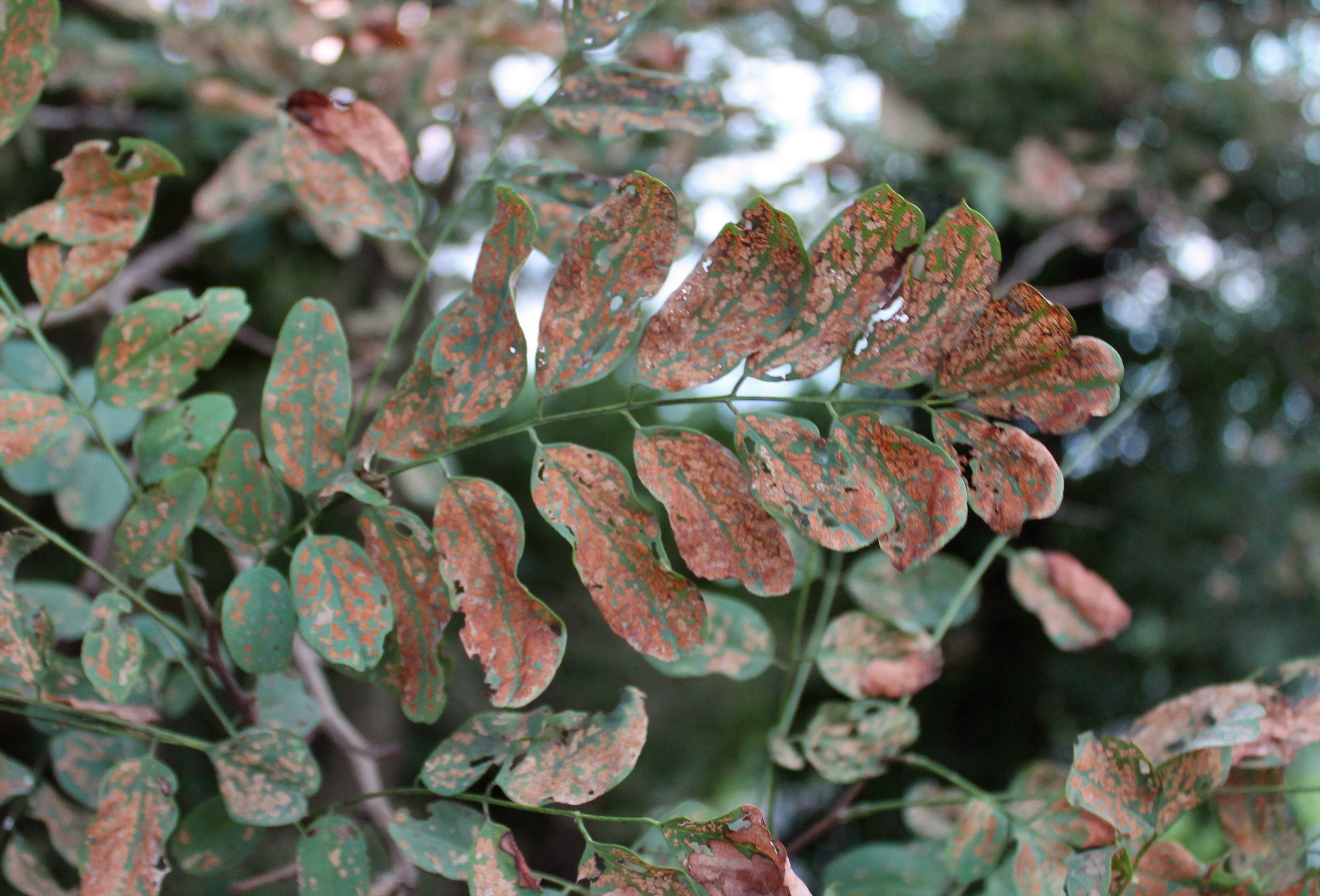
Leafminers have browned out these black locust leaves.
* Brown Trees
Are you noticing all of the browned trees along the roadsides these days?
That would be leafminer damage to the black locust trees.
Locusts are very common “wild” trees, but they’re prone to feasting from locust leafminer bugs, which apparently are having a banner year this year.
Look closely, and you’ll see the leaves aren’t brown all over but have a lot of smaller brown blotches from the feeding damage.
Leafminers won’t kill the trees, but they sometimes cause widespread damage and early leaf dropping.
The hapless locust trees usually grow a second set of leaves, only to have that set eaten again in September.
* Japanese Beetles
We’re on the last leg of Japanese beetle season, and I really haven’t seen many of them this year. Others told me they have, so this must be a spotty year instead of a dreadful one.
We’ll see how this plays out with grub damage in the fall, because even a few beetle adults can lay a lot of eggs that turn into those lawn-root-eating larvae this month and next.
The blackfly population seems to be a little better lately, too. I heard the state finally started spraying for them. These are what most people call “gnats” – the tiny swarming bugs that fly into your eyes and bite your ears.
* Crape Comeback
The crape myrtles started blooming last week, and the display is looking surprisingly nice after a butcher of a winter cut so many of them down to the ground.
The reason we’re getting crape-myrtle flowers after the dieback but not the similarly killed-to-the-ground bigleaf hydrangeas is that crape myrtles flower on new wood. That means the flower buds form on branch tips that grow the same season.
The popular bigleaf hydrangeas (Hydrangea macrophylla) largely didn’t flower earlier this summer because they bloom on old wood, i.e. from buds formed last fall that got killed by winter.

The tomatoes are finally ripening, just a little later than usual.
* Finally… Tomatoes
I’ve been getting a lot of questions so far this year about tomatoes not ripening. The cool start to the season set them back a bit, but they’re ripening now.
All told, I think they’re only a week or so behind where they normally are the first week of August, which typically is prime time for tomato-ripening in my Cumberland County garden.
Maybe it’s just me and my blight- and leaf-spot-infested soil, but it seems like the yield isn’t all that great this year.
* But… Rot
A lot of gardeners are also whining (OK, “observing”) that their tomatoes are rotting on the bottom as they’re ripening.
That’s a condition known as blossom end rot, and the prevailing thought used to be that it was due to a lack of calcium in the plants, aggravated by lack of regular watering.
Nowadays, the word is that it’s just the uneven watering. Keep the soil consistently damp, and you don’t get the rot.
* New Children’s Garden
Penn State University last month opened a new 1-acre Childhood’s Gate Children’s Garden in its main-campus H.O. Botanic Gardens.
I visited, wrote about it in my Patriot-News/Pennlive garden column, and think it’s an excellent design with interesting Pennsylvania-flavored features, such as a Susquehannock village, large veggie garden, and a limestone cave.
It’s already getting great use. See 16 photos of it in a Photo Gallery I posted.
Darned, though, if a couple of people didn’t post comments on Pennlive questioning the propriety of the Penn State/children connection, referring to the Sandusky case.
As I replied, this garden has absolutely no connection to that case, and the little kids already flocking to it know nothing about anything related to it. I’m glad Penn State didn’t deprive them of this sorely needed outdoor educational experience out of any thinking that it was “too soon” or somehow inappropriate.
* Crystal Threat?
Something else I recently came across… a warning from Washington State University horticulture professor Dr. Linda Chalker-Scott that those water-absorbing crystals (SoilMoist, Terra-Sorb, etc.) could be hazardous. Also known as “hydrogels,” these are the little granules people put in flower-pot soil to help hold water.
Dr. Chalker-Scott says most hydrogels break down into a potentially harmful form that’s a human neurotoxin and carcinogen. She therefore recommends against them – if nothing else, out of uncertainty and caution.
I wrote a Pennlive Q&A on that, which mentions how some manufacturers are now producing alternate forms using starch.