


How to Head Off Winter Plant Damage
November 4th, 2025
Our winters have been consistently warmer these past three decades, but that doesn’t mean we Pennsylvania gardeners can let down our guard like we’re now the semi-tropics.

Just one really cold night is enough to cause damage or death to a tender landscape plant.
Last winter reminded us that we can still flirt with sub-zero winter nights, even if it’s just for a quick-hit arctic blast or two. Really, that’s all it takes to kill or winter-burn plants that are borderline-hardy.
Although most of the Harrisburg area has now morphed into USDA Cold Hardiness Zones 7A and 6B (a half of a zone warmer than the turn of the century), we can still get temporary tastes of a Zone 6A or even 5B winter.
That doesn’t mean it’s foolhardy to take advantage of new possibilities like tea olives, hardy camellias, distyliums, and gardenias, or to feel more comfortable with previous iffy choices such as cherry laurel, figs, aucubas, and skip laurels.
Most winters now, we probably can get away with all of the above.
Read George’s PennLive column on 16 “southern” plants you now might be able to grow
What helps stack the odds in your favor is 1.) wise siting, and 2.) a few precautions and winter-prep techniques to mitigate those few extra-cold surprises and erratic temperature ups-and-downs.
When it comes to placement, look around the yard for any little microclimates you might have that can afford even a few degrees of extra warmth and a bit of shelter from those cold wintery winds.
Courtyards are a prime example. So is along a heated foundation wall or along a stone or brick wall that can throw back a bit of heat absorbed from daytime sunlight.
Even a fence or evergreen hedge is good at wind protection, even though those aren’t likely to make much of a temperature difference.
Two of the worst spots for borderline-hardy fare is out in the open and at the base of slopes, where cold air runs down, creating so-called “frost pockets.”
Areas that hold cold, wet soil for much of winter also can be a threat to rot roots.
I know of one local gardener who placed max-min thermometers are various points of his yard to zero in on the warmest and coldest exact spots. He found several degrees of difference – enough to make a difference in whether a borderline-hardy plant survived or not during a cold snap.
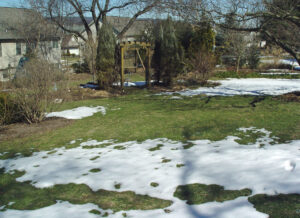
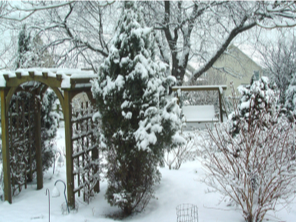
Watching the melt situation after a snow can offer clues about wind and light in the yard.
Another clue is to watch what happens in the aftermath of a snow. Drifts will tell you where the wind is coming from and going to, while the warmest, sunniest spots usually will experience melt the soonest.
Protection-wise, one of the best things you can do is keep the soil damp in fall until it freezes – usually around Thanksgiving.
That’s especially important for anything new you’ve planted in the last year or two that hasn’t yet fully rooted. It’s also especially important for evergreens and especially, especially important for borderline-hardy, broad-leaf evergreens, such as cherry laurel, osmanthus, aucuba, camellias, sweetbox, and even some boxwoods and hollies.
Evergreens keep losing moisture through their needles and leaves all winter, and when the ground freezes, their roots can’t replenish the foliage losses.
When it gets cold and windy enough for long enough, the foliage first browns around the edges and eventually browns all over and drops. In severe cases, the plant goes from this “winter-burn” to dead.
Don’t be too quick to put away the hose for winter. If we have a dry mid-autumn, you may need to do a few more soakings before the ground freezes.
Another helpful move is creating burlap wind barriers around tender, borderline-hardy or wind-exposed plants.

Burlap barriers offer good winter protection for broad-leaf evergreens.
Pound a few stakes around your plants, and staple burlap sheets to make a windbreak or circular open tent that goes all around the plants. Stuff the burlap protector with leaves or straw to buy a little extra insulation.
I know one Mechanicsburg couple that did this to protect their first-year bigleaf hydrangeas heading into what turned out to be a winter with several cold snaps. They were some of the few people that year who actually had hydrangea flowers that June.
A third strategy is making sure you have two or three inches of mulch over the ground around your trees, shrubs and perennials.
Wood chips, shredded hardwood, and bark mulch are all fine. So are all of those leaves that are dropping. They’re nature’s plant insulation.
Mulch helps keep moisture in the soil, keeps the soil warmer longer, and prevents the see-saw freezing and thawing that can be more harmful to young plants than a once-and-done solid freeze. Reason: Freezing and thawing can force poorly rooted plants up above the soil surface where the winter wind can freeze-dry the exposed roots.
Some people even pack mulch six inches or more against the trunks of grafted roses, figs, crape myrtles, and similar tender plants to help keep buds low on these plants alive in the event of cold-kill higher up.
That’s usually a gardening no-no (and one I don’t do), but if you limit it to woody plants and get the mulch back away first thing in spring, you may do more good than harm. My two concerns about mulching up on the trunks are 1.) rotting the bark and 2.) giving a safe haven to bark-gnawing rodents.
The protective strategy that’s probably best known – spraying plants with anti-transpirants (a.k.a. anti-desiccants) such as Wilt-Pruf or Safer’s No Wilt Plant Shield – is likely to be less helpful than the above three.
Anti-transpirants are primarily resin, latex, or wax sprays that coat leaves and block their pores (stomata). The idea is that the coating slows moisture loss from the plant.
In the case of winter injury, the products purportedly decrease the leaf and needle browning that can result from a combination of cold, drying winter wind and frozen soil.
Research and claims conflict over how well anti-transpirants do that. Most of the field studies into winter damage show they have little to no effect on that front.
Even if you apply the sprays three times over winter as usually is recommended, they make only a slight difference at best, from what I’ve both experienced and read.
Anti-transpirants were developed for and are mainly intended for transplant-related moisture control as opposed to winter protection.
Keep in mind that if a winter cold spell gets really ornery and out of character (always a possibility), there’s not much we can do.
Assuming you don’t have a Longwood-grade greenhouse, you can’t take the landscape into the heat. But if the worse happens, you can use the dead plants as an excuse to buy some of those new introductions you’ve been lusting over.