
Heat’s Toll on the Garden
July 26th, 2007
Don’t automatically reach for the garden hose just because your leaves are wilting.
It may not be dry soil.
It could be flat-out hot temperatures, which we’re likely to see more of shortly as we head into the blast furnace known as August.
Heat doesn’t get nearly the blame for summertime plant woes as drought.
That’s because heat is a more insidious and less understood plant menace.
The late Washington plant pathologist Dr. Marc Cathey, in his 1998 book “Heat-Zone Gardening” (Time-Life Books), said that all kinds of trouble starts at 86 degrees:
* That kind of heat causes the flower buds of many plants to wither.
* It begins to shut down chlorophyll production, robbing leaves of their healthy green color.
* It causes pollen to become non-viable, preventing popular plants such as tomatoes from setting new fruit until the weather cools.
* It causes subtle chemical changes in plant leaves, rendering them more vulnerable to bug attack.
* Especially if you don’t have mulch over the soil, it heats up soil temperatures to the point where root activity slows and plant growth is stunted.
* And most noticeable, it jacks up moisture loss from plant leaves, making plants more susceptible to dry soil.
Harrisburg is certainly no stranger to summer temperatures of more than 86 degrees.
In an average summer, we get 30 to 45 days in that range. Given the climate-warming trend, we’re probably looking at more as time goes along.
So what should we do, assuming air-conditioning the yard is out of the question?
Rethinking our plant selection is one option.
Like people, some plants take the heat much better than others.
That was the gist of Cathey’s book, which broke new ground by rating plants based on their heat toughness.
The book assigned numbers to what a lot of astute gardeners already have observed, for example, that annual flowers such as vinca, celosia and zinnia thrive in August steam while lobelia, osteospermum and nemesia peter out.
For awhile, there was talk of adding these ratings routinely to plant labels.
But for some reason, the whole idea just hasn’t caught on. You’ll have to get a copy of the “Heat-Zone Gardening” book to see all the ratings.
A second anti-heat factor is plant siting – exactly where you plant what.
Just about every yard has different microclimates. It might be hot and brutal out in the middle of the back yard or on the west side of a brick wall but 10 degrees cooler along the eastern foundation or under a shade tree.
By matching a plant to its preferred heat and sunlight tolerance, you hold the power to make a plant thrive vs. frying it to death.
If you guess wrong, don’t be afraid to move the plant to happier quarters… the sooner the better (just not in the heat of summer).
A third issue is keeping plants as healthy as possible with good soil and adequate water.
Plants lovingly planted in rich, loose, composted-enriched soil are going to put out better roots than ones jammed into lousy clay or packed shale. And that makes them better able to deal with any stress, including heat and drought.
When it comes to water, don’t overdo it.
I’m not sure I believe it, but some claim that even in a drought, more plants die because of too much water than not enough.
Nonetheless, just because it’s hot doesn’t mean your plants need more water.
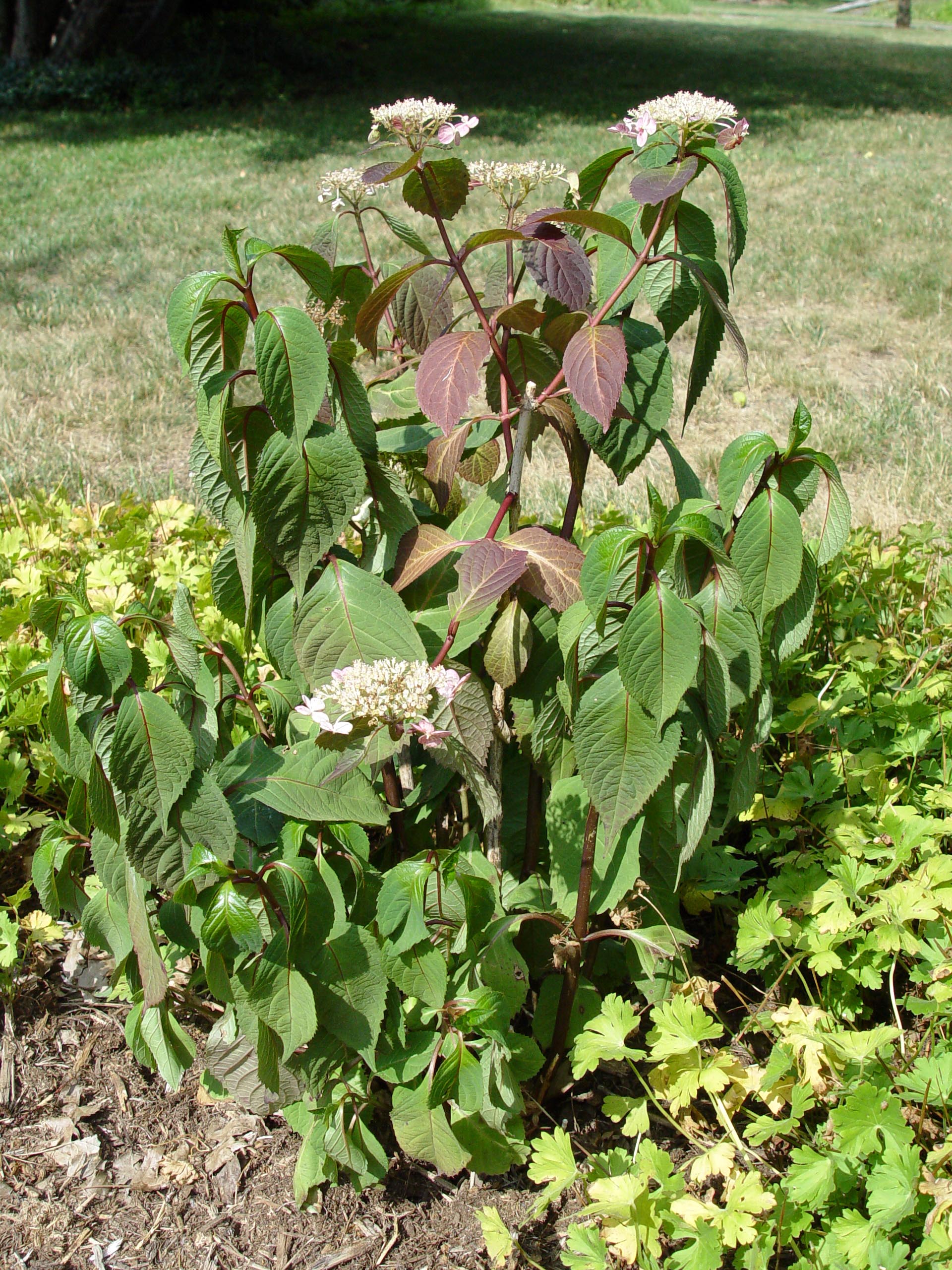
This hydrangea has wilted from intense heat, not lack of water.
The best example is the old-fashioned hydrangea bush.
This plant is notorious for wilting in the afternoon heat – especially when they’re planted in full sun.
Hydrangeas with adequate soil moisture will quickly rebound overnight and look normal the next morning. However, a lot of gardeners see the late-day wilting, assume the soil is dry and soak the heck out of the ground around them.
This may go on day after day until the plants die, and the gardener concludes they were just too far gone to revive. In reality, the roots rotted from being drowned on a daily basis.
The moral: Check the soil first to determine if it’s dry enough to need more water. One of the best indicators is a simple index finger stuck into the ground.
By the way, plants that are still wilted first thing in the morning probably do need water – or they’re in the process of dying from disease or other trouble.
A rain gauge also will help you keep track of recent rainfall on your property. This is especially helpful since summer storms can routinely dump on one area while missing a neighboring area (which usually includes your house) altogether.
A good covering of mulch over the beds is another huge help. A 2- to 3-inch layer of shredded bark and/or chopped leaves not only is great for holding down weeds and slowing moisture loss, it’s highly effective at keeping roots cool.
Bare soil in the sun can easily be 20 or more degrees hotter than the air temperature, and on 90-degree days, that’s very bad news for plant roots.
The ideal time to mulch is in spring after the soil has warmed and the early round of weeds has been pulled. But even mid-summer is better than letting unprotected ground bake for another six weeks.
Long-range, planting more trees is a great idea. More shade means lower temperatures – for your plants, for your house and for you.
Trees cool beyond just producing shade. Their leaves also cool surrounding air by transpiring moisture. It’s no coincidence that air temperatures near wooded areas is cooler.
If you’re not that patient, erect a few arbors or pergolas and plant them with vines.
Or plant a line of evergreens or erect fencing to block hot summer winds.
Or move north. Iceland should be safe.
Some plants that really don’t like it hot:
Cedar
Delphinium
Enkianthus
Fir
Forget-me-nots
Heather
Hemlock
Lady’s mantle
Lychnis
Marsh marigolds
Primrose
Pussy toes
Spruce
Verbascum
Virginia bluebells
Yew
Source: “Heat-Zone Gardening” (Time-Life Books, 1998)
Some of the most heat-tolerant annuals for Harrisburg-area gardens:
Ageratum
Begonias
Cannas
Cleome
Cosmos
Geraniums (Pelargonium)
Heliotrope
Marigolds
Melampodium
Nasturtium
Nicotiana
Portulaca
Salvia
Sunflowers
Verbena
Vinca
Zinnia
Some of the most heat-tolerant perennial flowers for Harrisburg-area gardens:
Agastache
Artemisia
Black-eyed susans
Boltonia
Catmint
Cimicifuga
Coralbells
Coreopsis
Daylilies
Gaillardia
Garden phlox
Gaura
Goldenrod
Hardy geraniums
Hollyhocks
Lavender
Liatris
Mums
Penstemon
Purple coneflower
Salvia
Spiderwort
Some of the most heat-tolerant trees and shrubs for Harrisburg-area gardens:
Abelia
Aralia
Arborvitae
Bald cypress
Barberry
Beautyberry
Beech
Birch
Boxwood
Burning bush
Butterfly bush
Caryopteris
Chokeberry
Clematis
Crape myrtle
Daphne
Dogwood
Flowering pear
Fothergilla
Hawthorn
Holly
Honeylocust
Juniper
Oak
Magnolia
Maple
Pieris
Pine
Redbud
Rhododendron
Shrub rose
Smoketree
Spirea
Summersweet
St. Johnswort
Sweetbox
Quince
Virginia sweetspire
Vitex
Witch hazel
Yellowwood